We first met filmmaker Ann Bennett in the summer of 2009. She had a formidable body of work by then, having been involved in the making of Citizen King, the Emmy-winning Hymn for Alvin Ailey, the mini-series Africans in America and America’s War on Poverty, all for PBS. She came to film camp, Kopkind’s partnership with the Center for Independent Documentary, with a project she was co-producing about photography in Afro-American life. In a sunny morning seminar she laid out her own mind-picture of moments preserved in numerous private snapshots and professional photographs, all of them accumulated in a documentary album, telling a story of a people whose histories were often undocumented and unparticularized when they weren’t caricatured. As she spoke, it was as if the images were spread out on the table before us, the memorialized individual instances of black people seen through black eyes, revealing something about collective experience that had been long obscured.
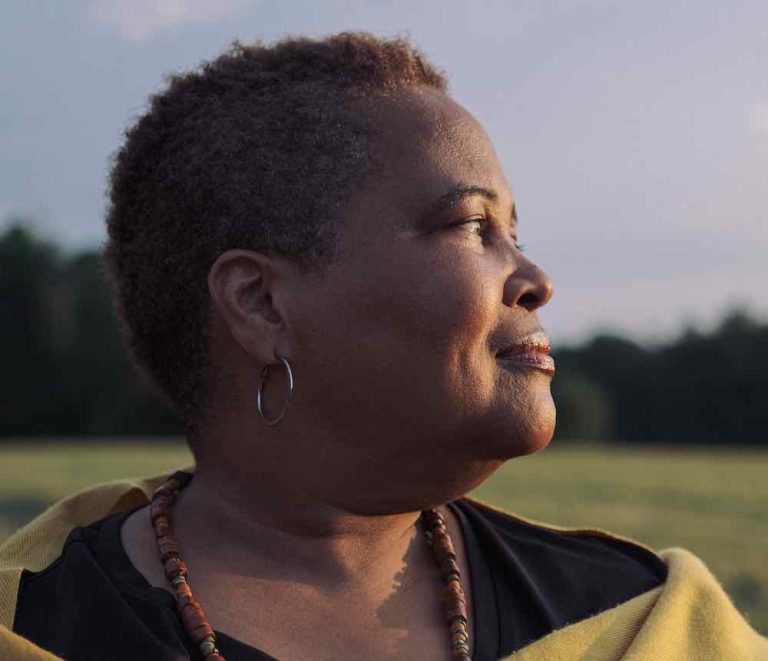
Ann was born on March 16, 1963, in Baltimore. She died at 61, on November 15, 2024, in New York. An obituary page photo gallery of her public life evokes that summer memory: pictures of her with collaborators and friends, of her alone (as in the uncredited image above, which sure looks to be set during the golden hour at Tree Frog Farm), the array reflecting the qualities that people who loved and admired her would try to put into words. Ann was wise, generous, a mentor to younger filmmakers and women in tech, a person who thrived in collaboration with others, a woman who was dedicated, who sparked one to think afresh, whose smile was pure sunshine, who exuded joyfulness, even when in considerable pain.
The next time Ann came to film camp, in 2018, her health problems were evident; her passion and radiance, undimmed. Through a Lens Darkly: Black Photographers and the Emergence of a People, directed by Thomas Allen Harris, had come out in 2014 to much acclaim. A community engagement project, which we had been invited to imagine with her in that long-ago summer, had taken off in multimedia roadshows called Digital Diaspora Family Reunion, with audiences exploring the role of photography in the contest between “self-affirmation and negation,” and celebrating a common humanity. She came to the film workshop again the next year, 2019, bringing a work in progress she was co-producing about the battle between public housing residents in Miami’s Liberty City and a combine of government officials and real estate interests determined to drive them from their home. She brought the film’s director, Katja Esson, who had to leave suddenly one day, upon learning that bulldozers were moving again on the storied black inland neighborhood — high ground, now called a potential “goldmine” by speculators foreseeing the fate of beachfront as the oceans rise.
Razing Liberty Square aired as part of the PBS Independent Lens series this past January. The public housing project, which readers might recall as a key location in Barry Jenkins’ great film Moonlight, is gone. The developers, who had assured residents of their right of return to bright new buildings, broke their promises. They also tried to stop the documentary from being aired. The film is the record of an assault on a community, and a vehicle for ongoing popular resistance. It has a continuing life in discussions on confronting climate gentrification; in organizing against further displacement, and understanding, across the country, the mesh of climate, race, class and housing justice; in agitation by those who’ve been disbursed and those still living in Liberty City to restitch their community. “Please don’t give up,” Samantha Kenley, one of documentary’s main characters, said at a public meeting in March. “Please do what y’all need to do because if we shut up, nothing is going to happen.”
Ann’s work succeeds her.
Desireena Almoradie, who was part of the film camp cohort in 2018 and who conveyed the sad news of Ann’s death, writes, “I first met her at Kopkind, and our connection grew to a deep friendship that included her consulting on my film, and me bringing breakfast to her every morning when she was in physical therapy rehab a few blocks from my home. Ann was generous, kind, and always happy to share her knowledge, her information about filmmaker opportunities, and her deep well of loving kindness. She urged us to do our thing and make a difference.”


 Kopkind Colony
Leave a comment