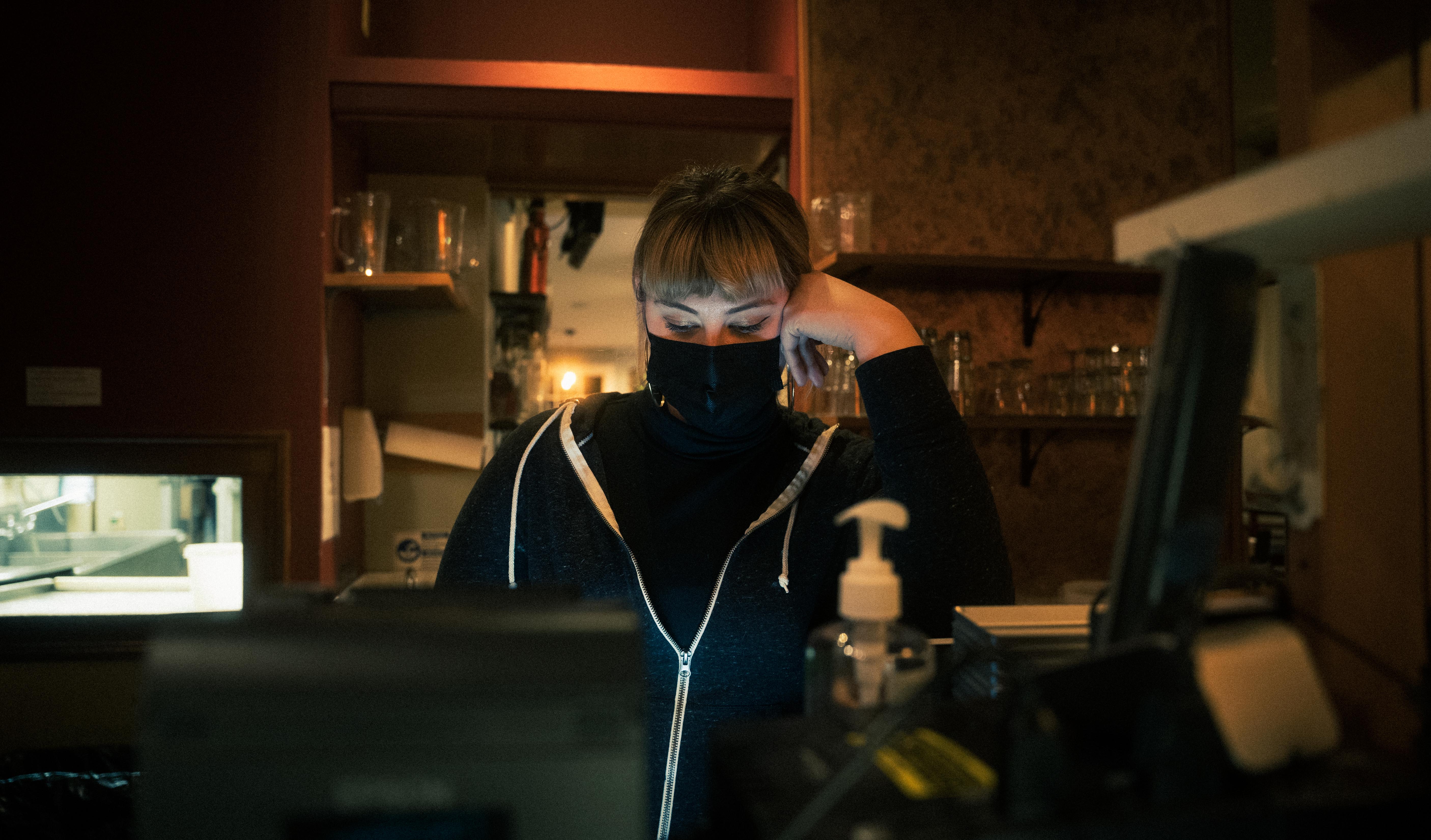
Scenes From a Pandemic: 50

3 05 2021

by Vijay Prashad

A continuing series of dispatches from Kopkind participants, advisers, guests and friends on life in coronavirus time as they observe and experience it.

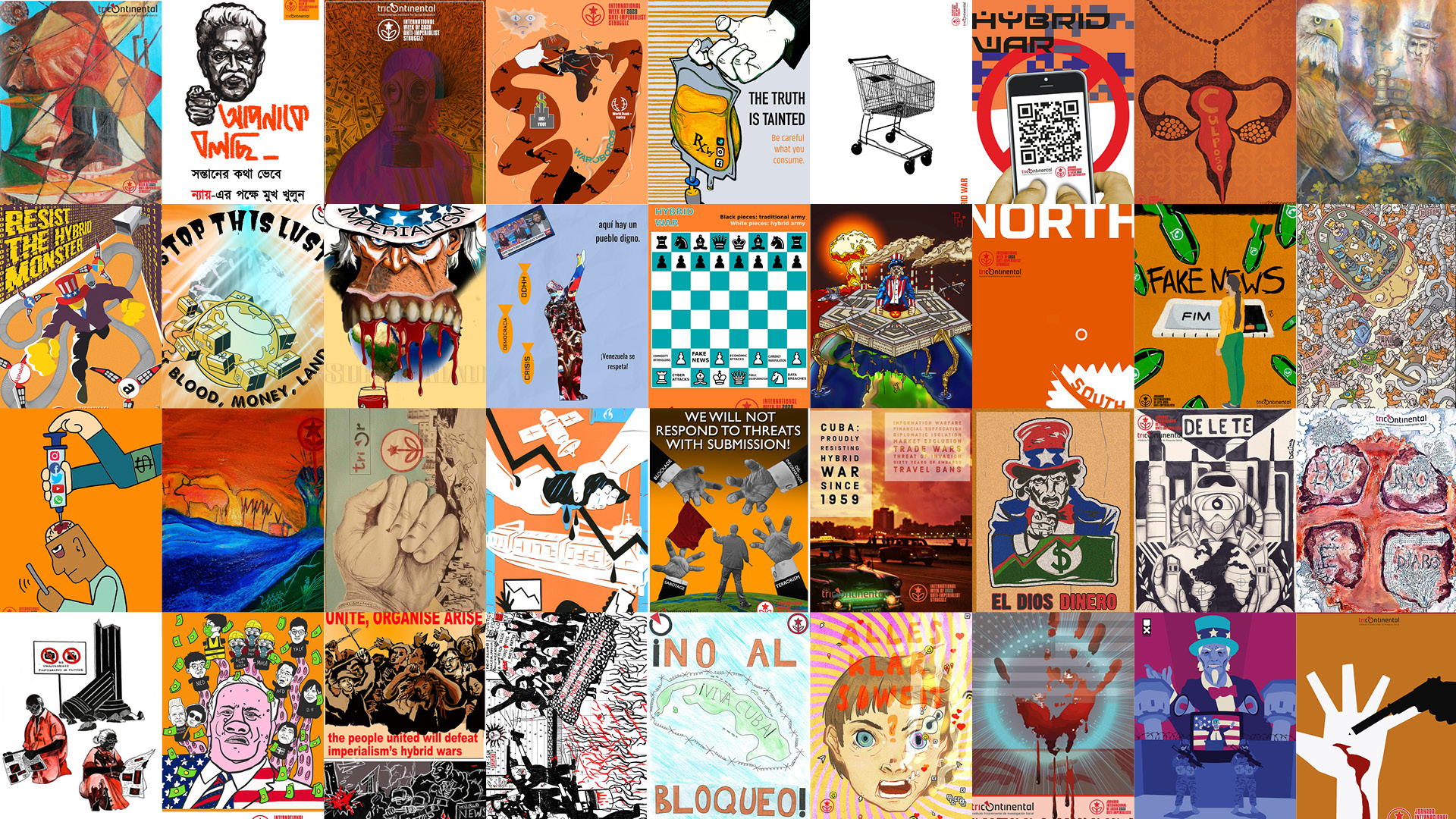
In the pandemic year, artists from 30 countries have created posters reflecting the defining crises of our time. (collage: Tricontinental: Institute for Social Research, from its Hybrid War poster series with International Week of Anti-Imperialist Struggle)

Waiting for Catastrophes

Chatting with a friend in Baghdad

I’ve been calling friends around the world to ask them how they are doing in the pandemic. Abbas, a veteran reporter in Baghdad, says that there have been over a million confirmed cases of Covid-19 in Iraq, and he does not know anyone who has been vaccinated. Journalists, we joke, using Trump’s phrase, are “enemies of the people” and not essential workers. “Not sure when I’ll get a vaccine,” Abbas said.

Conversations with Abbas meander into the necessary topics. US troops are pulling out from Afghanistan. There are only 2,500 of them left. What will remain when they’re gone are all kinds of mysterious assets: trainers, private contractors, ghost advisers (namely, from the CIA). No one knows how many of those there are, and few talk about it. Abbas tells me that after the Iraqi Parliament refused to let US troops linger in Iraq, such contractors (and the CIA) remained, many of them in the Kurdish-dominated north. This past February, a missile strike that hit Erbil airport was directed at these US assets. “Two strategic defeats for the United States,” Abbas says. In Iraq’s case, the advantages of the US withdrawal certainly went immediately to Iran, which has close relations with a large section of the Iraqi government; but the advantage also came to Iraq, whose confoundingly compromised government is nonetheless trying to exert some sovereignty over the fractured country. In Afghanistan, who will be in charge? Certainly not the titular leader of the country, Ashraq Ghani, who is—as they used to say about Hamid Karzai—merely the mayor of Kabul. There is a lot of jockeying for influence: among the Muslim Brotherhood states of Qatar and Turkey, and of course India and Iran. There’s been little mention of China, but it has an interest in a stable Afghanistan so as to build its Belt and Road Initiative linking China’s Pacific coastline to Europe. “These are the Vietnams of our time,” Abbas says.

Nothing is so clear. As we talk, the muezzin from the Razavi Mosque calls the faithful to prayer, his loudspeaker jarringly near. Abbas lives in what used to be called Saddam City, the bulwark of the old Iraqi Communist Party. It is now largely beholden to forces loyal to the Sadr movement and its many factions. Older left orientations have dwindled away over the past two generations. There is a 1951 report written by Haji Yousuf Chang to the US government asking Washington to finance an insurgency against communism not only in China but across Asia. I quote it in my book Washington Bullets. A decade later, Saudi Arabia’s royal family would do just this (with CIA backing) through the World Muslim League. There was large-scale attraction to left-wing ideas then. The promotion of a Saudi variant of Islam was used to divert it. This is exactly what undermined the communist movement from Lebanon to Iraq, and now into the Xinjiang Uyghur Autonomous Region of China.

Two friends on the phone talking, their ‘how are you doings’ sliding into politics, the world, Afghanistan, war and the dangers of ‘falling for it’.

The muezzin’s call, beautiful in its resonance, carries our conversation along, to the new information war about Xinjiang. Abbas laughs, “Never thought I would see the day when the United States becomes the defenders of Muslims.” I remind him that Ronald Reagan called the Mujahideen “freedom fighters.” These are the worst elements in Afghanistan. “Yes,” he says, “we fell for it then, and we keep falling for it over and over again.”

Falling for it. Yes. During one of my first conversations with Abbas, more than a decade ago, we spoke about an event that has receded from public consciousness. The Human Rights Caucus of the US Congress held a hearing on October 10, 1990, on the Iraqi occupation of Kuwait. The most powerful testimony came from a young girl named Nayirah. She spoke about seeing babies removed from incubators, left on the cold floor, as the incubators were whisked to Iraq. It was a searing image. The story was repeated by the press and by politicians to drum up support for bombing Iraq in 1991. A year after the Gulf War, John MacArthur revealed that the young woman, Nayirah al-Sabah, was the daughter of Kuwaiti Ambassador Saud al-Sabah—and the entire atrocity had been cooked up by a Kuwaiti government front group called Citizens for a Free Kuwait and the pr firm Hill & Knowlton (with help from the CIA). There was good reason to oppose Saddam Hussein and Iraq’s invasion of Kuwait, but this was not one of them. This was a pack of lies.

Something in the story about atrocities in Xinjiang smells like that public relations operation in 1990. The man at the center of the latest “information” is connected to the US-backed Victims of Communism Memorial Foundation and to the Jamestown Institute, which has links with US intelligence. His evidence looks detailed and rational, but even a slight inspection shows great anomalies. Whereas until yesterday no one in the West knew anything about Xinjiang—the world’s largest cotton producer, two and a half times the size of France—now everyone spits out ‘genocide’ and ‘forced labor’ without hesitation. Abbas and I think about the shallowness of media concern for the way information is managed. “Remember the time when they said Qaddafi was doing genocide in Libya?” he says. After the Libyan war, human rights groups studied the facts on the ground and said there was no evidence for that. Words like ‘genocide’ are routinely weaponized in the wars of our time.

The United States is notionally pulling its troops out of Afghanistan at the same time as it seems to be deepening its commitment to military action against China. Abbas laughs. “If they could not subdue us,” he says, meaning Iraq, “how will they fare against China?” It is true. But we are dealing with callous people who have contempt for world health. If they want a war, they might get a war.

Vijay Prashad is chief correspondent for Globetrotter, director of Tricontinental: Institute for Social Research, and chief editor of LeftWord Books. His most recent book is Washington Bullets: A History of the CIA, Coups, and Assassinations, with a foreword by Evo Morales Ayma. He was a speaker at Kopkind in 2010.

Scenes From a Pandemic is a Kopkind/Nation magazine collaboration. This piece originally appeared on The Nation‘s website on April 28, 2021. We thank Katrina vanden Heuvel, D.D. Guttenplan and the Nation crew.

Bonus: After May Day

Our dear friend Peter Linebaugh wrote an appreciation of the late Noel Ignatiev, a steel worker and scholar, for May Day. It’s also a story about steelmaking and consciousness, elemental things, and unfinished business.You can read the full story, “In the Smithy of His Soul,” on CounterPunch. Below, a bit of it.

Iron ore. (detail: Diego Rivera’s Detroit Industry Murals)

The archaeologist and historian V. Gordon Childe explains that the metal worker was the first crafts person in human history preceding even the potter and the weaver. The craft involved discoveries of geology and chemistry and transformation under heat. Smelting and casting were not simple procedures. The abstruse knowledge or craft lore was bound with magic, and eventually the workers formed a “mystery” or guild.

Iron ore originating in the Mesabi of range of northern Minnesota was shipped from Duluth in freighters upon Lakes Superior and Michigan. Here I must make another digression. Well so it seems. Actually it gives us two clues as to our unfinished business.

Many of the miners in the Mesabi range were Finnish, specifically ‘forest Finns’ who migrated at the beginning of the last century. Oral poetry maintained the memory of the mythic origins of the world. My colleague, Mikael Lövgren, explained to me that in Finland these became the Kalevala, the national saga. And were brought to the Mesabi iron range of Minnesota by Finnish miners and metal workers. A blacksmith and shaman, the archetypal artificer, named Ilmarinen forges Sampo, a wealth-making machine, or talisman, often interpreted as the sun. Ilmarinen is akin to Daedalus. There are many stories of his search for a wife and his failure, until he forges a woman of gold! With bellows, forge, and ore he fashions cross bow, skiff, heifer, and plow. These creations do not please. He then creates Sampo, solar like source of energy and power.

The eternal magic artist,
Ancient blacksmith, Ilmarinen,
First of all the iron-workers,
Mixed together certain metals,
Put the mixture in the caldron,
Laid it deep within the furnace,
Called the hirelings to the forging.
Skilfully they work the bellows,
Tend the fire and add the fuel,
Three most lovely days of summer,
Three short nights of bright midsummer,
Till the rocks begin to blossom,
In the foot-prints of the workmen,
From the magic heat and furnace.

….

Leave my native fields and woodlands,
Never shall I, in my life-time,
Say farewell to maiden freedom,
Nor to summer cares and labors,
Lest the harvest be ungarnered,
Lest the berries be ungathered,
Lest the song-birds leave the forest,
Lest the mermaids leave the waters,
Lest I sing with them no longer.

The clues here are first, gender, and second, meaning myth. The steel worker for all his brawn, bravery, and bull cannot have whatever woman he chooses. Certainly not if she must leave the harvest and the birds. He may be allied with the fire, she is allied with earth and air. The problem of climate change will not be solved without smashing the patriarchy. She simply will not have it. Such is the meaning supplied by the tale of Ilmarinen. Superstition or class consciousness? It was part of the lore of the Finns. The other clue may also be found in West Africa.

The Yoruba deity, Ogun, was the orisha, or spirit of iron and metal working. Among the Mande of West Africa the forge was an altar and sanctuary as well as a place of craft. Iron smelting was active in Dahomey and Benin cultures from six centuries B.C.E. Children were apprenticed to learn the nyama, an axiom that knowledge is power if property articulated. The weapons and the agricultural implements upon which material subsistence depended were made by these iron workers. They are also strict gender regimes. Robert Farris Thompson writes, “Thus, across the Atlantic, iron instruments are all, in the end, the children of Ogun, carried on his broad and mighty shoulders…. Oguin marches only with the spiritually vital and the quick of hand.” It was Ogun who throughout African America, Bahia to Haiti, accompanied the liberation fighters against slavery.


Scenes From a Pandemic: 49

26 04 2021

by Daisy Cockburn

A continuing series of dispatches from Kopkind participants, advisers, guests and friends on life in coronavirus time as they observe and experience it.

Portico (photos: Daisy Cockburn)

Letter From Italy

Florence

It’s been more than a year since Florence locked down for the first time, and the rate of Covid infection has increased by a factor of four. A family friend has been moved from the Santa Maria Nuova hospital to a hotel out of town to continue his recovery. He’s too weak to talk, but his daughter tells me that he wants P.G. Wodehouse novels: anything “non-Jeeves.” (He’s read those.) Or anything funny, for that matter. It proves harder than expected; put on the spot, my books have never seemed less capable of raising a laugh.

I am an outsider in Florence, here because of my husband’s teaching gig. As a voice actor, I am used to working remotely from a home studio set-up. Silence is good for that, but this is eerie. It’s as quiet in our street as it was a year ago. The university opposite used to mean reliable bouts of victory cries from laurel-crowned students, four times a year no less, which is when they graduate. The café on the corner used to cater to a stream of regulars with its affordable lunch menu of homey pasta dishes. Gone also are the students of love—those painfully breaking up in our dark side street. No more agonized crying, shouting, and huffing off over the cobblestones.

For a broader soundscape, 100 yards away is Piazza Santissima Annunziata, former home to megaphoned protest speeches, tourist groups of 50 in matching baseball caps topped with swirly helicopter blades, dubious brides posing for the camera, Santa conventions, etc. When the pandemic kicked in, the square became home to a soup kitchen set up under the porticos at the top of the steps. People waited to be called up by ticket number to receive their bag of food. It was quiet, apart from the sound of a small transistor radio belonging to a few gentlemen living on the other side of the square, under the portico of the old foundling hospital, now a building owned by UNICEF.

One of the paradoxes of the lockdown has been that Florence, a city of interiors, has had to play out some of its secret games in public. UNICEF has traditionally held a grand, exclusive ball. Last July, the ball was in the piazza, a perfectly socially distanced al fresco affair, with white-clothed tables spaciously placed and cordoned off with plush rope, where bodyguards checked names.

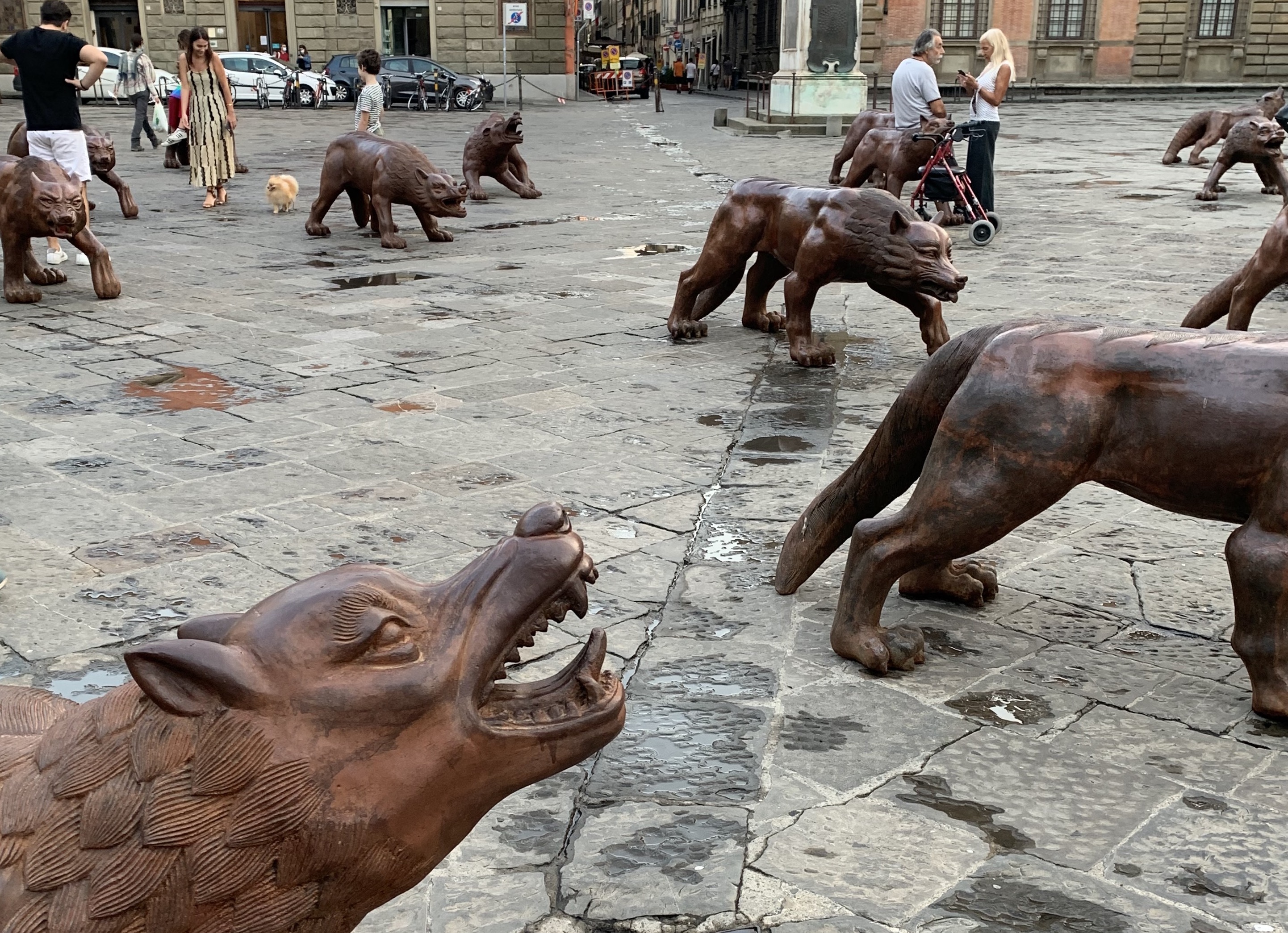
As a consequence of this ball, the wolves were kettled. Just a few days earlier, Chinese artist Liu Rouwang’s installation The Wolves Are Coming, 100 bronze castings of wolves, appeared in Piazza Santissima Annunziata and Piazza Pitti. In various attitudes of rapacious intent, the wolves encircled a statue of a cartoonish hero wielding a paddle-shaped sword, no match for the beasts. Exploding the stereotype of wolves as bad guys in fairy tales, here the hero was a caricature and the wolves looked like natural, powerful free beings. People interacted with them playfully, sitting on them, posing for selfies.

This encounter with the wild had an unexpected parallel in newly uninhabited spaces in Florence and other parts of Italy. Dolphins appeared in the Grand Canal in Venice, ducks waddled into malls in Florence, and actual wolves are having a major comeback, with as many as 2,000 of them presumed to be roaming the countryside. (The first national census of the Italian wolf was initiated last October.) As ball-goers celebrated in the piazza, the wolves were caged for the night. The men under the porticos also disappeared, but were back the next day. I asked what I could bring them. More triple-A batteries; that’s all.

During the initial lockdown, when we were allowed out one at a time for a valid purpose only, Matteo and I took turns going to the supermarket. Walking under the deserted porticos gave me the sense I was in a de Chirico painting, as if I were part of the city for the first time, inside its body, closer to the famously icy Florentine heart. Without people, each architectural detail is more vivid. The bas-relief sculptures of busts on plinths take on the appearance of figures pressing themselves into the walls, as if trying to socially distance from passers-by. The Duomo, the mothership, has seen it all before. In the summer of 1347, when the plague that would wipe out a third of the population here broke out, it was just being built. Despite the catastrophic blow to the city, construction wasn’t abandoned. Once more the Duomo is a silent witness. A local actor offered his take on a be-plagued and still Florence in a YouTube video of him questing through the streets, stopping to chat with statues of Dante, Brunelleschi, and others, looking for answers.

So much remains uncertain a year later. For stores and small businesses in Florence, the hardship is incalculable. Of the 3,000 restaurants in Tuscany that have closed permanently since the beginning of the lockdown, 100 have been in the province of Florence. A 44-year-old restaurateur in Santa Croce took his life in his restaurant before a restricted evening shift.

I wonder about Rocco, the owner of an after-hours teahouse in the center of Florence. His business appears not to have folded, but I haven’t seen him since the pandemic struck. Back when his cozy cafe was a beacon on the way home, a place to lounge for hours chatting—often with Rocco himself—Rocco purveyed the theory that some Florentines shuffle along under the unbearable weight of the city’s past, kept from new discoveries as if by a transparent domed ceiling. Any idea that flies too high hits the dome and comes crashing back to earth.

Walking through the subdued city the other day, I watched a crane crew’s final effort to secure a 90-foot trompe l’oeil photocollage by French artist JR to the front of Palazzo Strozzi. Called La Ferita (The Wound), it creates the illusion of a gash through the building’s shuttered facade.

Daisy Cockburn is a voice actor (under the name Daisy Tennant) based in Petrolia, California. She was confined to Florence during the long lockdown. Daisy, who spent many girlhood summers at Tree Frog Farm, is a longtime friend of Kopkind.

Scenes From a Pandemic is a Kopkind/Nation magazine collaboration. This piece originally appeared on The Nation‘s website on April 21, 2021. We thank Katrina vanden Heuvel, D.D. Guttenplan and the Nation crew.

Bonus: From Brazil — The Sounds of Life

“O Que é Que a Baiana Tem?”, written in 1939 by composer Dorival Cayymi, is one of the most beloved sambas in the world. A former Kopkind/CID Film Camper, São Pãolo native Daniela Broitman, has made a documentary on Cayymi, titled Dorival Cayymi The Sounds of Life. Daniela talked about making the film earlier this year with Sounds and Colours, around the time the film was being shown virtually for a limited time:

Daniela: Culture and art are seen today by a good part of society as something expendable, and what these people do not realise is that they live culture and breathe art for a large part of their day: during their entire leisure time, or even on a journey to work, or while waiting in a doctor’s office. Imagine the world without art, without culture, can you imagine people’s despair?! So, imagine Brazil without [artists from Bahia] Dorival Caymmi, João Gilberto, Caetano [Veloso], [Gilberto] Gil, Gal [Costa] and [Maria] Bethânia?

Caymmi revealed Bahia to the world in the voice of Carmen Miranda; he contributed to making Brazilian music known worldwide. He revolutionized Brazilian song-writing and influenced generations of musicians, paving the way for movements such as Bossa Nova and Tropicália. He is the symbol of a powerful, diverse, creative, exuberant, sensual, avant-garde, charismatic and affectionate Brazil. It is the image that I want to convey about our country, which has suffered a lot with so much political greed. I want Brazil to be remembered again for all this beauty and cultural richness, and I hope that Dorival Caymmi – The Sounds of Life will be able to show this.

See the full interview here. Daniela’s beautiful trailer is below.


Scenes From a Pandemic: 48

20 04 2021

by Suchi Branfman

A continuing series of dispatches from Kopkind participants, advisers, guests and friends on life in coronavirus time as they observe and experience it.

Dancing in the gym at Norco prison, before lockdown. (photo: William Short)

Undanced Dances

Santa Monica, California

My solo starts off with my arms out-stretched towards the sky, trying to touch the rafters, stretching on tip-toe, reaching, head up to the sky.

Terry Sakamoto, Jr., is describing a dance he calls “The Mountain.” He wrote the choreography from his bunk while in Covid lockdown last spring at the California Rehabilitation Center, a medium-security men’s prison located in Norco, California, about 65 miles from my home.

Before March 2020, when the state prison system shut down all programming and visitation due to the coronavirus, Terry was among the folks inside the prison with whom I had the remarkable opportunity to dance, make dance, and converse every Monday night for years. The project, called Dancing Through Prison Walls, began in December of 2016. The work took many forms, whether teaching credit-bearing college courses or Rehabilitative Achievement Credit workshops, collaborating on choreographies, bringing in guest artists, or simply spending hours dancing with folks inside the prison gym.

We were still dancing when the work was abruptly ended. I was given 48 hours to send in guidance as to how we might continue to dance together, apart. It was a rich challenge. I ended up writing prompts for ways that dance might be imagined/written, without actually moving. Although not a common way of making dances, there is a history of this kind of work in the dance world. And it turns out that writing dance is actually a liberating way of making dances. There are no financial, gravitational, technical, or locational limitations. Anything is possible.

Almost immediately, the dancers began sending out their choreographies for these undanced dances.

From “‘Safety and Security’: Two Nations’ Borders,” by Terry Sakamoto:

She’s slowly backing out of the driveway into the still quiet streets of Mexico, heading toward a day filled with check-points, questions, searches, and persons’ attitudes sometimes empty of human kindness and empathy.

From “I Wait,” by Carlos Rivas:

I start to feel the power of my dance as I empty out my thoughts and feelings on the dance floor. I always feel free when I dance.

From “Arm Leg Leg Arm Head,” by Landon Reynolds:

I see people gliding on water as they move fluidly across the landscape.

From “From In Here,” by Yusef Lamont Pierce:

Slide the top hand over the bottom palm from wrist to fingertips. You’re imitating the act of sliding bills off the top of a stack. This dance is called “The Hittem’ Where It Hurt$!”

More than a choreographic residency, for me the project has been a commitment to learning from and with folks inside; to making work grounded in their stories and ideas; to examining mass incarceration, its deeply racist roots grounded in the legacy of slavery, and the prison industrial complex. Prison abolition has become my North Star in the work, what gives the work context and location.

Last fall I began the process of embodying the dances to share them with the “free world.” Highlighting six, written between March and May by Brandon Alexander, Richie Martinez, Landon Reynolds and Sakamoto, I entrusted them to some dear dance colleagues who had joined me in dancing inside the prison over the years. Bernard Brown, Jay Carlon, Irvin Gonzalez, Kenji Igus, Bri Mims and Tom Tsai are steeped in hip hop, tap, breaking, performance art, Quebradita, spoken word, Bhutto, and contemporary dance forms. In these dances, movement is accompanied by the resonant narration of formerly incarcerated movers and organizers with whom I have worked inside: Marc Antoni Charcas, Ernst Fenelon, Jr., and Romarilyn Ralston.

One choreographer, Richie Martinez, was released last summer during the prison’s largest Covid wave; to our joy, he is now narrating and performing “Richie’s Disappearing Acts”:

I close my eyes and I’m somewhere else.

He calls his latest dance, written in 2021, “Richie’s Reappearing Acts.”

Richie Martinez dancing on Santa Monica pier. (photo: Suchi Branfman)

I have been overwhelmed by all of this profoundly personal yet wildly radical work. We still can’t dance in the prison, but people inside continue to send out their undanced dances, and they are always astonishing to receive. Meanwhile, the embodied work, dubbed Undanced Dances Through Prison Walls During a Pandemic, has been performed publicly. It is currently part of the City of Santa Monica’s Art of Recovery project, examining the school-to-prison nexus. A film of the dance and a conversation with the artists was presented virtually at the 18th Street Arts Center on April 16.

Conversations among the artists have highlighted the multiple realities of mass incarceration: the imprisoned loved ones not previously spoken of, the difficulty in getting parole during Covid, the restrictions that make it impossible for people on parole to see children in other counties, the unexpected in-home police inspections even many years after parole ends.

From “Internal Battle: Negative and Positive,” by Brandon Alexander:

Every move I make, every transition, every expression is reflecting the inner conflict within me.

In December, Sming Sming Books published Undanced Dances Through Prison Walls During a Pandemic. The book is a sort of message in a bottle (or in an envelope, so to speak), sent from people who are so profoundly invisibilized on the inside, to live in plain sight in people’s living rooms, altars, desks, kitchen tables on the outside.

From “Mapping a Journey to Visit Me,” by Landon Reynolds:

As the journey descends into Southern California with the clear skies and sunny weather, the dance transforms to a more relaxed style. A lot of open gestures which allow the sun to shine down on the body as if one is sunbathing.

Reading dances allows us to imagine them, much as abolitionists strive to reimagine society. Embodying them mirrors the act of bringing deep, well-grounded imaginings for justice into the streets. Writing and dancing itself, Richie Martinez once said, is an exercise in creating some “freedom time.” Back in 2018 a dancer at Norco, named Kamasi, told us, “You may not be able to get us out of here immediately, but you can take us out of here.” We are doing our best.

Suchi Branfman is a choreographer and prison abolition activist. A second edition of Undanced Dances Through Prison Walls During a Pandemic is forthcoming from Sming Sming Books. Suchi is a longtime friend of Tree Frog Farm and Kopkind, having known Andy and John from the early days. For more information on her project: dancingthroughprisonwalls@gmail.com

Scenes From a Pandemic is a Kopkind/Nation magazine collaboration. This piece originally appeared on The Nation‘s website on April 14, 2021. We thank Katrina vanden Heuvel, D.D. Guttenplan and the Nation crew.

Bonus: One Night and a Fight in Miami

Site of the historic meeting in Liberty City following the Clay-Liston fight in 1965, the subject of One Night in Miami.

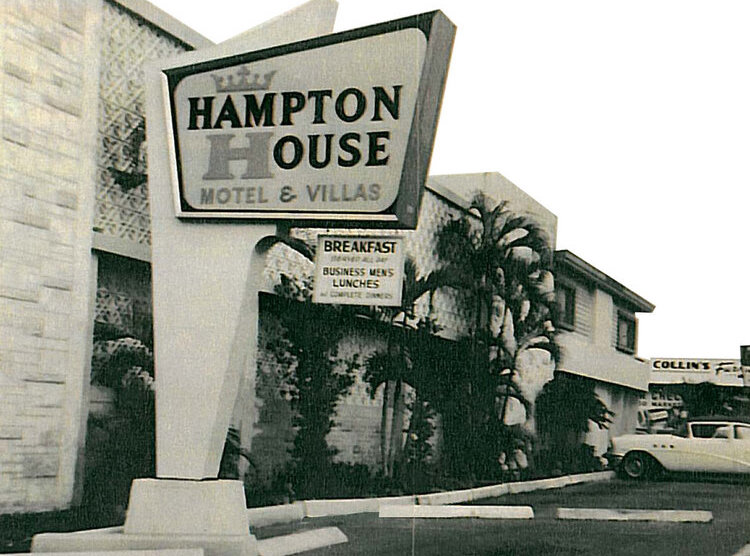
Those who follow the Oscars will know that on April 25, One Night in Miami is up for best adapted screenplay, original song and supporting actor (Leslie Odom, Jr.). For most of the action, the film takes place in a room at the Hampton House, where Malcolm X, Sam Cooke (Odom) and Jim Brown gather with Muhammed Ali, then Cassius Clay, to celebrate his victory over Sonny Liston. The motel is in the historically black community of Liberty City, which, though neglected by public officials and private developers for decades, is today hot property for one reason: it is ten feet above sea level. Liberty City, the public housing project long at its heart, Liberty Square, and the fight over displacement and climate gentrification are the subject of a documentaryin-progress by a filmmaking team including two former Kopkind/CID Film Campers. In 2019, Katja Esson (co-writer/director) and Ann Bennett (producer) came to Tree Frog Farm to workshop Razing Liberty Square. Katja had to leave abruptly that summer because bulldozers were about to level the low-rise housing project that had been home to generations of black Miamians. In its place, a $300 million development called Liberty City Rising. As a local resident, Valencia Gunder, tells the filmmakers: “My grandfather always would say: They’re going to come to take Liberty City because we don’t flood.” Here is a contemporary story about history and a fight in Miami, which keeps on going. Click here for a work sample.

A boy sits in ruin of his former home; in the background, the gentrifying development. (still from Razing Liberty Square)


Scenes From a Pandemic: 47

12 04 2021

by Lillian Osborne

A continuing series of dispatches from Kopkind participants, advisers, guests and friends on life in coronavirus time as they observe and experience it.

The ubiquity was always about more than just mittens.

A Common Love Lost

Chicago

Loss is the story of the pandemic. For me, over the past year, that has meant losing a relative to Covid, losing a job, an apartment, health insurance, and a romantic relationship. But there was another loss, a common love lost on the American left, that we haven’t fully grieved. I am reminded of that now because April 8 marks the anniversary of the end of Bernie Sanders’ 2020 campaign.

Around the time that the first Covid case appeared in Seattle, some friends and I packed a car and drove four hours to Muscatine, Iowa, to campaign for Bernie in the Democratic caucuses. It was January. At a makeshift field office—a detached garage warmed by space heaters—three women volunteers arranged piles of yard signs, canvassing scripts, and clipboards on a plastic folding table. As her mom trained us, a toddler waddled across the cement floor in a blue Bernie onesie and stretched her arms out to us, total strangers. Hours later when, exhausted and frozen, we returned from door-knocking, it was dark. The women were still there, the mom and her baby, too.

That scene, both mundane and remarkable, warmth in the dead of winter, will stick with me forever. It symbolized the depth of commitment and shared connection of ordinary people who joined the campaign in the millions under the banner of “political revolution” and “Not Me. Us.” As the campaign crescendoed, the unity of purpose, the high stakes, and electricity of the campaign made it feel like falling in love for the first time, only with millions of other people.

Love is about reminding us we’re alive. And what was Bernie’s campaign about if not an affirmation of life and human dignity? Bernie’s campaign was fundamentally about feelings—feelings of loss, anger, and insecurity; feelings of being stuck in alienating and undemocratic workplaces and political systems. Better than any other candidate, he grasped working people’s realities, affirmed our frustrations, and channeled those feelings toward a common project and a common enemy: capitalism. The campaign genuinely was about “us” and taking control of our lives.

For my generation, the left had never felt like this. Then it was over. Bernie dropped out on April 8, 2020. Those of us who’d worked on the campaign suffered the loss alone, huddled in our houses, playing Tracy Chapman’s “Talkin’ About a Revolution” on repeat, sobbing at the line “‘Cause finally the tables are starting to turn.”

For once, we felt we were in the driver’s seat, making the road as we sped across it. For my generation, the left had never dreamed of gaining popular support for socialist ideas, let alone coming within arm’s reach of winning with them. The day AOC’s endorsement became public, my boyfriend recorded a video of me with freshly showered hair, wearing his too-big sweatshirt, dancing and singing, “I’m having the time of my life, and I owe it all to AOC.” For the first time in a very long time, the left felt confident.

Then it was over. None of us that night in Iowa could have imagined the rapid spread of Covid over the following weeks, the political and economic crises in its wake, the Democratic Party’s resilience in unifying around Joe Biden, and Bernie’s subsequent drop-out. For those in the campaign, it was like watching a car crash in slow motion. We were powerless to stop it.

To make matters worse, we suffered the loss alone, huddled in our houses. The night Bernie announced the end of his campaign, I listened to Tracy Chapman’s “Talkin’ About a Revolution” on repeat, sobbing at the line “’Cause finally the tables are starting to turn.” We had gotten so close, it seemed, to turning the tables.

But we had to move on, quickly. People were sick and dying. Essential workers were organizing and striking. Mass protests against police killings and racism erupted. There was work to do, and many of us threw ourselves into it. There wasn’t time to take stock and reflect.

Now politics feels different, like falling out of love. Organizers from the campaign told me that afterward they felt numb; some cried. We had “debriefs”; people posted on social media about the campaign; some wrote articles about its lessons; but nothing came close to “closure.” Maybe nothing will. I don’t know. But it feels as if we’re each carrying a box around alone, afraid to open it together for what might come out. Not the lessons or failures, but the emotions that we packed away. The grief. Dealing with what it felt like. I don’t want to carry that unopened box forever.

Before Bernie, the left was like a sleepy Rust Belt town. We organized and marched, but acceptance of dilapidation was a basic part of living there after decades of defeat. After Bernie’s 2016 run, tens of thousands of people came flooding through the doors of the Democratic Socialists of America. Organizing meetings became standing-room-only. The usual faces, now stunned by the explosion of new political energy, were few and far between. The left wasn’t just revived; it was reborn.

After four years of organizing, Bernie’s 2020 campaign became a patchwork quilt of movement struggles. Our coalition in Chicago had more than a dozen grassroots organizations, including Chicago DSA, Sunrise Movement, progressive ward-level organizations, and socialist aldermen. I was repeatedly struck by the level of political unity among so many people I had never worked with before, and by our collective clarity that the campaign was about both electing Bernie and, most important, building a mass working-class movement through the campaign.

We packed away the yard signs a while ago, but my heart still leaps when I see Bernie signs in my neighbors’ windows. The movement continues, but the relative silence on the sheer depth of what we all lost—not just the race but pieces of our lives—makes it hard to reconcile with what we have gained, advances the left hasn’t experienced in decades.

We need to grieve the loss so that we can celebrate what we’ve won: a reborn left whose ideas resonate with millions of people. We’ve built real political will that has forced the establishment to abandon talk of “tough choices” or balancing the budget on workers’ backs amid the current crisis. The point of mourning is to get back to living—to recover the conviction, together, that we can win a better world.

Lillian Osborne is a union researcher in Chicago. She was a participant in Kopkind’s political camp in 2018.

Scenes From a Pandemic is a Kopkind/Nation magazine collaboration. This piece originally appeared on The Nation‘s website on April 7, 2021. We thank Katrina vanden Heuvel, D.D. Guttenplan and the Nation crew.

Bonus: ‘… and Your Little Dog, too!’

No, that’s not Toto; it’s Li’l Bro at Tree Frog Farmand now that we’ve got your attention…

On Monday, April 19, PBS will broadcast American Oz, as part of its “American Experience” series. The documentary, co-produced by former Kopkind/CID Film Camper Tracy Heather Strain, tells of the life and times of L. Frank Baum, who wandered in the arcade of life’s endeavors until, in his 40s, he began writing children’s stories—most famously and fabulously, The Wonderful Wizard of Oz. While in Film Camp, Tracy workshopped her marvelous film Sighted Eyes/Feeling Heart, the first feature documentary on the great Lorraine Hansberry, which won the Peabody Award in 2018. Click on image below to watch an extended trailer for American Oz.

Detail of original 1900 edition of Baum’s book.


Scenes From a Pandemic: 46

5 04 2021

by Joël Díaz

A continuing series of dispatches from Kopkind participants, advisers, guests and friends on life in coronavirus time as they observe and experience it.

(photos: Joël Díaz)

Contact Tracing

Between Dominican Republic and the world

We’ve yet to find my uncle.

On September 18, 2020, my stepfather’s elder brother boarded the yola. It was the tail end of hurricane season, which had left 700,000 people without electricity and a reported 1.5 million without safe, drinkable water. Painted an auspicious ocean water blue, the boat, said to be undetectable at night by La Armada de Repùblica Dominicana, held within its interior a gaggle of men who’d paid thousands of dollars in hopes of fleeing the island for the United States.

Not long into the journey, the yola was ambushed by coastal pirates. Aware of the financial investments in migrations out of Dominican Republic, they attempted to steal the boat and seize its resources. The captain, avoiding the armed attacks, jettisoned from the boat, with the key fob in his pocket. No longer in range of its signal, the engine shut off.

Stunned, the men decided to chance their way to shore. Perhaps it was the adrenaline that minimized the distance, or the ecotone indecipherable in the dark, but ambition is most cruel under these circumstances. It was clear my uncle did not possess the physical endurance to reach the shoreline.

As chance would have it, they flagged a fisherman, who at first was reluctant to help because of the impending dawn and the risk of being named an accomplice by authorities, if caught.

* * *

I learned of his disappearance in a text from my mother, as an aside to a larger conversation: “…fyi, your uncle has been missing since 5 days. Daddy is very upset and anxious.”

Following the news, my father coped with the idleness of the pandemic and the unknown whereabouts of his brother by restlessly cleaning the Bronx apartment. My mother recounted his projects, among them patching and painting a ceiling that the landlord had neglected for years. During one of the city’s heavy downpours, the ceiling had collapsed. What remained was hanging plaster and water stains that, at first, had turned yellow, then a molded brown.

* * *

When I had visited my family months earlier, on March 4, 2020, before heading out on a trip to London, concern about the coronavirus was heightening, but not enough to stall movement.

“Yo no se po’que tu ’ta viajando,” my dad said, from a gray reclining chair, his worry masked in judgment.

“I’ll be fine,” I said.

Accustomed to withholding relationship details from my family, I told them only that I was traveling to visit a friend. What I didn’t say is that I was going to seek closure—though I really wanted continuance—after a severance. I had placed many hopes in this courtship. Up until that point, I had spent nearly a year and a half in Saint Louis in a graduate program that was stifling. Our six-month romance had been a balm for so much disappointment.

I don’t know why you’re traveling.

Later I wondered about how I’d dismissed my father, which I’m sure, at first, was a casual response but now mirrored the disregard many migrants to this country, like him, experience.

* * *

I was in London, spun wild with naiveté and optimism. We had spent much of that week in lengthy and redundant conversations about desire, aspirations, and life goals, attempting to make sense of our severance. On March 11I ventured to Battersea Park, trying aimlessly to fill the time. Staring out toward the Thames River, British flags made ecstatic by the wind beside the Albert Bridge, I wondered, How did I get here?

That evening, Trump announced a travel ban to and from Europe. I was overwhelmed at the prospect of being stuck in a non-native country with someone who’d just broken up with me.

Sensing my worry, he encouraged me to call the airline to find a flight. Those calls were long, arduous, and in vain. I feared I was marooned.

* * *

My mother was the first to contract the virus. She downplayed her symptoms while we were on a FaceTime call, diverting my attention toward the line of taxis that were working in tandem with local pantries to deliver food to families who had difficulties making ends meet or traveling to grocery stores. This aguante, the carrying of the load, I have known intimately over the years.

Days later, I received word that she had a fever, difficulty sleeping, and tightening pain in her chest. She had called a hotline to see where she could receive a Covid test; they weren’t as ubiquitous then as they are now. If you aren’t having difficulty breathing, don’t come in was the verbiage used to discourage people from visiting hospitals. The care afforded to Bronx patients is notorious for being insufficient, subpar.

Health is a luxury; it is most often easier to endure than it is to chance care.

We assumed that she had contracted the virus from my sister, who might have brought it home from the hospital where she worked. “We’re being given one disposable surgical mask per week”: I recall the paranoia in my sister’s voice. She had lost two colleagues to Covid-related complications. When my sister inquired about how or if the hospital would sanitize her station regularly, she was reprimanded. There was no sense of safety. Unlike other health professionals who didn’t have to come into contact with many who entered the hospital, as the front intake and billing receptionist she had to receive each one. She has asthma.

My dad got tested for Covid in a makeshift, outdoor clinic erected at a Bronx reservoir. He couldn’t remember the identification number they had assigned him and assumed that the adhesive label placed on his windshield for contactless testing had flown off in the wind on the drive home. He was distracted, sick, and never able to confirm his symptoms.

* * *

No one is certain about what actually unfolded. The tale goes that, either begrudged or wary of his companions, my uncle split from the group once he reached shore. Unfamiliar with that part of the island, he went into the forest to make his way toward the closest inhabited town. During one of the police searches, a pair of shorts were found. They are believed to be his.

When I asked for updates, all details amounted to nothing, some wispy trace, deteriorating in an instant. My father and my uncle’s wife in the United States were investing all their resources into getting information on his whereabouts. One rumor was that he’d been taken by Haitian kidnapés, who would soon request ransom, said to be stalled because of police searches. It is uncertain if those claims are rooted in anti-blackness or in the realities of the kidnappings plaguing Haiti and neighboring towns in Dominican Republic.

* * *

Legend will say that there is a man who roams the town in his underwear, searching for his family. And there he stays, neither fully clothed nor whole. Just a memory. A rumor. A hope.

Joël Díaz is a writer and educator currently based in Savannah, Georgia. His work has been featured in The Feminist WireInterviewing the Caribbean, and Peregrine. He is the director of the Walter O. Evans Center of African American Studies at SCAD Museum of Art. He was a participant in Kopkind’s political camp in 2015.

Scenes From a Pandemic is a Kopkind/Nation magazine collaboration. This piece originally appeared on The Nation‘s website on March 31, 2021. We thank Katrina vanden Heuvel, D.D. Guttenplan and the Nation crew.

Bonus: Not Working 9 to 5

Filmmaking, an art form that historically has been an on-site group activity, has required creative approaches in the pandemic, from filmmakers going it alone to collaborating remotely while leveraging various technologies. Ari Rossen, who was part of the Kopkind/CID (Center for Independent Documentary) CineSLAM workshop in 2017, and Christopher Dawes, assistant programmer and projectionist for the Kopkind/CID Film Camp for the past decade, have made three short films together without being in the same room, let alone the same borough of New York City.

For your enjoyment, here is one of Ari’s creations, made remotely during quarantine: “Not Working 9 to 5”, written and performed by Ari himself. Check out his other creations on his YouTube page, including his most recent, an homage to Dolly Parton.

Click on image above to watch “Not Working 9 to 5”

We also congratulate Ari on his film “Lost + Found” (a modern twist on Milton’s “Paradise Lost”), being the most recent viewer chosen film to screen on PBS’ Reel 13 Shorts, winning the competition with 237 votes out of 254. Congratulations Ari!

Click on image above to watch “Lost + Found”


Scenes From a Pandemic: 45

29 03 2021

by Lisa Torio

A continuing series of dispatches from Kopkind participants, advisers, guests and friends on life in coronavirus time as they observe and experience it.

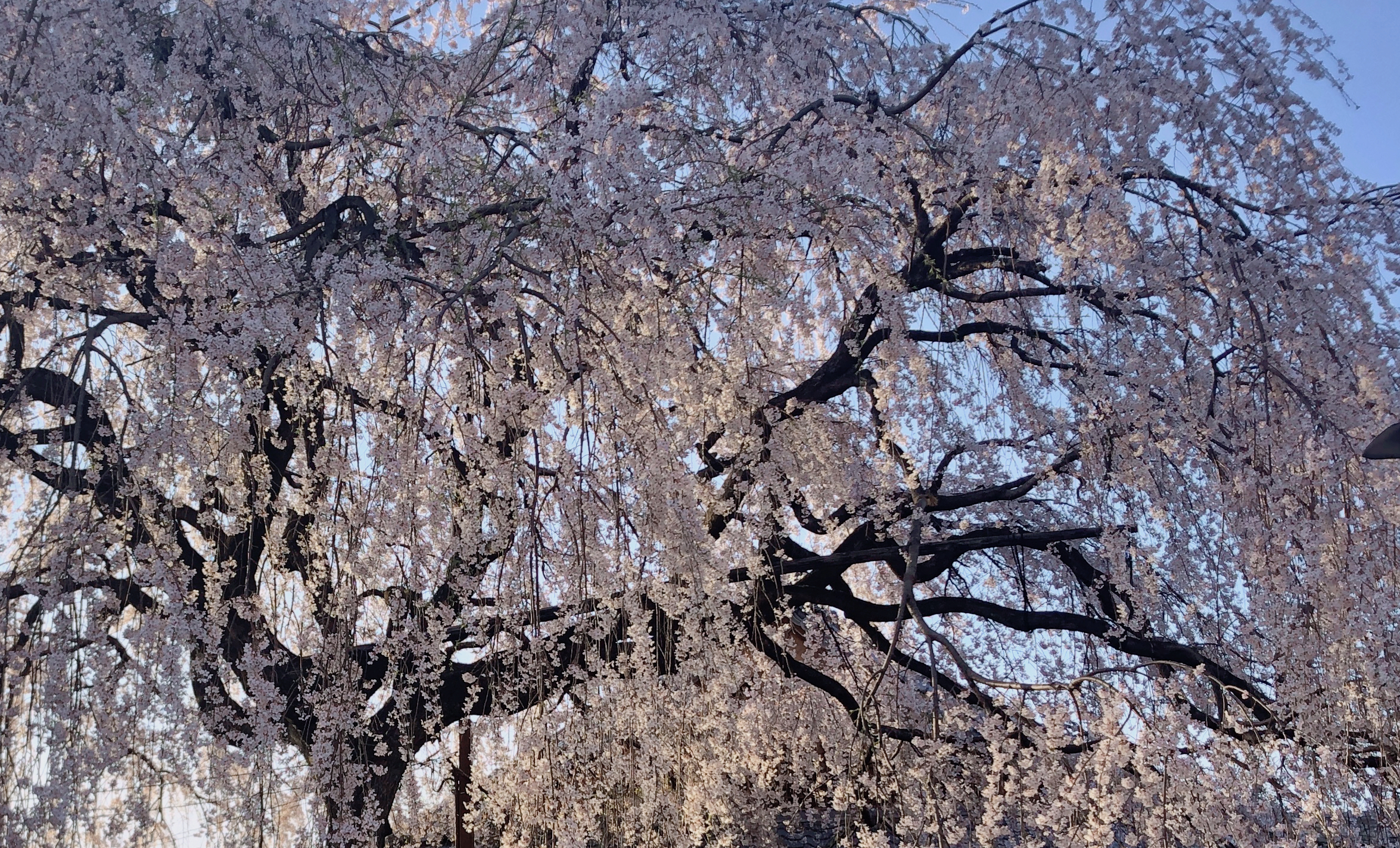
Cherry blossoms, spring. (photos: Lisa Torio)

‘Hopefully, This Will All Be Over Soon’ and Other Evasions

Kyoto, Japan

It’s starting to feel like spring, finally. Local shoppers and tourists have begun returning to the small pedestrian arcade where I work, a covered street lined with restaurants and family-run stores selling daily goods and traditional foods of all kinds. There are shops for tofu, kelp and beans, green tea, and a small market with boxes of spring vegetables like bamboo shoots, with canola flowers laid out in front of them. Just a couple of months ago, when coronavirus cases were rising across Japan, the street was so quiet you could hear the small chatter of merchants at the end of the street; now, it’s bustling with young couples strolling, pointing at the various foods on display, and neighbors stopping to chat by the side of the narrow street.

Now and then I hear stories from a relative on the phone, from co-workers and customers at work—a local grocer is going out of business; a bankrupt business owner committed suicide to pay employees with his life insurance; an elderly woman is struggling with loneliness and depression. Calamity is conveyed in carefully hushed tones, as though such news might disrupt the surrounding peace if spoken too loudly. We exchange a few observations, a few encouraging words, the “hopefully this will all be over soon”; and life goes on.

The number of new coronavirus cases in Japan has declined drastically since reaching a peak in January; on March 21, the government lifted all “state of emergency” measures, by which people were advised to stay home. With vaccinations beginning, the country seems to be starting back up again, slowly. As headlines talk of “recovery,” I find myself wondering when the quiet conversations will dissolve into silence again. Coming of age in the years following the nuclear disaster in Fukushima in 2011, I learned from the way adults spoke in measured tones, from their pauses and awkward glances, that talking about tragedies has an expiration date.

* * *

On March 11, at 2:46 pm, people across the country prayed in silence, remembering those who lost their lives in the Tohoku earthquake-tsunami and those still missing. The day marked the tenth anniversary of the nuclear disaster, and yet, just for a moment, it felt like no time had passed. A 20-year-old student, who lost his grandparents in the tsunami, told a reporter that he keeps a broken clock—the clock that he had begged them to buy for him, and that fell off the wall when the earthquake struck and stopped time at exactly 2:46. “I don’t want to fix it,” he told the reporter, “I want to remember how I felt then.”

The government’s promise of recovery in the wake of that disaster meant erasure. It meant covering up the full extent of radiation and lifting evacuation orders without proper evaluation and evidence. It meant cutting subsidized housing for tens of thousands of people who were simply dropped from the “official count” of evacuees. Two years after the disaster, the Japanese prime minister declared, “Japan is back.” With that, mourning became something reserved for official days only.

We traded reflection for a version of recovery that requires a finite past. Fukushima became a tragic thing that once happened but that we overcame, a testament to our resilience as a nation. Such recovery requires us to reconstruct our lives around the official narrative, to draw a line between those who bore the brunt of the disaster and the rest of us, their world and ours. It requires our silence—we repress the dismay, fear, rage, and sorrow we feel to go on as if everything is back to the way things were, the way things always are. It becomes harder and harder to remember—what is happening, what it feels like, what is being erased. The current of all the unsaid things running beneath the silence.

* * *

Government officials dubbed the 2020 Tokyo Olympics and Paralympics—which were postponed to this summer—the “Reconstruction Olympics and Paralympics.” The Games were meant to display Japan’s recovery from the Tohoku/Fukushima disaster—or in the words of former Prime Minister Abe, to show the world a Japan “born anew” against the “backdrop of splendidly reconstructed streetscapes of Tohoku.”

In a recent op-ed titled “History shows the importance of holding the Tokyo Olympics in 2021,” Hisashi Sanada, a professor at Tsukuba University, writes that the Olympic Games in ancient times “sprang from the very idea of overcoming wars and epidemics” and that “this Olympics will bear a strong message that humanity is united in confronting the challenges that threaten its very existence.” He goes on to explain that the first Tokyo Olympics, to be held in 1940 but canceled because the world was at war, was intended to showcase the nation’s recovery from the Great Kanto earthquake of 1923. Two decades later, the Tokyo Olympics were held in 1964 to “show how Japan had risen from the ashes of World War II.”

Sanada says recovery has a “double meaning” now. The 2021 Games will signify “the world’s recovery from the pandemic” and show that “the pandemic has not defeated humanity.”

What I really, desperately need, though, is not triumph but healing.

* * *

Healing requires confrontation. It demands that we face a national crisis that has seen more death due to suicide than to Covid in the past year, with a surge in the number of women and children taking their own lives. Healing prods us to reckon with the ongoing nuclear disaster during this pandemic: the fact that more than 40,000 people are still displaced; that 337 square kilometers of land where towns used to be are uninhabitable; that it will take many decades to decontaminate the region, and we don’t know what to do with the more than 1 million tons of radioactive water stored in the nuclear plants. The government plans to dump it into the Pacific Ocean.

Healing requires a change of plans. It requires us to recognize our cycle of denial, to listen to people and their experiences, to understand that the root of the wounds we carry go much, much deeper in our history. The gaslighting of evacuees from Fukushima, especially women who continue to voice concerns over health effects and demand accurate information from the government, is reminiscent of Minamata, where officials dismissed the dire impacts of mercury poisoning. When it was discovered in 1956 that a chemical factory had been dumping methylmercury into the bay of the fishing village for decades, the government did little. The dumping, and the dying of people and animals, continued for another twelve years. Like the survivors of Minamata, evacuees from Fukushima are mistreated and stigmatized by a society invested in forgetting.

As part of its pledge to go “carbon neutral” by 2050, the government is looking to restart the more than thirty operable nuclear reactors scattered across the archipelago that had been put to sleep since the disaster. At the memorial ceremony on March 11, Prime Minister Suga declared that the “reconstruction” in the Tohoku region is “now entering its final phases,” even though rebuilding has been significantly delayed due to the pandemic. The government’s efforts to restart the nuclear reactors have been obstructed by opposition from local residents, spurring lawsuits and nationwide protests.

It feels like we’re at a familiar crossroads. We can choose Kako-ka, literally “to make past.” We can file away the nuclear disaster, the pandemic, in the cabinet of historical challenges we “overcame,” and continue on our same tired path. Or we can choose to remember, to mourn together, and to start on a path of reflection to repair our world.

Lisa Torio, a former Nation intern, was the Kopkind/Nation fellow in 2016.

Scenes From a Pandemic is a Kopkind/Nation magazine collaboration. This piece originally appeared on The Nation‘s website on March 24, 2021. We thank Katrina vanden Heuvel, D.D. Guttenplan and The Nation crew.

Bonus: From ‘Dancing Through Prison Walls’, a Preview

In 2016 Suchi Branfman, choreographer, educator and longtime friend of Andy, John and others in the early days at Tree Frog Farm, began a five-year residency inside a medium-security state men’s prison in Norco, California. The project, dubbed “Dancing Through Prison Walls,” developed into a critical dialogue about freedom, confinement and ways for surviving through the act of dancing. The dancing abruptly ended when the California state prison system shut down programming and visitation last year due to Covid-19. The incarcerated dancers began sending out written choreographies from their bunks to the outside world. The resulting collection of deeply imagined choreographic pieces, written between March and May of 2020, became “Undanced Dances Through Prison Walls During a Pandemic.” We will hear more from Suchi and the dancers in a future installment of “Scenes From a Pandemic.” In the meantime, there for two upcoming virtual events! On April 2 and April 16, both at 6:30 pm Pacific time, 9:30 Eastern time. Click on the link below for details and free tickets.

Richie Martinez (foreground) dancing on Santa Monica pier. (photo: Suchi Branfman)

2 virtual events centering 6 dances written inside Norco Prison, a 35-minute dance film, 11 artists conversing on dancing in the carceral spaces (7 choreographic interpreters, 4 formerly incarcerated narrators) https://www.eventbrite.com/e/undanced-dances-through-prison-walls-during-a-pandemic-premiere-screening-tickets-145390469809


Scenes From a Pandemic: 44

22 03 2021

by Asam Ahmad

A continuing series of dispatches from Kopkind participants, advisers, guests and friends on life in coronavirus time as they observe and experience it.

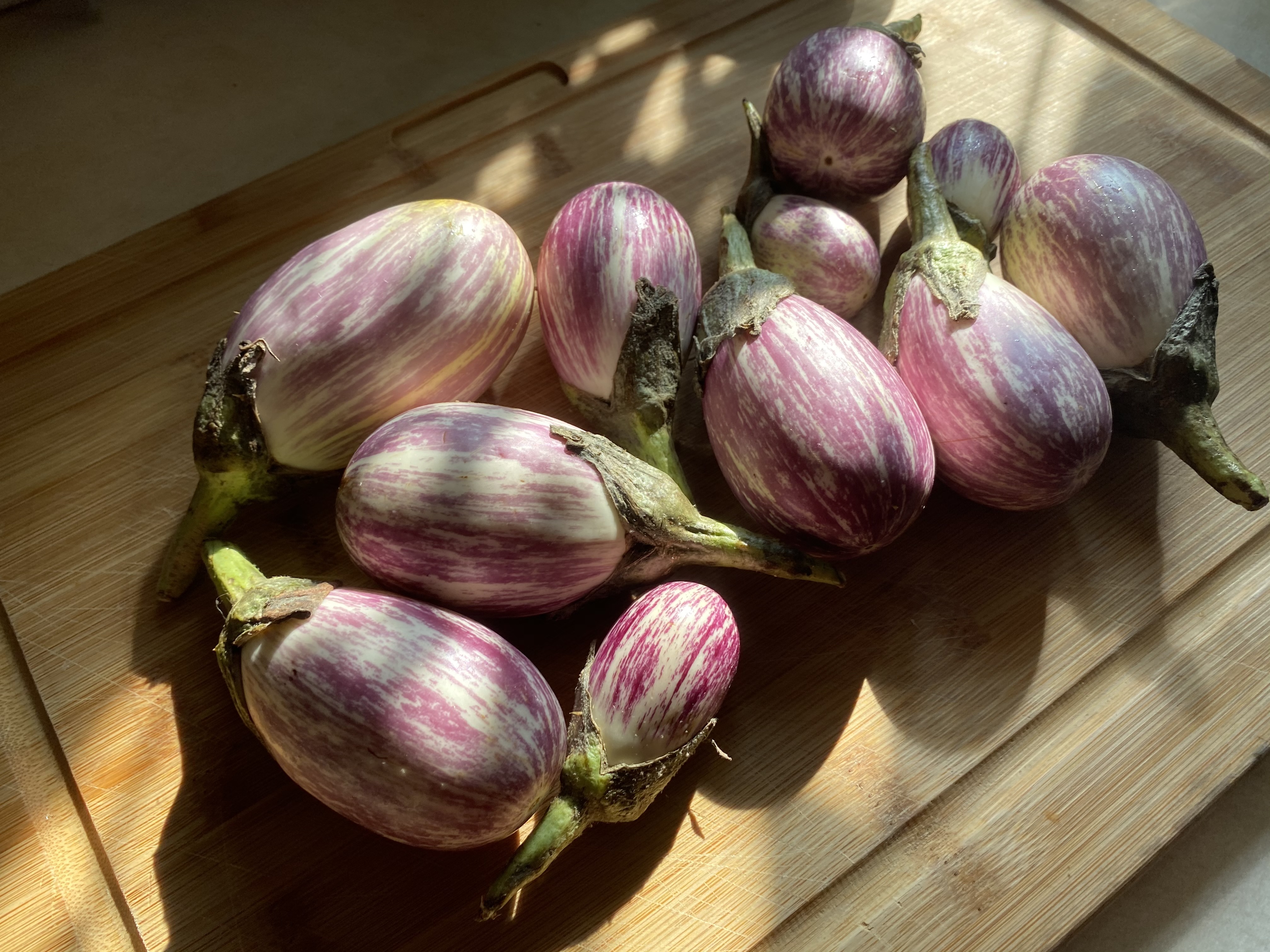
Last garden’s bounty (photos: Asam Ahmad)

Growing Things

Toronto

Two months before it all started, we moved out of the downtown core to a residential cul-de-sac ten miles away, near the city’s western edge. At the time, having to move unexpectedly felt like a nightmare, but now, a year into the pandemic, this place feels like a gift. It is a beautiful home: the living room has large south-facing windows that let in light as soon as the sun rises in the morning. Along the perimeter of the backyard there are steps leading down to a terrace-sized ledge that overlooks a creek surrounded by trees and lush foliage.

We’d moved because we had to: We were being illegally evicted through a “renoviction” order. Toronto is one of the most expensive real estate markets in North America, with a housing bubble and a crisis of unhoused people, where renovations are just one excuse to push tenants out. Our new neighborhood is not far from Jane/Finch and Brampton, high-density communities of mostly black and brown service workers and many newcomers, neighborhoods known in the media largely for gun violence and thus for being dangerous. Visiting us soon after the move, a friend remarked on feeling unsafe, as if the nightly news’ scare stories had any bearing on the vast majority of lives in this part of the city, where the most common experience was reflected in buses full of our neighbors, mostly middle-aged and young people, riding to work early in the mornings.

Then it started, the contagion, the lockdown, the anxiety. I stopped letting light into the living room. What was the point? The living room is where we watch the news, where the ledgers of the dead kept growing. Outside, our neighbors, now called essential, still filled buses in the morning. Ontario still refuses to mandate paid sick days for all essential workers.

Now, on the cusp of another surreal spring, I have never felt simultaneously more at home and more afraid of being unmoored.

Last May we planted a garden, the first I could call my own. It is still thrilling to think about how much we were able to plant, and how much grew. The names themselves are a delight: zucchini, delicata, butternut, spaghetti squash; heirloom and red, blue, and white cherry tomatoes; black beauty and pink stripe eggplant; habanero, sweet, and red lipstick peppers; blackberries, blueberries, strawberries, golden raspberries, golden gooseberries; chives, sage, cilantro, basil, spear and black peppermint, pennyroyal; brocade and French marigolds; calendula, climbing nasturtium, velvet queen sunflower; snap peas; sampaguita, or jasmine; St. John’s wort, white yarrow, English lavender, sweetgrass, white spruce; radishes; gifted blue corn; brown bear beans; dinosaur and Red Russian kale, arugula, spinach, purslane, butter lettuce; yellow gold and blueberry kush; baby watermelons; hydrangea. It felt like a small miracle to escape the news and sit with things that needed our help. Tending to the seedlings and the plants was enough; for a time, just to keep them alive was enough to keep ourselves going.

Our garden let our neighbors peer a little into our lives. Some of their stiff coldness thawed. Catherine, a university admin worker, makes beautiful soaps and enjoys a good pastry. Adeline, a flight attendant, loves to grow things almost as much as we do. The Jewish adage “My neighbor’s material concerns are my spiritual needs” has never felt more resonant. We are learning to check in on one another in hesitant but kind ways. Yet we are still cautious about how honest we are about our needs; my partner and I still don’t know how much of our politics to share.

Near the end of 2020, when a second lockdown loomed and new Covid variants were emerging, I started going for long walks along the Humber River. Being outside before dawn and breathing the cold air reminds me that I am still alive. On every walk I meet some new fauna: cardinals, thrush, hawks, egrets, hares, even a small fox who scurries near the creek behind our house. Walking is a new and comforting ritual. I have only recently realized that I am doing a kind of cartography: learning the routes of this place, figuring out which are the easiest, which the most joyful. One imagines building a politic like this: knowing the routes that work, knowing the ones that are clogged, knowing which ones will never yield.

This moment, awaiting spring, feels less like an ending or a beginning than a respite: a brief moment until another downturn. Clearly, for some the downturn has never fully stopped. As I walk for pleasure, others are forced to leave their homes so they don’t lose their homes (while still risking their health in order to do so). The emergency benefits of 2020 have ended for many who relied on them. Eviction orders ceased for a couple months in Ontario before kicking back into high gear; thousands of people are camped out in public parks in Toronto, and instead of designating enough adequate housing or hotel spaces, the city has chosen to take a carpenter who was building tiny shelters for the homeless to court. The unresolved contradictions of capitalism keep accruing; whose lives matter and whose don’t becomes more glaringly obvious under the pandemic’s harsh, bare light. I cannot shake the feeling that we are not through this yet, even though using the generalized we, as in “we’re all in this together,” feels more obscene every day.

What kinds of coalitions, of we‘s, are possible in this protracted, still expanding historical moment of catastrophe? What kinds of routes are available to make one another’s lives less vulnerable to despair? Like Gramsci, I keep reminding myself that it is painful to be alive at the time of a new birth; that it is painful to witness newness being born.

Coda: The day this article appeared on The Nation’s site was bittersweet. We found out that the landlord is selling the house, and we are being evicted again.

Asam Ahmad is a writer living on Treaty 13 land in Tkaronto, the original Mohawk name for the lands around Lake Simcoe, now known as Toronto, Ontario. He was a participant in Kopkind’s political camp for writers and organizers in 2014.

Scenes From a Pandemic is a Kopkind/Nation magazine collaboration. This piece originally appeared on The Nation‘s website on March 17, 2021. We thank Katrina vanden Heuvel, D.D. Guttenplan and The Nation crew.

Bonus: An Interview From Kerala, India

Our friend the indefatigable Vijay Prashad writes from Tricontinental: Institute for Social Research about upcoming elections in Kerala (population 35 million), where the Left Democratic Front has been in the government for the past five years. In that time it has confronted the aftereffects of Cyclone Ockhi in 2017, the Nipah virus outbreak of 2018, the floods of 2018 and 2019, and the pandemic. Kerala’s health minister, K.K. Shailaja, has earned the nickname the ‘Coronavirus Slayer’ because of the state’s rapid and comprehensive approach to breaking the chain of infection. All polls indicate that the left will return to the government.

Junaina Muhammed (India), Green Kerala, 2021

In the engaging interview below, Vijay speaks with Kerala’s finance minister, Thomas Isaac (also a member of the Central Committee of the Communist Party of India (Marxist), about the development strategy that Kerala has charted and intends to extend; one that, within the terms of Indian federalism, has managed to meet the needs of the people and show, as Isaac says, that “another world is possible”.


Scenes From a Pandemic: 43

15 03 2021

by Jason Kotoch

A continuing series of dispatches from Kopkind participants, advisers, guests and friends on life in coronavirus time as they observe and experience it.

(photos: Jason Kotoch)

Postcards From Restaurant-Land

Northampton, Massachusetts

Front of the house. I’m sitting in the empty bar section of a Western Massachusetts restaurant, the kind of place where you can count on finding a Buffalo chicken Caesar salad and a Friday night fillet special on the menu. I’m not here to eat—I haven’t eaten inside a restaurant since the pandemic started a year ago. I’m here to talk to Taylor Kall, one of two people managing the front of house tonight, mostly taking phone orders. 

Taylor stands tall. Above the mask, her eye makeup is perfect. A seasoned restaurant worker, having supported herself through college working in restaurants, studying part-time while carrying 40 hours a week at diners and bars, she learned to love the hectic environment of the industry. Mixing drinks became a manual skill, a social skill, and a source of financial stability that has since vanished. Bartenders will always have work, she thought. Tonight, the laugh track of a sitcom echoing from a wall-mounted television into the barroom amplifies the quiet that has settled over the once bustling townie haunt. Taylor has been on shift for three hours and hasn’t mixed a drink yet.

At around 7, an older couple walks in and takes a corner booth. The two quickly unmask and sink into vinyl seats that squeak as they wrestle themselves into position, not saying a word to each other. Taylor walks over, greeting them with menus and that familiar tone all practiced front-of-house workers quickly master, a sort of customer service code-switching that when performed just right, yields better tips. The man orders a hot tea, the woman orders water with no ice and a cocktail, and asks to have a moment to look over the menu—neither one remasks. The man wipes his nose with the back of his wrist and coughs a little smoker’s cough just as Taylor walks away. 

Early in the pandemic she might have said something. She says she doesn’t have the energy to play the game anymore. She stands mixing her first drink of the night behind a row of plexiglass shields, and no amount of eye makeup can distract you into thinking she’s smiling under her black surgical mask.


* * *

Back of the house. I’m standing in an alleyway on another night at a different restaurant, between a dumpster and a graffiti covered steel door, waiting for Javier behind a popular pizza shop in a dilapidated industrial town that has been left to rust ten minutes north of Springfield. 

At around 5:30, the door screeches open and Javier emerges, carrying two big clear bags of trash to the dumpster. A dirty white apron hangs off his waist. Before we greet each other, he yells over the sound of the compactor to tell me that he wants to use the name Javier for this story because it belonged to his father, a Mexican migrant worker who died two summers ago on a farm in California. 

The air is cold and carries the warning of a winter storm, so we both rush back inside. The door slams heavy behind us, ominously, like we are locked in. Javier is the only person working tonight in the brightly lit stainless-steel kitchen. His only co-worker is taking phone orders. Those print out in the kitchen with a kind of rhythmic timing that occasionally matches step with the bachata music playing from a small WiFi speaker at the front counter. Javier has been the keeper of the kitchen night after night since last March when the pandemic swept the state.

He is a young-looking 37, with short dark hair and lean limbs. He is the father of two children, both born in the United States. His wife was recently let go from her two jobs. A year ago, he says, they had just moved into a two-bedroom apartment. The relative financial stability they relied on then is gone now, and you can hear the stress in his voice when he talks about this.

Undocumented workers are always navigating difficult decisions, but the choices facing them now are extreme. Work, get a paycheck, but risk contracting the virus. Without access to testing or healthcare, Covid could be a death sentence. Stop working and die another way, as those without work authorization generally don’t qualify for unemployment or other government aid. 

As Javier slips a pizza into the oven, he catches the bottom of his wrist on the door. It sears his skin, but he responds as if he hardly notices the burn. It will become one more old cooking scar among the many covering the inside of his right wrist. Walking to the counter to grab a pre-folded pizza box, he looks past a few vacant tables and out a big pane glass window with the words “NEPO ERA EW” painted in big, bold red-and-white letters.

A new order comes through the printer. He begins to shape and smooth another ball of dough into a large pizza, and I ask him what he thinks of the term “essential worker.”

“To them, my work is essential, yeah, but my life, I’m not sure.”  

Jason Kotoch is a photographer and filmmaker living in Western Massachusetts. He was a participant in Kopkind’s political camp for journalists and organizers in 2018.

Scenes From a Pandemic is a Kopkind/Nation magazine collaboration. This piece originally appeared on The Nation‘s website on March 10, 2021. We thank Katrina vanden Heuvel, D.D. Guttenplan and The Nation crew.

Bonus: Virtual Life, a Short Film From New York, plus…

Long before the pandemic, in 2013 to be precise, Annie Berman made a short about virtual travel in a virtual city—there but not really, except as recorded in a moment via Google’s Street Views App, and ‘visited’ the way we have come to visit so much now, remotely. You can watch the film, Street Views, which won Best Experimental Film at the Rome Independent Film Festival of 2014, by clicking on the image below. Annie was a participant in the Kopkind/CID Film Camp in 2010. The documentary she workshopped in camp, The Faithful, is about to premier, on March 19. It explores the public’s connection to and veneration of cultural icons—Elvis Presley, Pope John Paul II and Princess Diana—and what this enthusiasm means in terms of memorabilia, copyright law, memory and identity. The new film (see the green box below for information about how to see it) is also an experiment in independent film distribution. With film festivals and small theaters largely foreclosed or restricted because of Covid, and with behemoths like Netflix and Amazon dominating home entertainment, it’s even harder out there for independent filmmakers. Annie and her team are pioneering alternative modes of connecting directly with audiences to strengthen the ecosystem for indie film producers and their work.

About Street Views, Annie writes: “I started making a series of ‘cameraless films’ beginning in 2011. This is the second. It was my antidote to The Faithful, a project that had inadvertently made me an archivist. I was feeling the burden of the weight of my archive and questioning why photograph when the world I lived in had already been imaged by humans and machines alike. It was also my way of grappling with disconnectivity. I was feeling nostalgic for a time when people asked one another for directions, rather than their devices.”

The Faithful premieres live at www.The-Faithful.com Friday, March 19, 7 pm EDT, with additional live showtimes through the weekend at 2 pm and 7 pm daily, and will be available on streaming services March 22. To join the live premiere event, viewers pay, watch and interact with Annie and company on the filmmaker’s own screening platform, the-faithful. Check out the trailer and reserve tickets here: The-Faithful.com. The first 25 people to reserve tickets with the promo code KPKD50 at checkout will get tickets at half-off the standard price.

Counterclockwise from bottom, The King, The Pope and The Princess (detail: The Faithful film poster)


Scenes From a Pandemic: 42

8 03 2021

by Matt Nelson

A continuing series of dispatches from Kopkind participants, advisers, guests and friends on life in coronavirus time as they observe and experience it.

(photo: Julian Leshay / Shutterstock)

American Carnage

Oakland

On January 20, 2017, in a chilling inaugural address, Donald Trump declared, “This American carnage stops right here and stops right now.” As white supremacists stormed the Capitol on January 6, it struck me that the exact opposite had transpired during his term as president. A large proportion of the 500,000 Covid deaths in the United States can be attributed to his executive negligence and incompetence. It is horrific; the coronavirus, though, is a pathogen, in the realm of science and medicine. The effects of rising violence and vitriol represent a carnage of Trump’s, his allies’, and enablers’ own making. These too are matters of public health, but there is no medical vaccine for the white-supremacist and fascist ideology that festers in our body politic.

Watching the violence that transpired on January 6, replayed with new intensity during the impeachment trial, I had a visceral memory of my own dangerous encounter with a rageful white man. In June of 2018, someone who came to be known as “Jogger Joe” attacked an unsheltered man by throwing his scarce belongings into Oakland’s Lake Merritt. He said he was “taking out the trash.” After I confronted him, Jogger Joe, now with an accomplice, attacked me, dragging me in a moving vehicle and striking me repeatedly in the head (thankful for my hard head!).

As I reflect on that day, it’s clear that such spasms of violence should figure in the toll of American carnage under Trump. Reported hate crimes increased by around 20 percent during his tenure, while bias-related murders rose to their highest peak in 28 years. Jogger Joe’s rapid escalation of what seemed to be a benign conversation to a life-threatening situation is frighteningly similar to the politics of today. Personal violence, like state violence, is encouraged and leveraged by elected leaders and their corporate enablers—and encouraged by a culture that does not respect human rights. The consequences are tragic to individuals but also systemic.

Back in 2015, the organization I direct, Presente.org, recognized the gravity of Trump’s corruption and the threat that he posed. Our #ArrestTrump campaign called for a criminal investigation of bribery (about which he’d boasted in the first televised Republican primary debate), inciting violence, and defrauding students of Trump University out of millions of dollars. Our critics called us alarmists, but we always knew how high the stakes were. Trump represented a danger to our existence.

Fortunately, many more Americans now see the reality. As we re-emerge from the Trump years, we have a formidable task to embody solidarity amidst the pandemic and shift the culture toward creating an inclusive, equitable, and sustainable way of life. Concurrently, it is our duty to challenge and change the structures and decisions that equip oppressive systems.

Undoing the ethos of American carnage and changing the culture is not just a political project. As the pandemic has made dramatically clear, it is relational, social, massive and deeply individual.

Consider immigration. “American carnage” is an apt description for one of the Trump administration’s most sadistic moves: separating infants and children from their parents and locking them in cages. While detention and deportations preceded Trump’s presidency, this humanitarian nightmare would not have been possible without the private prison industry, which in turn depends on banks and large investors, who are essentially complicit in the atrocities supported by their dollars. Under Trumpism, we witnessed how human rights abuses can have a cascading effect, leading to unspeakable acts like the forced sterilization of migrants.

In 2018, a newly formed corporate accountability committee of the umbrella #FamiliesBelongTogether coalition demanded an end to the financing of detention centers that feed off human suffering. Now, Presente and our partners have been calling on the Biden-Harris administration to step up and safeguard the full human rights of all immigrant families. We were cautiously encouraged by President Biden’s early executive orders to cut off funding for the border wall, nix the Muslim ban, and end Department of Justice contracts with private prison companies. The next behemoth he must address is the broader federal government’s use of the private immigrant detention industry. More than eight in 10 people in ICE custody are incarcerated in privately owned prisons. Executive orders can go only so far, and must give way to bold legislation and governance—dramatically changing course not just from the last five years, but from the last five presidents.

Biden can furthermore embrace a pro-migrant tone to begin exorcising the racism and xenophobia that has long tainted national discourse around immigration. By using his authority to protect immigrants in vulnerable situations and reorient the way asylum law and other forms of humanitarian protection are applied, Biden could demonstrate that he intends to transform US foreign policy. Will he? Biden has his work cut out for him. We hope he’s up to the task, and we will hold him to account. His administration’s recent decision to reopen a child detention facility reeks of complacency and belies the morality he promised to restore. But undoing the ethos of American carnage and changing the culture is not just a political project. As the pandemic has made dramatically clear, it is relational, social, massive, and deeply individual.

When the case with Jogger Joe went to trial, the court—including the public defender—asked me how many years in prison defendant Henry Sintay should face. I said that prison would likely make Henry a more violent and racist person, which would not benefit anyone. He had to apologize to the unhoused man and me, and to face consequences that would make him less belligerent. This came in the form of lengthy probation, strict travel restrictions (staying away from me and Lake Merritt for several years), anger management work, and restitution payments. After the judge approved these alternatives to incarceration, a top-level staffer in the district attorney’s office told me that while he had believed in restorative justice throughout his career, it was the first time he had seen it in practice.

The culture of white supremacy and the carnage it creates will not disappear overnight. These often materialize at the neighborhood level, through encounters with people like Jogger Joe/Henry and situations where we fall short of acknowledging one another’s humanity. This period demands more than a sigh of relief that Trump is gone. There are structures to rebuild based on a broad and deep understanding of public health and social justice. Now is the time to seize this movement moment, and co-create what comes next.

Matt Nelson is executive director of Presente.org, the nation’s largest national Latinx digital organizing hub, advancing social justice with technology, media, and culture. He was a participant in Kopkind’s camp for journalists and organizers in 2008.

Scenes From a Pandemic is a Kopkind/Nation magazine collaboration. This piece originally appeared on The Nation‘s website on March 3, 2021. We thank Katrina vanden Heuvel, D.D. Guttenplan and The Nation crew.

Bonus: From the Streets of Buffalo

(photo: JoAnn Wypijewski)

The motto—”I’m for Truth, no matter who tells it. I’m for Justice, no matter who it’s for or against.” Malcolm X—pops up on machine-printed signs in front of houses in a section of the city’s East Side. This one is unlike all the rest. The full quote continues: “I’m a human being, first and foremost, and as such I’m for whoever and whatever benefits humanity as a whole.”


Scenes From a Pandemic: 41

1 03 2021

With this we resume our collaborative series with The Nation—weekly dispatches from Kopkind participants, advisers, guests and friends from around the country and the world on life in coronavirus time as they observe and experience it. Scroll down to read all the pieces this project has published since April 1, 2020, in descending order, plus Bonuses and other material particular to this site.

by Angela Ards

(photo: Angela Ards)

Yappy Hour: or, Pawing Our Way Toward Community

Newton, Massachusetts

During lockdown last March, one of the few approved excuses for being outside was to walk your dog. In Newton, a suburb outside of Boston, stir-crazy folks with the requisite pet in tow began congregating, six feet apart, at Braceland, one of our local parks

We were educators, health care workers, and nonprofit executives; musicians, engineers, and entrepreneurs—alongside a mix of designer doodles and rescues. There was early talk that the rescues all came from Southern states, where yahoos are dumping pups in garbage bags by the roadside on the regular, so say the shelters. I find the narrative suspect, serving to feed my Northeastern neighbors’ sense of regional superiority, but then again I’m a Texan, with a Standard Poodle, Zuri, and a superiority complex of my own.

At first, we knew the dogs’ names better than one another’s. We knitted neighborly bonds with small talk. Once a week, at least one person would declare that the inventor of the Chuck-it Launcher should receive a Nobel Prize. The rod’s aerodynamic curves and cup allow you to throw a tennis ball like Tom Brady, tiring out young pups and cutting stupefying rounds of fetch in half. We had running jokes. The dad of two Shih Tzus would ask, “How’s Father Leahy?”, the president of the college where I teach, who frequents his Brookline shop. I wouldn’t know, and the Shih Tzus’ dad really didn’t care; the query was more about the two of us, connecting. In time we all started sharing tips about the neighborhood, passing on recommendations for good repairmen—our exchanges like the Nextdoor app come to life, but without the casual racism. Out from behind the anonymity of screens, people have to face one another and actually think about their words.

Eventually, the oak trees overlooking a long field sloping toward the Charles River became an office watercooler of sorts, where we talked politics and the pandemic while watching the dogs play. Like barking, though, mindless banter can turn edgy if you miss the cues. There were some tense moments as job loss and quarantine and boredom wore on us.

When stock markets initially tanked, would-be titans of enterprise parroted maxims about buying low, selling high. “That’s how you build wealth,” touted a salesman, owner of a gorgeous young Vizsla, invoking Warren Buffet as a liberal shield. A nonprofit executive and an entrepreneur agreed. They were trying not to sound crass, like capitalists preying on disaster. I walked away to renew a round of fetch with Zuri.

Around the election, the regular “How’s Father Leahy?” turned into an incredulous “You’re voting for Biden? He’s so old.” A retort I didn’t even know I had ready landed hard and on target: “Well, he’s not a white supremacist.” We both stood silent, stunned, and turned on our heels.

Mostly, though, the only irreparable breaches have been disagreements over whose dog started it. Now that handshakes and hugs are out, the need to be held in community keeps bringing us back, even if at a distance. On the occasional weekend, when weather permits, our resident “mayor” organizes “yappy hours,” featuring Milk-Bones for the pups and festive drinks for the humans. There was spiced apple cider at Halloween and a sweet peach tea to celebrate the Georgia Senate races. One sunny Saturday last fall, a retired principal wrote a funny ballad in honor of our accidental community, accompanying himself on acoustic guitar:

Elvis had Graceland
But we’ve all got Braceland
If we want, we can stay here past dark
Because it’s Yappy Hour here at the park.

Sunset at Braceland with dogs. (photo: Sarah Hildebrand)

As the days of the pandemic lengthened, with less travel and day-to-day business, the skies cleared and wildlife came out. We did too. Neighbors came to rely on one another in a pinch as neighbors do: dog-sitting for a few hours or a weekend; sharing hand-me-downs for new pups; celebrating milestone birthdays with cupcakes and banners. From such neighborliness real friendships grew. For Zuri and me, a standing playdate at the park with a couple and their two Standards led to other get-togethers as we discovered affinities beyond poodles. On our group chat, the common thread among all the cute dog pics is gratitude for the community we’ve built to keep each other sane through constant uncertainty. “The silver lining,” we say.

It’s been almost a year. Wildlife is back in hiding; smog in New Delhi and Los Angeles has returned; yet, we still gather. A few streets surrounding Braceland are named after states: Ohio Avenue, Indiana Terrace. On the night of the inauguration, we met at the white house at the end of Pennsylvania Avenue, letting the serendipitous address speak of our hopes for us and the nation. Our resident mayor embraced Biden’s theme of unity, serving champagne with grenadine or cassis to spike it red or blue.

The Vizsla’s dad, who was laid off and then rehired at a much lower salary, says the pandemic has changed his mind about a lot. Perhaps “building wealth” sounded more like a scam after losing his job. Following the January 6 insurrection, he asked if I thought Trump supporters would have a change of heart having seen the violence. I doubt it. I think it’s more like the Shih Tzus’ dad. He does work harder now to make small talk, to connect, but he persists in showing up without a mask despite a statewide mandate. Standing on the hill by the oak trees, he wishes “Good morning” to the rest of us, masked, standing below. He seems to want to show us that he’s not like those people who stormed the Capitol.

Angela Ards is an associate professor of English and the director of journalism at Boston College. She is the author of Words of Witness: Black Women’s Autobiography in the Post-Brown Era. She was a Kopkind participant in 2000, a mentor in 2015, and has been an adviser since the early 2000s.

Scenes From a Pandemic is a Kopkind/Nation magazine collaboration. This piece originally appeared on The Nation‘s website on February 24, 2021. We thank Katrina vanden Heuvel, D.D. Guttenplan and The Nation crew.

Bonus: Tell Me a Memory

Jon Crawford, a participant in Kopkind/CID Film Camp (2018, 2019), began interviewing people in Memphis last year about their lives, their loves and memories, the small and large pieces of experience that together form the beginnings of an archive of the lgbtq community. You can view all the videos to date and learn more about Jon’s reason for starting the series at Tell Me a Memory. Below is one Memphian’s story.