Scenes From a Pandemic: 24

15 09 2020

by Nathan Schneider

A continuing series of dispatches from Kopkind participants, advisers, guests and friends on life in coronavirus time as they observe it.
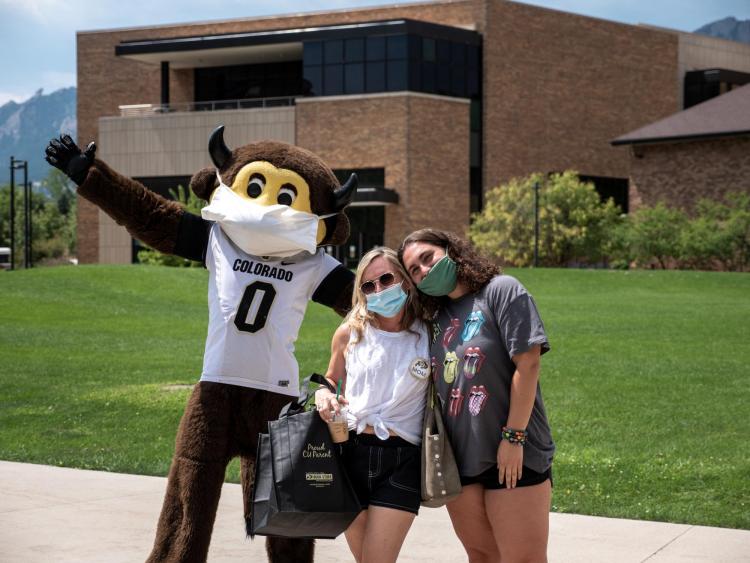
University of Colorado urges students to “Be a Buff” and be safe, as mascot welcomes students back to school. (photo: CU Boulder Today)

The Wrong Lesson

Boulder, Colorado

The call to action my generation received, during our first moment of inflection, was to get back to business. I was in my last year of high school on September 11, 2001, when an airliner slammed into the Pentagon a few miles away. Later that month, while visiting O’Hare International Airport, President George W. Bush implored the American people to “do your business around the country. Fly and enjoy America’s great destination spots. Get down to Disney World in Florida.”

Don’t soul-search or undertake shared sacrifice. Don’t learn Arabic or better under-stand the wider world. Take a picture with Mickey Mouse, where Jeb Bush was governor. To someone young and looking to find a calling and a purpose, such leadership was crushing. It was an invitation to waste the best energy of youth.

In 2006, as President Bush’s delusional wars in Afghanistan and Iraq raged on, he told us much the same thing: “I encourage you all to go shopping more.”

Back to shopping, back to school—we are there once again.


As after 9/11, another generation of youth at a moment of inflection is being encouraged to get back to business. We ought to be teaching a different lesson, one that addresses students as “moral beings rather than desiring consumers.”


I teach at the University of Colorado now, and my students are coming of age in another moment of inflection. They are entering adulthood during a pandemic, an economic collapse, and a historic uprising for justice. What calls to action have they received?

The virus, their president told them, is no cause for change: “It’s going to disappear. One day—it’s like a miracle—it will disappear.” That was in February. He said everything would be back to normal by April. Trump’s delusions exceed those of his predecessor. But I don’t want to focus on presidents any more than they deserve, for they are not the only ones teaching the young.

I have had delusions of my own. Until the very last minute, I thought I could still make it to long-planned engagements in Europe in late February. I let myself believe the assurances that, somehow, our kids would be impervious to the virus at school. I keep imagining I can go back to business as usual.

Now my university is opening again, behind plastic shields and face masks. Students are repopulating the dorms and roving around town in partially masked flocks. Since we receive only an infinitesimal part of our budget from the state, we’re told, institutional survival requires business as usual. I am refreshing an old syllabus. Vast bureaucratic expertise has gone into establishing the fiction that such a thing is reasonable, that we can continue to provide the experience that students and their families are paying so much for. Perhaps, if we taught a different lesson, we could.

Earlier in the summer, a group of my colleagues published an open letter arguing that the return to campus would be not only a medical danger but also poor pedagogy. “It is the responsibility of the leadership to tell them,” these professors wrote, “to put public health first, and not to make false promises about a meaningful on-campus experience, when health and lives are on the line.” I didn’t sign. I was still waiting and seeing.

NYU anthropologist Angela Zito has diagnosed higher education’s failure of imagination especially pointedly:

Colleges missed the chance to directly address our students as moral beings rather than desiring consumers, and invite them to join us in a time of grieving perseverance in order to save ourselves together. Will never get over that. Intend to teach that way myself.

She reminds me of two lines from a poem by Ralph Waldo Emerson. At some old colleges, these lines are carved into monuments to students killed in the Great War (and, surely, the concurrent influenza pandemic):

’Tis man’s perdition to be safe,
When for the truth he ought to die.

As a student at Brown University, I walked by those words almost daily, hearing their call to sacrifice in grating opposition to what President Bush was asking of us at the time. The words themselves invert Angela Zito’s lament: “man” rather than all of us together; an adventure of death as opposed to the struggle for collective safety. Yet Zito and Emerson are united in their embrace of a morality that embraces non-normal times, that invites the young to take history upon themselves and act in it—not merely for the sake of approximating their earlier expectations but in order to raise their expectations and live lives that mean something.

Can we teachers “address our students as moral beings” behind the institutional pretense (and masks and screens) of normal education delivery? As Zito says, we need to grieve. Then we can get down to the non-normal work of reshaping our world out of this cataclysm.

I hope my students will hear the call to put their best selves into this moment. It’s their time. Those who most want to rush back to normal are probably those who most fear the opportunity for change that the young now have before them.

Nathan Schneider is a journalist and assistant professor in media studies. He is the author, most recently of Everything for Everyone: The Radical Tradition That Is Shaping the Next Economy. His current project is an exploration of models for democratic ownership and governance for online platforms and protocols. He is founder of the Media Enterprise Design Lab. In 2012 he helped organize Kopkind’s camp focused on the aftermath of Occupy.

Scenes From a Pandemic is a Kopkind/Nation magazine collaboration. This piece originally appeared on thenation.com on September 9, 2020. We thank Katrina vanden Heuvel, D.D. Guttenplan and The Nation crew.

Bonus: Grief in Philadelphia

(photo: Aja Beech)

Before writing her dispatch for “Scenes From a Pandemic,” Aja Beech walked her neighborhood of Philadelphia, taking pictures. This one was among the many she sent our way. Her piece will appear at The Nation on Wednesday and here next week.



Scenes From a Pandemic: 23

7 09 2020

by Laura Flanders

A continuing series of dispatches from Kopkind participants, advisers, guests and friends on life in coronavirus time as they observe it.

The author interviews a local farmer using a social distancing selfie stick. (photo: Sabrina Artel)

Covid Country Diary

Sullivan County, New York

It’s a myth that people in small-town America know one another. I’ve had a cabin in this place for 30 years and never knew that a foie gras factory sits high above Ferndale, a hamlet I’ve driven through hundreds of times. I found out one sunny Sunday this spring, when 40 flag-festooned cars filed up to La Belle Farm past blooming forsythia and a white-picket-fenced farmhouse, part of an appreciation drive for farm and factory workers.

The drive kicked off at Murray’s Chickens, a packing plant 15 minutes away in South Fallsburg, and weaved through a housing project where workers and their kids smiled and waved, sprawling out onto concrete stoops in the spring warmth as we honked our horns.

No one waved in Ferndale. Not a soul could be seen. Only row after row of workers’ trailers, exposed on a hilltop, perpendicular to an enormous, low, windowless barn. When New York City banned the sale of foie gras, a few years ago, no one stopped this place or nearby Hudson Valley Foie Gras from force-feeding and slaughtering enough ducks, ducklings, and geese to make these the nation’s premier producers of the sickening pâté. Who knew?

* * *

We left Manhattan and drove up here in March. A pocket of hanging-on farms, scrubby woods, and defunct hotels, Sullivan Valley is neither Hudson Valley rich nor Delaware Valley airy. From its heyday as the Catskills’ famous Borscht Belt in the 1950s, it is home now to 75,000 souls in winter. Social distance comes with the territory. As the snow fell late and wet, and lines at the supermarket got better organized, it was possible to imagine that nothing new was coming, not spring or Covid-19.

The novel coronavirus came quietly to the country, prowling the backroads of poor health, poor health care, lack of attention and clout. Facts took time to come into focus, as inconspicuous places with tucked-away poultry plants started showing up in county statistics, followed by obscure villages fronting off-road meat packers and down-by-the river dairy processors.

By late April, people were realizing that, just like the city, their patch of country was powered by a pool of poorly paid, poorly documented, mostly latinx and black workers. Some were dead, and more were falling sick.

Thirty-eight-year-old Luz (not her real name) worked in a cold, crowded factory wrapping luncheon meat around cheese sticks for sale at deli counters around the country. Twenty-five workers toiled bunched up at three tables, and ate together at mealtimes. She learned about the virus through the Internet, then on Facebook, and didn’t believe it posed a threat here. All spring, Luz kept working. Still, she’d undress as soon as she returned home and shower before greeting her children.

“She went nowhere, just from her job to home; home to Walmart or ShopRite to get what we needed; then home again,” explained teenage Marisol, speaking on Zoom from the home her mother forbade her to leave.

Then a co-worker died. Luz left work that day and hasn’t been back: “How could they do such a thing, to not tell us what’s happening?”

* * *

Two months into the lockdown in Manhattan, Sullivan County had the highest positive test rate, and the most new cases per capita, in New York State.

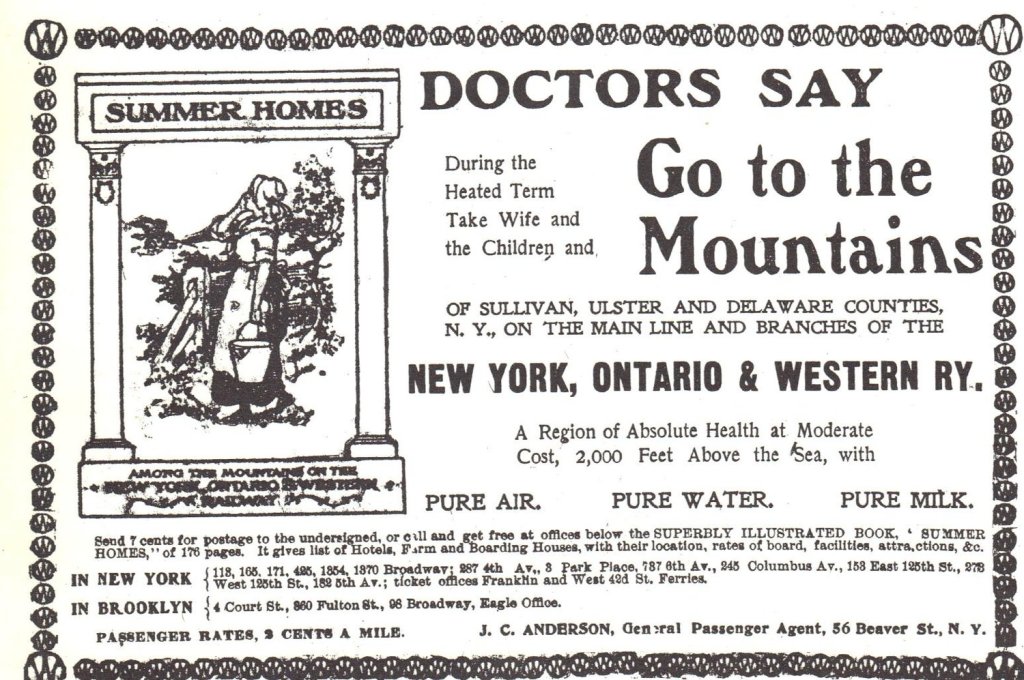
Ad from Sullivan County’s Silver Age (1890-1915) of therapeutic tourism. (image: John Conway/The River Reporter)

The county’s public health director, Nancy McGraw, raised concerns about farm and factory workers at her weekly briefings, which were face-timed on a press officer’s cell phone. Local media picked up the story, and with bad broadband and little elbow room, activists got busy.

By early May, Rotary clubs were delivering food to essential workers, piling station wagons full of Monticello’s famous bagels in the morning and cooked meals from grateful restaurants at night. At the entrance to the senior care center in Liberty, nurses put on superhero costumes to greet a rain-drenched solidarity drive-by. Nurses thanking drivers, drivers thanking nurses, everyone getting wet.

Meanwhile, Juanita Sarmiento and members of the Rural and Migrant Ministry set up signs at the entrance to Murray’s Chickens: FREE MASKS. Across from the bank and the kosher butchers, they handed out boxloads of protective masks to blue-apron-clad workers at shift change.

“We could have seen it coming. I saw it coming,” says Sarmiento, a former biology student.

“What’s coming into its own is new leadership,” purrs Sandy Oxford through a red chili-pepper face mask. Director of the Hudson Valley Area Labor Federation, Oxford joined Sarmiento at Murray’s one Friday to support workers and berate the bosses: “If the workers have all the masks they need, why are they rushing over here to get more?”

* * *

Crowds rallied for black lives in June: half a dozen on the bridge in Narrowsburg; several hundred in Monticello, demanding release of prisoners from the town’s ancient jail.

Notice for June 21 Black Lives Matter rally in Roscoe.

In Roscoe, at the foot of Catskill State Park, the Black Lives Matter rally took place on Railway Avenue, a broad, empty block, home of the Trout Town Inn.

Organizer Ashlee Perez straddled a wooden ranch fence to be seen. “Yes, we have racism here in Roscoe,” she told the mostly white, mostly young group of protesters. Along with half a dozen other African Americans, she told her neighbors about their town—about school bullies, bureaucratic bigots, absurd arrests, and too-many-to-count traffic stops, about silence and threats.

The group clustered around two vintage train carriages, a perky red caboose, and a long, sea green “trout car,” reminders of the railway platform that once occupied this block. One hundred years ago, people in long dresses and high hats, mostly white, mostly Christian, spilled off the trains of the O & W line, drawn by Roscoe’s fish and fresh air. Only the train cars and the trout remain.

The future will look different, says Perez. Demographics demand it. “But right now, people like me aren’t going to want to stay here.” Waving her arms for balance, Perez seemed to gesture down the invisible tracks. “This place is going to have to change.”

* * *

I have seen every day of spring and summer here for the first time. I’ve discovered that those trout, millions of them, were city transplants, shipped from Long Island hatcheries in the 1880s and ’90s. They rode the rails as people did. From the crowded city, many people came with tuberculosis, seeking fresh air, a cure, relief.

For 30 years, Sullivan County boomed. That was its Silver Age. It ended in the 1920s, when people began to understand that human contact could spread disease.

One red hot Saturday in July, strolling down a long former track, now a wheelchair-accessible walkway, with county historian John Conway, I learned more. TB killed the passenger trains, an entire network of spidery rail lines that had brought generations of city-dwellers north. But TB also brought a Jewish immigrant and his family here, seeking escape from city smog and anti-Semitism. The Grossingers bought a failing farm at a bargain price and helped usher in Sullivan County’s next big boom, its Golden Age. Grossingers Catskill Resort Hotel had 35 buildings, its own airport, and a post office until it closed, in 1986.

Ruins of Grossinger’s Catskill Resort Hotel (photo: John Moore/Getty Images)

What’s coming next? Connection or contagion? Coming together or coming apart? History surprises, but it doesn’t predict.

Laura Flanders was a Kopkind mentor in 2018 and 2019. She is the host of The Laura Flanders Show, a TV and radio program which for years has covered the people and places other media miss. As of September 6, The Laura Flanders Show is broadcast every Sunday at 11:30 AM ET on the World Channel and on more than 90 PBS stations across the week. Check local listings. If your station isn’t airing The Laura Flanders Show, contact them! For information: lauraflanders.org.

Scenes From a Pandemic is a Kopkind/Nation magazine collaboration. This piece originally appeared on thenation.com on September 2, 2020. We thank Katrina vanden Heuvel, D.D. Guttenplan and The Nation crew.

Bonus: Remembrance of Summer Past

Behind the waterfall at Green River in Guilford, Taté Walker (Kopkind 2015) and JoAnn Wypijewski. Taté, a writer, photographer and activist, contributed ‘Scenes From a Pandemic: 6’ in May. (photo: Taté Walker)

We look forward to the return of Kopkind summer in 2021.


Scenes From a Pandemic: 22

31 08 2020

by Kristin R. Pak/ 이영숙

A continuing series of dispatches from Kopkind participants, advisers, guests and friends on life in coronavirus time as they observe it.

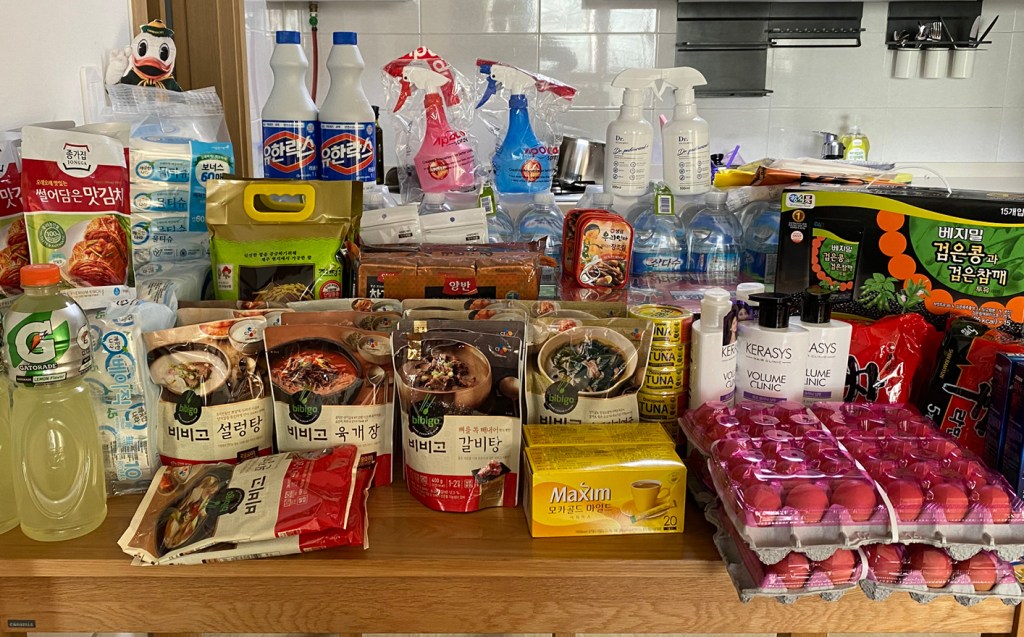
Government–supplied provisions for any person in quarantine in South Korea because of Covid-19. (photo: Joey Weinman / Courtesy)

Letter From Seoul

Seoul

Masks have always been common in Korea. People wear loose ones to avoid tanning their faces or to cover makeup-less mugs. Instead of calling in sick with a cold, they are expected to work with a mask to protect their coworkers. Terrible air pollution prompts about half the people to wear masks, and since antiquity, masks have come out every spring, when the Gobi Desert blankets east Asia with fine sand during Yellow Dust Season. Since the onset of the pandemic, masks have been mandated on all public transportation, including taxis, in Seoul and its suburbs. Nearly everyone complies, with drivers and other riders reminding maskless passengers of the requirement. No one takes violent offense; people are always in your business in Korea. Until late August, following a right-wing rally that caused a spike in infections, masks weren’t mandated here in most other settings. It was largely unnecessary, since almost everyone already wears them, although some establishments had posted signs requiring them.

This past spring, after returning to Seoul from a visit to New York, I’d sit with friends in restaurants and parks discussing reports from the United States about mask fury and toilet paper hoarding and fights over hand sanitizer. Although Korea was “on pause,” we never locked down like US cities. After the crisis began in Daegu, with a member of a secretive Christian church who was a “super spreader,” the government response here and the public’s trust in that response made the difference.


Masks are commonplace. Test results within 24 hours are the only acceptable standard. Everyone in quarantine receives government provisions, including non-citizens. People accept contact tracing because it’s in everyone’s interest — and, we love drinking and socializing with friends.


Besides long-established mask wearing, other aspects of Korean culture and history helped contain Covid-19. The 2015 MERS outbreak had put disaster plans in place, and also activated a sense of solidarity among Koreans. As during the 1997 IMF crisis, when faced with existential threats, Koreans shift from competitiveness to a “together we can overcome” approach. Furthermore, as the national and local governments’ policies proved effective, public trust in the official response soared. In April elections, the incumbent party won by a landslide.

In May, Korea fell out of the top 10 countries worst hit by the virus. By the end of July, we were ranked number 74, with six deaths per million. In contrast, the United States was number one, with 465 deaths per million. While the US had about 70,000 new cases per day, here we’d get panicky if 60 arose. By August, US fatalities exceeded 170,000; in Korea the dead number just over 300. Even with the great difference in population, there’s no comparison.

South Korea, historically in a highly paternalistic relationship with the United States, is not looking to the US to show the way anymore. In some scenarios, like the run-up to the November elections, the US should take cues from the ROK. Here, elections were held with an extended early voting period to curtail waiting and crowding. At polling stations, floor markings made social distancing easy, and both temperature monitoring and disposable gloves were provided. As a Korean American, I know that differences in cultural norms and values would make some of the other ways Koreans have stemmed the pandemic much harder to transfer to the US.

In addition to the two-week pause, involving intense social distancing, the government has tackled the pandemic aggressively with public education campaigns and extensive contact tracing. Text messages inform people about the routes newly diagnosed patients took for several days leading up to diagnosis. Anyone who had been in the same places as a confirmed patient can get tested for free. Testing centers have been set up across the country. True to the cliché of South Korea’s “hurry-up” culture, results within 24 hours by text message are the only acceptable standard.


South Korea isn’t looking to the US to show the way anymore.


People who test positive, or who have been in close contact with someone positive, are quarantined at home with provisions delivered to their door by the government: rice, ramen, Spam, masks, garbage bags for biohazard, water, vegetables, disinfectant, toilet paper. Those under quarantine are also assigned a case worker who checks in on them several times a day to monitor their mental health during isolation. This occurs regardless of the patient’s immigration or citizenship status. The government understands that the virus also disregards these legal distinctions. Such measures help residents who are threatened by disease feel that they haven’t been abandoned, plus it’s in everyone’s interest to contain the virus, even if it means extensive contact tracing.

Contact tracing uses smartphone GPS, security cameras, credit and bank card purchases, and transit card usage. (When a Covid cluster in a foreigner- and gay-friendly neighborhood was sensationalized by a right-wing Christian media outlet, some identifying information was not sent out anymore, like people’s age and citizenship, which could stigmatize foreigners.) Recently, people have been compelled to scan QR codes with their phones, thus sharing their contact information (name, phone number, address) when they enter an establishment that has been known to be the source of outbreak clusters like nightclubs, hostess bars, karaoke rooms, and churches.

Why do people tolerate such surveillance? In so densely populated a country, it’s impossible to do much without someone watching you, even more so in the Seoul metro area, where half of the country’s population lives. South Korea is the most cashless country in the world, and we aren’t going to start using cash again anytime soon. Some purchases are even done through contactless transactions using our phones, whose user agreements allow collection of data. Virtually everyone has a smartphone, and Koreans love convenience. The only thing Koreans love more is drinking and socializing with coworkers and friends, so the high-tech tracing is accepted. Finally, there is the necessary relationship between effective, trustworthy leadership and public commitment to the idea of a shared fight and a shared fate.

Kristin R. Pak/이영숙 has returned to live in Korea after immigrating to the United States. She co-founded and served as the policy director of Solidarity and Political Engagement of Adoptees in Korea (SPEAK), which educates society about the adoption industry to foster critical analysis with the aim of ending intercountry adoption. She is an English professor at Seokyeong University in Seoul. In the US, she had taught English to adult immigrants in New York. She was a Kopkind participant in 2013.

Scenes From a Pandemic is a Kopkind/Nation magazine collaboration. This piece appeared on thenation.com on August 26, 2020. We thank Katrina vanden Heuvel, D.D. Guttenplan and The Nation crew.

Bonus: A Poster From Vietnam

Ở nhà là yêu nước! (‘To stay at home is to love your country!’), Vietnam, 2020. (graphic: Hiep Le Duc)

“Vietnam, with a population of 100 million, has had no fatalities from COVID-19 as of early July,” write the authors of “CoronaShock and Socialism,” the third in a multi-part series of studies on international responses to the pandemic from Tricontinental: Institute for Social Research, directed by our friend Vijay Prashad. The whole report is fascinating and handsomely illustrated. An excerpt:

On March 30, … the [Vietnamese] government announced a national pandemic. The Ministry of Health posted a music video to explain the concept of physical distancing and hand washing; this video went viral on Tik Tok, where young people created a dance to go with it. The message was broadcast within days. Telecommunications firms – including private companies – sent three billion messages about COVID-19 to those with mobile phones. Masks were mandated in public and alcohol-based hand sanitisers were distributed and made available for sale everywhere. Schools and religious sites were all immediately closed.

The government directed public sector units to produce necessary equipment, including Personal Protective Equipment (PPE) and ventilators, as well as hand sanitizer and medicines. There was enough industrial capacity that could be directed to produce these goods without any concerns about price gouging, since these are public sector enterprises. On 8 April, the government of Vietnam sent 450,000 units of PPE to the United States in an act of solidarity.

Vietnam recorded its first Covid deaths on July 31. In total, 34 people have died there. The US death toll is 183,000.


Scenes From a Pandemic: 21

24 08 2020

by Aaron Talley

A continuing series of dispatches from Kopkind participants, advisers, guests and friends on life in coronavirus time as they observe it.

The author’s new middle school classroom (photo: Aaron Talley)

This Is What Dystopia Looks Like

Chicago
Jamila had never officially been my student.

I’ll call her Jamila. In September 2017, she had marched into my classroom because she wanted to meet “the new black English teacher,” a rarity at my school, where the staff is predominately white, despite being on the South Side of Chicago in one of its “toughest” neighborhoods.

In my mind, she was ready for college. At the age of 16, she was already adept at making jokes about “toxic masculinity,” and already had a catalogue of her favorite black feminist poets. Over the course of the next three years, she and I held several discussions about family, her future, race, gender, and writing.

She was intentional about performing her existence as an act of defiance. She opted for bold short haircuts, wore oversize thrift store clothes, and was popular in school for her slam poetry. She was the type of student who gave you hope for the future. She was charming and bombastic, with a voice that you could hear long before you saw her.

And it’s beautiful to see a child grow via her relationship to art. In the 10th grade, she just wanted to share her poetry. Now in her senior year, she talked about the intention of her poems. These intentions began to bleed into her own decision making. Decisions like choosing to stay at home for college rather than going away. Or choosing whether to accept her mom’s discomfort with her gender performance. Once an angsty teenager full of complaints, she was growing into an assertive adult who made adult decisions. Like many teachers, I wanted to see her growth as a reflection of my own energy and attention as well. I felt that seeing her walk across the stage would be a culminating moment.

I didn’t imagine my last time seeing her would be as it was in June of 2020—she, riding alongside her mom in a small, bare brown car; me, masked, distant on the sidewalk alongside other teachers cheering at the car-parade graduation. Covid had led to Chicago Public Schools officially closing in mid-March, so it had been approximately three months since I had last heard from her, and in a rush of excitement I ran toward the car, thinking to myself that an “air high five” would be the best I could offer at that moment.

As I got midway to the car, her mother’s smiling face dissolved into a frown, and sense swarmed back into my brain. Why would you run toward the car during Covid? Of course, Mom doesn’t know you were just gonna give an air high five. I halted and threw my palms in the air, in a gesture that was now equal parts high five and surrender. Jamila threw hers up as well and smiled. I retreated to the sidewalk to continue cheering on the other graduating students. The brown car moved on.


This is what dystopia looks like. Nothing is clear-cut. No one has the answers. There are no real endings or beginnings, just a procession of limbos… It’s back-to-school, and remote learning.


It was gorgeous outside. It was the type of sunny that makes you aware of the silhouettes of the trees against the concrete. Despite being prepared to be sad, I found the car graduation to be a beautiful moment of innovation. Cars in procession, most accented with maroon and gold balloons and paint, or Class of 2020, or my students’ names spiraling along the windows. Amid the noise of celebration, my students looked out from the car windows, popped up through sunroofs, rode on the back of pickup trucks. What I had thought would be a bland substitute was a rather regal event. My students had turned their cars into chariots. Some soaked the moment in fully, with their shoulders erect, their hair flapping in the wind.

I left the graduation early. My car was parked on a crowded street, and I didn’t want to be trapped when the procession finished. Inwardly I was embarrassed for my earlier impulse, since there’s no room to be impulsive during a pandemic. When everything stops rather than finishes, you have no choice but to be intentional.

This month, Chicago Public Schools rolled back its idea of a “hybrid” model of schooling, a concept that had been initially announced with a tone of certainty that anyone actually working within CPS knew not to trust. In that model, students would’ve spent part of their time in remote learning and part of their time at school, with parents able to opt out of in-person learning altogether. I wonder about what exactly would have been hybridized, since this model would’ve had my time split between a computer screen and an ill-ventilated building, with students split six feet apart, with split resources, and split investment. And despite CPS’s deciding to go fully remote beginning September 8, because of the lack of clear direction I still feel split, like I’m still alone midway in that street between a frowning face and cheering.

I start every year teaching a unit on dystopia, where the joy is meant to be found in realizing how dystopic our society really is. The irony is palpable in this moment. In fictional dystopias, however, clarity is abundant. There is a clear social ill that plagues society, a clear sense of past and present, a clear enemy; and it’s clear when the revolution needs to happen. There is a beginning and an end. In a real-life dystopia, no one really has the answers, so there are no real endings or beginnings. Just a procession of limbos. In a real-life dystopia, apocalypse still hits, and sometimes it comes in a familiar form: an explosion, a natural disaster, or a revolution. Sometimes, the apocalypse is just an air high five instead of a hug. Nevertheless, you have to keep going.

I set up my new makeshift workspace in the corner of my living room. It consists of a small circular table sitting by the largest windows in the house. I prepare for the year. I think of my students. I reflect on what I want to do differently. I flirt with the idea of starting a YouTube channel. I brainstorm how to teach a novel over the computer. I groan at work e-mails. I worry, and then I don’t. And when I remember, I take a deep breath.

Aaron Talley, a writer, activist, facilitator, and educator, teaches middle school on Chicago’s South Side. His writing has been featured in various news outlets, including Colorlines, the Feminist Wire, The Advocate, Education Post, and Chicago South Side Weekly. An alumni of the Voices of Our Nations Arts Fellowship (VONA), he is currently pitching a speculative fiction novel for young adults. Follow him on Twitter and Instagram: @Talley_Marked and read more of his work on his blog Newer Negroes. Aaron was a participant in Kopkind’s 2015 political camp.

Scenes From a Pandemic is a Kopkind/Nation magazine collaboration. This piece originally appeared on August 19, 2020, on The Nation‘s website. We thank Katrina vanden Heuvel, D.D. Guttenplan and The Nation crew.

Bonus: Remembering Andy & His Birthday

Andy and John Scagliotti, his life partner and the administrator of Kopkind (photo: Gregg DeChirico)

Andy Kopkind would have been 85 today, August 24. Andy contained multitudes: an extraordinary writer and thinker, with a radical politics, a gay sensibility, a perfect style, a seemingly boundless store of knowledge (and curiosity about what wasn’t known), he was also a consummate cook and gardener, a source of puns and fun. To anyone who experienced the joy of Andy’s birthday at Tree Frog Farm, the occasion is unforgettable—the convergence of people who came to celebrate, stayed for days, cooked great food (or just ate it), swam and danced, and talked about all things under the sun and stars.

So, a treat! A memento of Andy from a long-ago summer in Guilford, Vermont, when he played the Duchess in a community performance of Alice in Wonderland. Also featured in clips from this rough vintage home movie are John as the Brown Mouse, Verandah Porche (our neighbor and a Kopkind advisor) as the Caterpillar, our longtime friend Will Wilkins, and other members of the Monteverdi Players. (With thanks to our friend and Kopkind alum Christopher Dawes for editing this little montage.)

Please click on image above to watch video.

The convergences that marked Andy’s birthday inspired the Kopkind Colony. Covid-19 has prevented us from holding what would have been our 21st year of seminar/retreats, weeklong sessions in which political journalists and activists or documentary filmmakers share ideas and insights, eat well, revel in nature—think and breathe and recharge for the work ahead. For 21 weeks now, members of the extended Kopkind family have, instead, been sharing stories of this long suspended season. Scroll down through the Scenes and the Bonuses. Share this site with your friends. And, brother, sister, if you can spare a dime, please click on DONATE at the top of the page or click here. Thank you!


Scenes From a Pandemic: 20

17 08 2020

by Gregg DeChirico

A continuing series of dispatches from Kopkind participants, advisers, guests and friends on life in coronavirus time as they observe it.

Kayaker facing the storm (photos: Gregg DeChirico)

Grief in Florida

’Tis the times’ plague, when madmen lead the blind…

—William Shakespeare

Fort Myers, Florida

The term 2020 is associated with visual acuity, but chronologically 2020 has been a year of blindsiding trauma. I have witnessed and survived a plague before, that one ignored by Reagan’s White House when I lived in Greenwich Village from 1977 to ’88. AIDS took 34 friends, lovers, and colleagues before I stopped counting and fled the city in grief.

Now the plague’s name has changed, but the circus of obfuscation for political gain remains the same. That and death, as the US toll from Covid-19 exceeds 170,000.

With death comes grief, and its stages of denial, anger, bargaining, depression, and acceptance—a cycle I see distorted in the chaos around me.

This time, I live in the great state of denial… Florida. Denial offered a sublime state of bliss in March, when the kids came down for Spring Break, and Governor DeSantis held off shutting down beaches and bars until it was almost over, conceding to community leaders and medical experts as Covid cases were starting to multiply. And so the kids went home—to Connecticut, Illinois, Michigan, New Jersey, New York… The rest is history.

Except, Florida didn’t let go of denial; it reopened for business on May 4. When the filter of rose-colored glasses finally fell away to the harsh light of reality, blissful ignorance turned to anger.

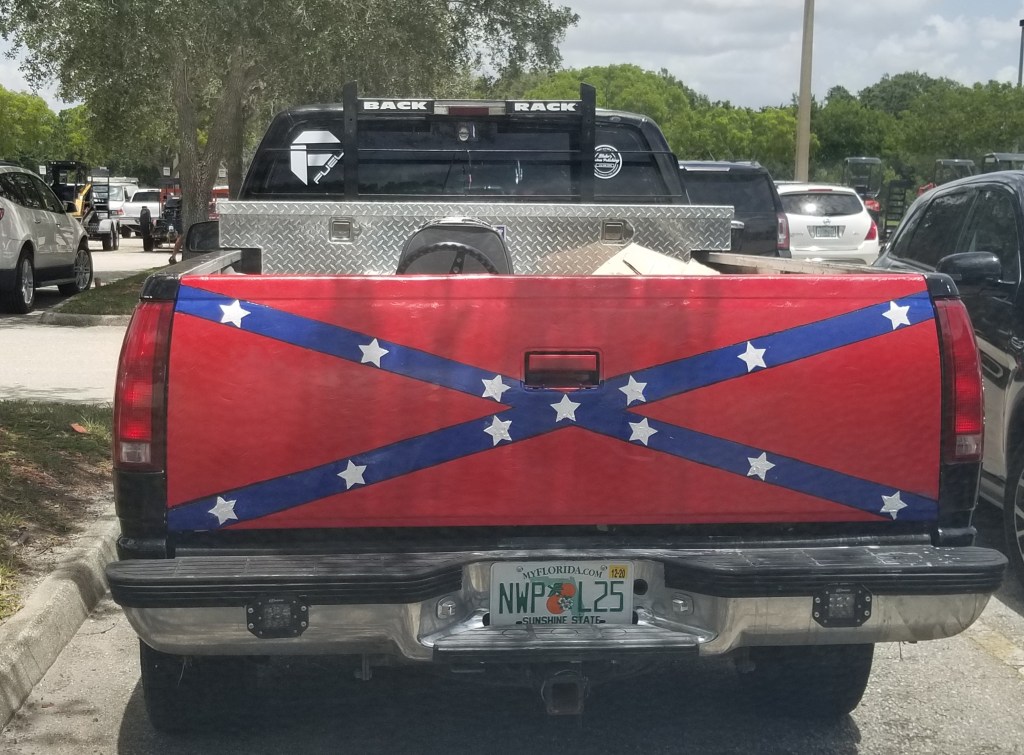
Anger takes various irrational forms. I live in a working-class neighborhood in Lee County. Here the roads and strip mall lots are dominated by pickup trucks. Some are shiny, though rarely new. Others are battered, rusted, their beds littered with McDonald’s packaging, crushed cans, tools, everything pushed to a corner and held in place by a tire. Virtually all bear insignia—the flag, the Christian fish, Trump/Pence 2020, the badge of some branch of the armed services, an AK47 decal, if not a fully stocked gun rack mounted inside across the rear window. Subtlety having taken a back seat to bold statement in recent months, Confederate symbols, also common, have graduated from four-by-six-inch decals to four-by-six-foot flags, snapping crisply in the wind.


Grief in Florida: Doctors Without Borders sent a triage unit to Immokalee to treat migrant farm workers and track the viral spread. This was not widely publicized. The governor, like the president, blames the workers for spiking infections. In the great state of denial, blissful ignorance turned to anger.


This is still an agricultural region. Tomatoes are a prime commodity, with other warm-weather crops. Harvesting depends on migrant workers, the majority of them Mexican. Despite their intimate connection to Ag profit and the state’s economy, DeSantis publicly echoes Trump in blaming farm workers for Florida’s spiking infections.

Most of the estimated 150,000 to 200,000 migrants converge in or near Immokalee, in neighboring Collier County, surrounded by cypress swamps. They live in tight quarters, often in complex multigenerational families, and ride to work in groups. Hand sanitizer and masks were not made available to them. Maligned as “illegals,” they were denied testing and treatment. It is no wonder the virus spiked here. More surprising is that Doctors Without Borders (MSF) sent a triage unit to Immokalee to help treat patients and track the viral spread. This was not widely publicized. I learned of it while inquiring about volunteer opportunities. Had I volunteered with MSF, I would likely have been recruited to accompany the triage unit on to the Democratic Republic of Congo to assist with ongoing Ebola outbreaks. If I were 20 years younger, I’d have gone.

Out of economic and psychological necessity, I took a job with one of the Big Box Essential Businesses, but I am a naturalist at heart, most content when immersed in a wild setting, captivated by most anything that crosses my path. I love snakes, even the venomous species, among the most highly evolved of all reptiles. However, most people react to snakes with a compulsion to kill. Case in point, my co-worker, Joe Z., ordinarily humble, helpful, affable beyond measure. Joe and I were talking casually about local wildlife when he declared that he will drive his truck onto the sidewalk if necessary to kill any snake he sees.

I tried reasoning, most snakes are benign unless provoked…, but a sentence scarcely passed my lips when his face contorted and he flew into a rant. “They” are… “snakes! They are evil.” Something about Adam and Eve, and how “we” lost everything. “Remember the apple, she got it from the snake!” Faced with his conviction, all I could manage to say was, “Oh, Joe, I used to like you.” To which he laughed agreeably, because he thought I was joking.

It struck me later that Joe is deeply mad. Spiritually, he feels he has been robbed. He blames snakes and seeks retribution through their wanton execution, but the enemy could be anything: face masks, BLM, Democrats, Republicans, Confederate flags, libtards, Muslims, migrants, vote by mail. Everywhere across the country, fear and uncertainty opens a Pandora’s box of festering vitriol, with causes both real and imagined, crossing all communities, in all directions, and becoming amplified as we approach November’s elections.

Anger having failed to resolve grief, elections—our flawed collective bargaining session where winner takes all—is unlikely to, either.

Bargaining of this sort is more likely to prime the losing side to retaliate. At work, I have overheard several break-room conversations about how many guns and what types people have, and where they buy ammunition—prices skyrocket weekly—specifically in preparation for the election. I told a co-worker that I don’t own a gun. Shocked, he later texted me an ad for a $359 Smith & Wesson .38: “Good deal!” The text wasn’t as unsettling as his apparent certainty that armed resistance is imminent. How can we bargain for fairness in a democratic process when civility is off the table, each side bludgeoning the other with demands and threats? It is depressing to think about.

Depression is something most of us know in this grief-struck time. My neighbor burst into tears the other day, standing 10 feet from me, both of us masked. “I can’t take it anymore,” she kept saying, before disappearing behind her door. Who isn’t depressed about a total disruption of life, many unemployed, facing economic ruin, others shut off from ailing relatives and friends? We have become a housebound, home-shopping, home-schooling, Door-Dashing, day-drinking society, castaways from the past, without a clear plan for the future.

Acceptance is the final stage of grief. But is it in this case? Especially when there is a constant flux of people experiencing different stages in different ways, with varying frequencies. When the mere idea of having to accept this as “the new normal” sets the cycle anew.

It is no longer a cycle but a perpetual state of social grief.

As a counter to its weight, I retreat to the natural wild, a world I understand, where the laws are fixed, cyclical, seeking balance. Through the eye of nature, I look for renewal, for calm, and hope to be spared from another hurricane. Speaking of denial…

Gregg DeChirico is a specialist in exotic plants. He is a member of Kopkind’s board of directors, a longtime dear friend, who once lived at Tree Frog Farm.

Scenes From a Pandemic is a Kopkind/Nation magazine collaboration. This piece originally appeared on August 12, 2020 on The Nation‘s website. We thank Katrina vanden Heuvel, D.D. Guttenplan and The Nation crew.

Bonus: A Photo From a Teacher

(photo: Aaron Talley)

Back to school? Aaron Talley, who participated in Kopkind’s political camp in 2015, sent this photograph of his old middle-school classroom in Chicago. In the next installment of the Kopkind/Nation pandemic series, he will have a dispatch from the limbo state of remote learning. Watch for it! August 19 on thenation.com. August 24 here, plus a very special bonus.


Scenes From a Pandemic: 19

10 08 2020

by Judith Levine

A continuing series of dispatches from Kopkind participants, advisers, guests and friends on life in coronavirus time as they observe it.

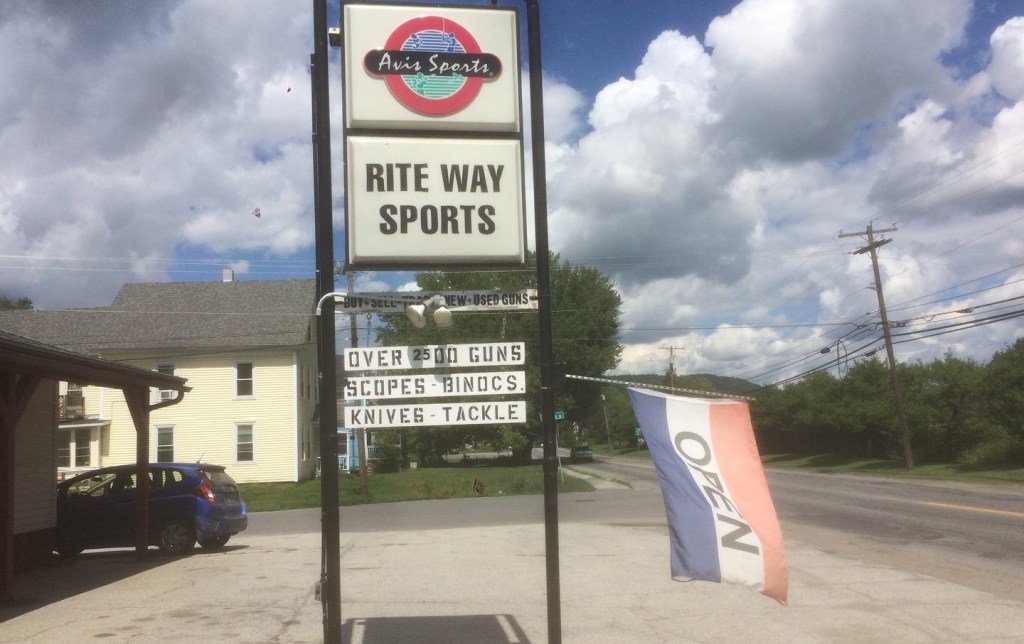
Unconstrained by mask requirements, customers may pick up a handgun or a case of Covid-19. (photo: Judith Levine)

‘History Makes Us, Not Age’

Hardwick, Vermont

Like a lot of people my age—pushing 68—I don’t usually feel old. Now it turns out I am. Among the ways my body is aging is its decreased production of “fresh naïve T cells” (or, probably, fresh naive anything). This makes me more susceptible to contracting Covid-19, and if I do, to dying.

This fact sensitizes me to the uneven, and politicized, state of mask wearing in my town. In the food co-op, the scoops for bulk foods—grains, granola, nuts—are used once and collected in a box. No such precautions at Rite Way Sports, where customers are free to pick up a container of night crawlers, a Beretta M9 semiautomatic handgun, or a case of Covid-19.

To many around here, the virus is an abstraction. Caledonia County, among the most rural in the state, has had 26 cases—less than one in 100,000—and no deaths. In all of Vermont, just over 1,450 people have sickened and 58 died. As elsewhere, the dying are old. Only four have been under 60.

Sidelined by rural isolation and elderly caution, I watch videos of the Black Lives Matter uprisings and police brutality and federal military invasions and feel my emotions swinging between radical hope and apocalyptic terror. Hope inspired by the diversity and militancy of the protesters; terror, by the flash-bangs and teargas and an awareness of the future these young folks face. I note they almost all wear masks, acknowledgement of their outsize vulnerability as black and brown people, but also, to my eyes, of concern for their elders. Tenderness overwhelms me.

Then I switch to videos of maskless twentysomethings crowding beaches and bars, and I seethe. The phrase Kids these days springs uninvited to mind.


We rarely list age among intersectional oppressions. But deep in the genocidal US pandemic, there it is. Age is a defining feature of Covid fatalities in prisons and jails. Senior workers are being slammed as hard as the youngest cohort in the economic shutdown. Age discrimination means most elders won’t work again. “People who are middle-class workers now will be poor or near-poor retirees for the rest of their lives.”


Such mixed feelings are not rare among my contemporaries; the rigidly disapproving oldster is a caricature. Yet how easily we can be caricatured. Here is the usually nuanced political analyst, labor and health care historian Gabriel Winant, in “Coronavirus and Chronopolitics,” in n+1:

There is a great contradiction embodied in the facts that the virus is fundamentally a threat to the old; that this threat has been magnified enormously by the incompetence and malice of the ruling regime; and that the old are the primary mass political constituency of that regime. The coincidence in time of the outbreak of coronavirus in the United States and the crushing of Bernie Sanders’s bid to democratize our health system and face the related crisis of climate change—a defeat inflicted through extreme generational polarization—intensifies this contradiction further. The young are trying to save the old, as well as themselves; the old are trying to kill the young, as well as themselves.

Emphasis mine, as in, WTF, Gabe?

Winant quotes sociologist Gøsta Esping-Andersen, coiner of chronopolitics: “As the necessity of financial cuts mounts, the need for trade-offs mounts.”

What “necessity” for cuts and trade-offs? You mean austerity?

Adds Winant: “The old have formed into battalions to mount a defense of the predatory and destructive capitalism we have known.”

What battalions? The AARP?

In fact, as older Americans drop dead from the coronavirus, the economic shutdown is slamming senior workers as hard as the youngest cohort. Age discrimination means most elders won’t work again. Drawing down savings or going into debt, “people who are middle-class workers now will be poor or near-poor retirees for the rest of their lives,” says economist Teresa Ghilareducci.

“Entitlements” don’t go far. In 2019, a third of Social Security recipients relied solely, or almost solely, on that benefit, which averaged $1,461 a month. Medicare, deducted from a person’s Social Security but increasingly privatized, costs more and covers less. Out-of-pocket bills consume, on average, 40 cents of each dollar of recipients’ income; by age 85, the portion rises to three-quarters. A 2013 analysis predicted that the ranks of the homeless old would swell by a third between 2010 and 2020. What now?

We rarely list age among intersectional oppressions. But deep in the genocidal US pandemic, there it is. Why are 48 of the top 50 Covid clusters prisons and jails? It’s not only racial health disparities and overcrowding, says the Marshall Project. Because of ever-longer sentences, inmates over 55 make up a larger share of state prison populations than those 24 and under. Chronic illnesses render them easy marks for Covid-19.


History makes us, not age.


“The young are not interested in reducing old-age benefits but rather increasing other ones,” says Winant. But who are ‘the young’? Paul Ryan, elected to Congress at 29, spent his career trying to feed the poor and the old into the jaws of Republican swamp creatures. Neil Gorsuch, corporate proxy on the Supreme Court, is a Gen-Xer.

Alicia Garza is the same age as Jared Kushner, 39. Angela Davis is two years older than Mitch McConnell. The young people crowding the beaches are not the young people being gassed in the streets.

Winant concludes with a call to solidarity: “Our survival depends upon resolving the antagonisms that have separated us and joining together against the regime of capital accumulation that has brought us to this precipice.” Yet having condemned his elders for starting the fight, he doesn’t absolve them.

Similarly, Vermont’s governor, amid paeans to protecting “our” elders, declares the state’s aging population a “crisis.” Voters are never told why an older populace—that is, increasingly, themselves—is the problem, especially given that in the coming de-pression their Social Security checks may be the one reliable source of state revenues.

I come not to praise, or plead for, my generation. But, younger comrades, don’t blame us for the policies that will bury us—or you. History makes us, not age. No generation holds greater claim to justice or greater responsibility for attaining it.

Judith Levine’s latest book, with Erica Meiners, is The Feminist and the Sex Offender: Confronting Sexual Harm, Ending State Violence (Verso). Judith was a special guest at Kopkind in 2006.

Scenes From a Pandemic is a Kopkind/Nation magazine collaboration. This piece originally appeared on August 5, 2020 on The Nation‘s website. We thank Katrina vanden Heuvel, D.D. Guttenplan and The Nation crew.

Bonus: With Love From Chicago/Cuba

From Chicago, Alex Halkin sent us another short film made with Cuban artists.

Alex and Ivette Avila, the film’s soundtrack editor (and, with Ramiro Zardoya, a central figure in the Cuban collaborative), write:

The Cuban animation series Creation Collective in Quarantine (Creación Colectiva en Cuarentena) arose, as its name suggests, amid isolation during the Covid-19 pandemic. The mostly Cuban artists who have collaborated—musicians, plastic artists, dancers, filmmakers, and children—aim to document the moods, the creativity in confinement, nightmares . . . in short, what people are feeling and experiencing in these times of pain, uncertainty, reimagining, and—why not?—hopes of change To date, the group has produced six animated shorts.

Once upon a time in Chicago/Erase una vez en Chicago starts with footage shot by Alexandra Halkin of the dysfunctional and half-empty city in quarantine. The animations fill the video with lyricism, poetry, new insights, and meanings. This is the second animated collaboration Alexandra has done with the group. The first one, Ojos/Eyes, released last April (and posted on Kopkind’s site on May 4), was about a dream Alexandra had about a four eyed dog: https://vimeo.com/406941038.

Alexandra Halkin, a US documentary filmmaker, participated in the Kopkind/Center for Independent Documentary film camp in 2014. In 2010, she founded the Americas Media Initiative (AMI), a nonprofit that produces, distributes, and screens film and video made in the Americas by community media organizations and independent filmmakers, particularly Cubans living in Cuba. Her own films have been shown at film and video festivals worldwide. For more on AMI’s Cuban film catalogue, click here.


Scenes From a Pandemic: 18

3 08 2020

by Najla Said

A continuing series of dispatches from Kopkind participants, advisers, guests and friends on life in coronavirus time as they observe it.

Mural on the apartheid wall in Occupied Palestine. (photo: Abeer Salman)

Diary of a Never-Ending Crisis

New York City

March. I remember Beirut in 2005, after a car bomb went off, trying not to go near parked cars, and stopping, hyperventilating, catching my breath, and drilling into my brain: “Keep walking, keep going; you can’t control it; you have to keep going.” I need to do this now, here.

Having spent my childhood between Beirut during two wars and NYC in the 1970s–’80s, I have learned to be prepared. I tell myself, “I fear nothing and live for human solidarity.”

Half my Pilates clients are away, some are over 70 and canceled out of fear, and the rest just don’t think it’s a good idea right now. I am officially income-less. My production of Palestine in Chicago will be pushed back at least two to three weeks as of now. I have waited 10 years for a theater to want to do my play again. Now I’m pretty sure it ain’t happening.

I’m making a pink glittery unicorn T-shirt for my niece. I have no problem staying busy. I don’t feel like I have ADHD anymore, because without the confines of other people’s structure, I can do things at my own rhythm.

My shrink says that many traumas will be reactivated during this crisis and asks me how I am doing.

“This is kind of like Beirut, but easier.”

“Oh right. Well, for you it’ll be easier, then.”

I predict the return of telephone calls. I hope no one calls me. I’m an introvert; I hate the phone.

In the store the guy behind me has a cart filled with bottled water. “You must be Lebanese,” I say.

He laughs. “How can you tell?”

“The bottled water.”

There is no need to stock up on water in New York, but that is what Lebanese people do.

I tell people that niqabs (veils over the mouth and nose) were originally worn in the desert to keep sand out of people’s faces, just as masks now are supposed to keep the virus out of our mouth and nose. I explain that Arabs invented soap and the word “quarantine.” No one cares.

There were 6,000 911 calls in the city yesterday. In Beirut, I would hear bombs and artillery fire, and then the sirens. Here it is just sirens. Which is eerie, more unsettling.


Diary of a crisis: nothing is happening; everything is happen-ing. Month after month. I am income-less. I keep busy. I fear nothing, and many things. I feel I am living in a Beckett play.


April. My birthday. My cousins organized a Zoom call for me, and people rang me on the phone. I made a cake. I sang “Miss Mary Mack” with my niece, talked to my nephew, and virtually jumped on a trampoline with my goddaughter. Expect nothing, do nothing, no pressure—perfection.

I’ve knit five scarves. I make pudding, even though I don’t eat pudding.

CNN keeps saying that other countries have more beds in ICU and better medical systems to respond to the virus: “Why? It’s a long story.”

I want to scream, “Socialized medicine! Duh!”

Easter is soon. Maybe Jesus will come back and fix this mess.

For many Americans feeling unsafe is too much. But the whole world lives this way all the time. American exceptionalism needs to die and stay dead.

Meanwhile, I am living in a Beckett play, making up things to do and say so that I exist. There is something satisfying about that.

May. George Floyd is dead.

“Mama, Mama…”

My heart shatters.

My nephew changes his Instagram profile pic to one of John Carlos with his fist in the air, and shares a photo of the George Floyd mural on the wall in Palestine. The kids are alright.


I think about the importance of breath, and breadth. I worry about all that gets left out in our politics. I seem to be out of place. I’m Palestinian and Lebanese; I’m a New Yorker. I tell myself, ‘Keep walking, keep going.’


June. Between the virus and George Floyd’s death, I think about the importance of breath.

I make connections with Palestine, explaining that the IDF trains our cops, that the move used to kill Mr. Floyd is from Krav Maga. I’ve been told that expressing Palestinian solidarity is “co-opting” the black struggle. I should be quiet.

Cornel West keeps mentioning Edward Said on TV. I’m grateful, because no one seems to know that my father’s work helped us get to this point.

I’m glad people are getting radicalized, but I worry about all that gets left out. I worry about the inability to make connections.

I wonder where I fit in this new BIPOC acronym. I just got chased down the street by a nutjob who screamed that I’m a stupid white bitch who doesn’t care about Black lives.

“I’m Palestinian!” I yell, for all the Upper West Side to hear.

“Yeah, bitch, and I’m Cherokee.”

What. The. Fuck.

I am not Black. Or Indigenous. Am I POC? I never seem to have a place here.

A nice gay boy asks if I’m OK.

Happy Pride.

July. Extroverts text and call too much; they need to call other extroverts.

Outside New York, no one wants to wear a mask. Almost everywhere else in the world, people value community. Here it’s the individual, who always seems to be complaining.

We have another family Zoom call—relatives in Beirut, New York, South Carolina, Connecticut, London, Dallas, San Francisco, Seattle—my mom’s generation, my generation, the kids.

My cousin, on his way to Beirut, stops at different ATMS to bring cash and medicine to family members. Lebanon is in free fall for other reasons, but still they test everyone on the plane before and after the flight; anyone who tests positive is sent to a hotel for two weeks. That seems like the proper way to do things.

I kind of loved lockdown at the beginning. Now some days the silence is too much and I just cry.

Nothing is happening; everything is happening.

I am invisible. I am exhausted.

“You must go on. I can’t go on. I’ll go on.”

Najla Said is an actor and playwright, and the author of Looking for Palestine: Growing Up Confused in an Arab-American Family (Riverhead Books). In 2010, Kopkind presented a staged reading of her one-woman play, Palestine.

Scenes From a Pandemic is a Kopkind/Nation magazine collaboration. This piece originally appeared on July 29, 2020, on The Nation‘s website. We thank Katrina vanden Heuvel, D.D. Guttenplan and The Nation crew.

Bonus: A Song by and for Nurses

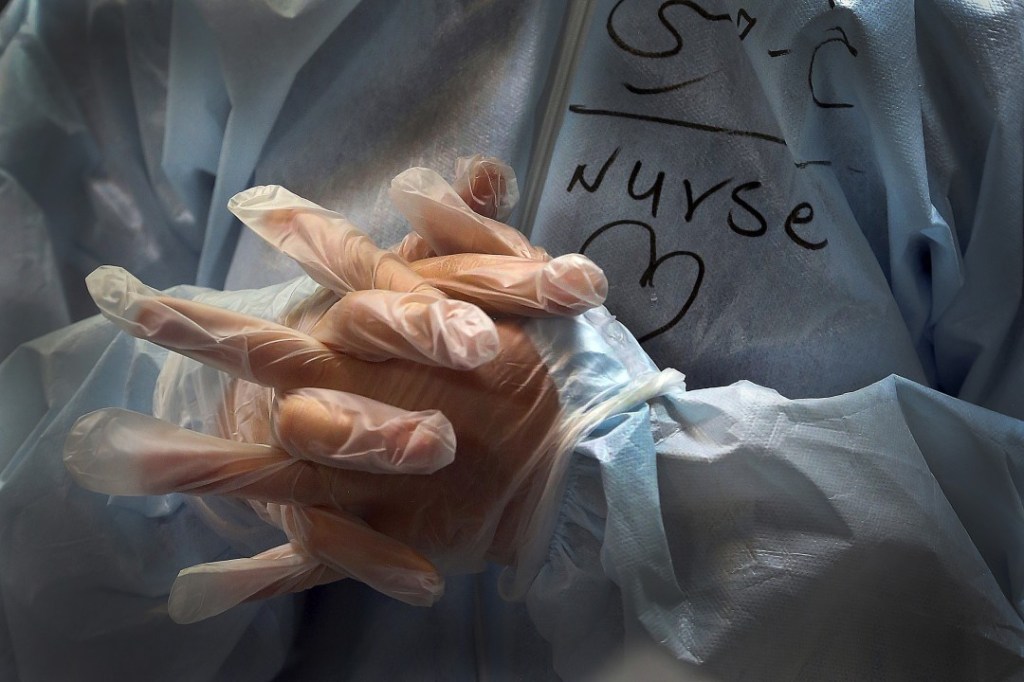
A nurse on a Covid ward in Teheran. (photo: Mohammad Ghadamali/AP Photo)

In New York the 7 pm clapping for nurses and other health care workers stopped months ago. It was always more a ritual for the benefit of those in lock-down; it told us we weren’t alone. Nursing has become symbolic, but let’s honor the work. The WHO, the International Council of Nurses (INC), and Nursing Now recently reported that worldwide there is a shortage of six million nurses–especially affecting the Global South–and deep income disparities. The INC has made a music video in recognition of the work and the people everywhere who do it. In Kopkind’s immediate family, one of those people is Dave Hall, our longtime operations manager and cook, John Scagliotti’s partner, our brother, and a psychiatric nurse in Vermont. For Dave and all nurses of the world: “I Am a Nurse.”


Scenes From a Pandemic: 17

27 07 2020

by Maria Espinoza

A continuing series of dispatches from Kopkind participants, advisers, guests and friends on life in coronavirus time as they observe it.

(photo: Maria Espinoza)

You’re a Doc, You’ve Got This, But Your Face Shield is Fogging Up

Cuernavaca, Morelos

They say that a person can get used to anything, except not eating. I guess that’s true. After five months of exercising extreme caution as a doctor, it all seems comfortable and easy now compared with those distant days of late February, when the pandemic had just begun to dawn on us all.

Back then, I was getting ready to go to the Mexico City airport to travel to the annual meeting of a group of sexual and reproductive health specialists when a rumor was spreading online that the first case of Covid-19 had been documented in Mexico. It swiftly became clear that the rumor was fact. A colleague, who coordinates training for our loose and vulnerable national network of abortion providers, reported that her husband, an internist at one of Mexico’s most exclusive private hospitals, was treating that first Covid case.

Some of us had surgical masks with us. In the airport, virtually no one used them. Nor do most people use them today, even as the curve of contagion and death bends continually upward.

Our group was divided at first on the seriousness of the threat. In the leftist circles within which I move, most people believed it was a false flag to control Mexico’s poorest and most vulnerable classes. Soon, though, I would see patients in my own clinic in Morelos with respiratory symptoms who would die before they were tested. In New York City, people I know and love would be hospitalized. It was clear that a national emergency was on the horizon, and that, like health workers throughout the world, I would be on the front lines.

With little and conflicting information on how to operate during a fast-arriving crisis, we were all confused. Some colleagues told us to dress like astronauts, basically to armor up, when seeing patients. This would prove difficult when even N95 face masks were sold out or resold online for ridiculous prices. I made do with face masks from the local hardware store, the kind that house painters use.

I was afraid to see my patients, and yet I felt more committed than ever, given the other never-ending health emergency for women who wish to end their pregnancies in a state where it is prohibited. As Covid took hold, my patients also were afraid. When they came to appointments, they brought what protective gear they could, simple face masks or cloth bandanas. We spaced out appointments. My assistants and I used what safeguards we had at our disposal: boots, a double layer of gloves, hairnets, and surgical gowns, along with face shields we purchased from the same guy who sells pirated DVDs in the pueblo.


I used face masks from the local hardware store. My face shield came from the same guy who sells pirated DVDs. I struggled to see what I was doing as my breath fogged up the plastic shield. Anxiety took hold as the risk of making a mistake increased. And yet, everything turned out fine, every time. I kept waiting for my luck to run out.


The medical procedures continued, as they had to, even as my breath fogged up my plastic face shield, and I struggled to see what I was doing. The risk of making a mistake increased, even when conducting this simple outpatient procedure. Anxiety took hold, and I had to fight the impulse to tear off my uncomfortable and unwieldy gear. The goggles cut so deeply into my face that I sometimes started seeing double. I controlled my fear with deep breathing exercises, which served only to fog up my face shield more.

And yet, everything turned out fine, every time. I kept waiting for my luck to run out. That, or an end to the pandemic. None of this seemed humanly possible, and the working conditions I and the other providers in our network imposed on ourselves seemed similarly inhuman.

Combing my hair became a luxury, so I shaved my head. I began to dress in an improvised version of that space suit others had recommended. The time I had used to take care of my hair was now used to suit up.

Today, the challenge for my risky line of work is getting some of my patients used to telemedicine when possible. While many of my younger patients couldn’t be happier at the chance to treat their problems without leaving their room, others don’t trust it, especially older women who are used to making eye contact, judging me, and feeling my presence.

Yet telemedicine is a necessity now. The script I use to start my calls has become second nature: “My name is Maria Espinoza. Everything we discuss will be absolutely confidential. Everything I ask you is with the aim of getting enough information to make a diagnosis that helps me provide you with the best treatment possible. The main objective of this consultation is to allow you to exercise your rights as a woman. That’s why you should feel free to interrupt me whenever you feel the need to, and so that you can participate actively in this process. I’m here to listen to you, and you have my complete attention.”

I had always started patient conversations this way, but when the phone is our only link, it has become the key to getting close to the lives of the women I treat, gently.

This crisis within a crisis has taught me that responding to change with agility makes us stronger. Looking for solutions is what I have always done. It’s what we’ve always done, as women, as doctors, mothers, neighbors, daughters, sisters, and partners. The pandemic brought paralysis to my work at the beginning, but it didn’t last long. Women began to knock at my door, as they always have, and always will. I had to respond. Fear, commitment, responsibility, propelled me forward. But above all, the will to live and help other women live.

It is with this will, emanating from every solid beat of my joyful heart, that I hope that solidarity continues to fortify us, so that the many-colored hands of the earth can build a better future, in spite of the virus. To do it, we just have to look below and toward the left. That’s where our heart is, and I’m grateful to it.

Maria Espinoza (pseudonym) is a Mexican physician specializing in women’s sexual and reproductive health in a state where abortion is prohibited with some exceptions. For more than 20 years she has helped women assert their rights to make decisions regarding the “autonomous territory” of their bodies. Under her own name, she was a mentor at Kopkind in 2011.

Scenes From a Pandemic is a Kopkind/Nation magazine collaboration. This piece originally appeared on July 22, 2020, on The Nation‘s website. We thank Katrina vanden Heuvel, D.D. Guttenplan and The Nation crew.

Bonus: A Poem for the Dead, & the Living

Alexander Cockburn, with his dog, Jasper (photo: Tao Ruspoli)

Eight years ago, just hours before members of the Occupy movement arrived at Tree Frog Farm for a special camp beginning July 21, 2012, our beloved friend Alexander Cockburn died. A brilliant journalist, cook, fancy man, Alex had once spent summers at the farm. With Andy Kopkind, his oldest friend in the US, John Scagliotti and others, he was part of the vivid, gamesome world that inspired so many of us who were young with the joy of politics, the joy of writing and doing—of living at an angle to the settled universe. One night during that camp, with torches blazing and flowers gathered from the garden and the field, people from the area came to tell and hear stories of their friend. At the end, one of the campers, Amin Husain, who’d been deeply involved in Occupy Wall Street, offered a poem by Nazim Hikmet. Called “On Living,” it goes, in part, like this:

Living is no laughing matter:

            you must live with great seriousness

                        like a squirrel, for example—

I mean, without looking for something beyond and above living,

                        I mean living must be your whole occupation.

. . .

I mean you must take living so seriously

            that even at seventy, for example, you’ll plant olive trees—

            and not for your children, either,

            but because although you fear death you don’t believe it,

            because living, I mean, weighs heavier.

II

Let’s say we’re seriously ill, need surgery—

which is to say we might not get up

                                    from the white table.

Even though it’s impossible not to feel sad

                                    about going a little too soon,

we’ll still laugh at the jokes being told,

we’ll look out the window to see if it’s raining,

or still wait anxiously

            for the latest newscast . . .

Let’s say we’re at the front—

            for something worth fighting for, say.

There, in the first offensive, on that very day,

            we might fall on our face, dead.

We’ll know this with a curious anger,

            but we’ll still worry ourselves to death

            about the outcome of the war, which could last years.

Let’s say we’re in prison

and close to fifty,

and we have eighteen more years, say,

                                    before the iron doors will open.

We’ll still live with the outside,

with its people and animals, struggle and wind—

                                    I mean with the outside beyond the walls.

I mean, however and wherever we are,

            we must live as if we will never die.

This excerpt of “On Living” is from Poems of Nazim Hikmet (Persea), translated by Randy Blasing and Mutlu Konuk. Hikmet, born in 1902 in what was then the Ottoman Empire, was in a Turkish prison in 1948 when he wrote these lines. Turkish sailors had been reading and discussing his poems, and for that he, a well-known radical, was charged with inciting revolt in the armed forces, and sentenced to 28 years in 1938. Following a hunger strike and a national campaign, he was released in 1950. His work was banned in Turkey from 1938 to 1965. He died in Moscow in 1963. “Read and write without rest,” he advised those who will spend time in prison: weave, make mirrors, anything so that “the jewel on the left side of your chest doesn’t lose its luster.”


Scenes From a Pandemic: 16

19 07 2020

by Renee Bracey Sherman

A continuing series of dispatches from Kopkind participants, advisers, guests and friends on life in coronavirus time as they observe it.

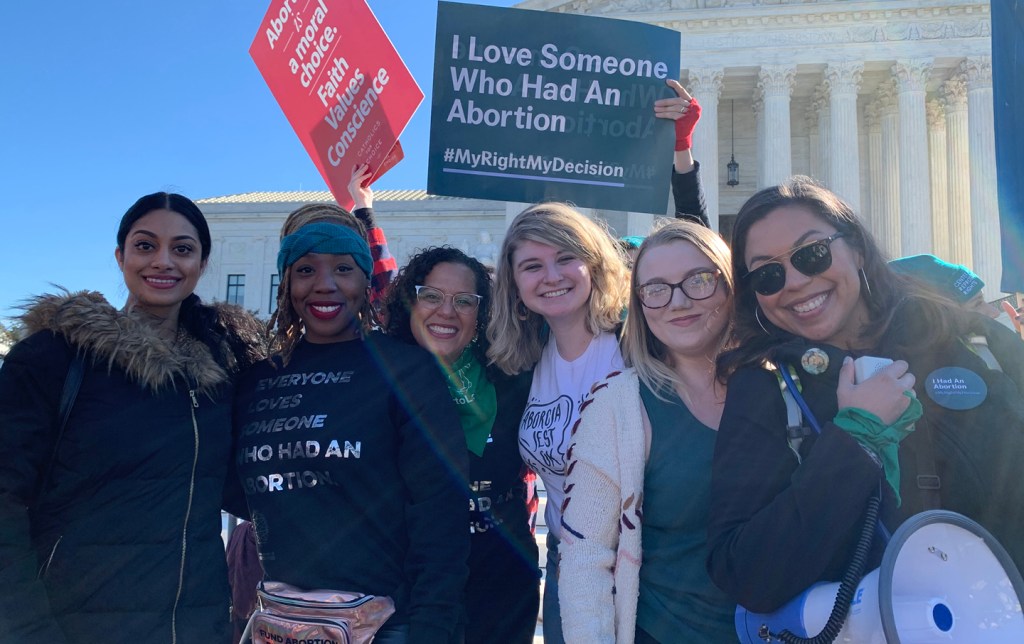
We Testify abortion storytellers rally at Supreme Court for June Medical Services v. Russo oral arguments, March 2020.  (photo: We Testify)

What Kind of Nation Prosecutes People for Health Care?

Washington, D.C.

Last November, I drove more than 12 hours for an abortion. It wasn’t mine (I had mine in 2005); I picked up a young woman in rural Pennsylvania whom I’ll call Raquel. She needed a ride to a clinic in Maryland to get some pills that she would take back at her home to have a medication abortion. As we drove to the clinic, I told Raquel about what to expect during the appointment; after I finished I paused and said, “As much as I love getting to know you on this drive, did you know you could safely do this at home but the government won’t let you?” She was surprised. Like many people, she knew about limitations on abortion but didn’t know that very safe and basic methods are being restricted because of outdated FDA regulations on how they can be dispensed. The drive bonded us—we still keep in touch, and she approved the inclusion of her story here—but it was an unnecessary exercise, one that antiabortion politicians created to make yet another constitutional right as inaccessible as possible. The cruelty of the barricades along the journey is the point.

Since Covid-19 hit, I’ve thought a lot about that drive with Raquel, particularly as people have reached out needing abortions. States have limited travel, issued stay-at-home orders, and required people to quarantine for at least two weeks. While several states declared abortion an essential service, others exploited the pandemic to shutter clinics. The future we have worried about was upon us in an instant. Patients had appointments canceled. Those who could afford it, or who knew about abortion funds, were able to travel to other states for care. The moment was both unprecedented and familiar. The uselessness of our nation’s health care system was showing, and became even more burdensome on abortion patients.

In a just society, Raquel (or anyone wanting an abortion but anxious about contracting Covid-19) could have ordered the necessary pills via telemedicine, online, or at a pharmacy, and completed the abortion at home. That’s the way many people around the world do abortion, because it’s incredibly safe and simple. That’s how Americans once did it. Concoctions were advertised in newspapers and shipped through the mail, or herbs such as pennyroyal and black cohosh root were made into teas. But since the late 1800s, abortion has been deeply criminalized, and if Raquel had ordered the pills online, she and the person who sent them would have risked prosecution and jail.


Covid-19 has brought a taste of what life would be like if abortions were illegal, but then it always has been, in some form… What kind of nation allows people to be prosecuted for health care?


Recently, Polish abortion activists reminded me that all of our laws governing abortion actually promote criminalization. (To be sure, those are different from medical practice regulations that ensure procedures are performed correctly.) Rules dictate how, when, where, and why someone can have an abortion, and mandate a series of physical and legal barriers one must cross. Wait too long because you can’t afford the procedure? You can be criminalized. Take pills at home with a parent because you couldn’t afford a procedure? You both can be criminalized. Have a miscarriage, but a doctor thinks you self-managed an abortion? You can be criminalized. It doesn’t matter whether the rules are medically necessary or just, and of course, enforcement and punishment are significantly more severe with overpoliced communities of color and those who live in poverty.

What kind of nation allows people to be prosecuted for health care?

On July 13, just as this article was nearing publication, a federal judge issued an injunction on in-person requirements for dispensing pills necessary for a medication abortion, saying they create a “substantial obstacle” for patients, and may be an unconstitutional undue burden during a pandemic. The ruling allows providers to mail or deliver the pills to patients—an important step, however temporary, in juris-prudence and in people’s lives.

But this moment has radicalized me. I’ve never supported restrictions—I’ve ex-perienced the panic they create when I was unsure if I could afford an abortion—but I’ve realized that it’s time for us to push for decriminalization of abortion and the abolition of all abortion restrictions. There is no medical necessity for any of these laws restricting abortion. They just create a tightrope for people to fall from and then invite the police into the experience.

As Black Lives Matter protests have swept our country, we are having a national dialogue about the spaces and places police hang around to control black and brown people—schools, hospitals, grocery stores, coffee shops, and our homes. Police are heavily involved in our inability to exercise reproductive freedom; they brutalize us while pregnant; spray us with tear gas, which can affect our fertility; arrest people who choose to terminate a pregnancy outside of the narrow confines of the law; shoot our children; and shackle us during labor. We deserve police-free pregnancies. This is why the fight for reproductive justice is critical. It addresses systemic issues that have long prevented families of color from thriving on our own terms. It’s worth recalling that antiabortion white supremacists pivoted from rallying for school segregation to protesting abortion; they want to control our futures.

If we are serious about protecting abortion access, we have to become serious about the fight to abolish abortion laws. Our ancestors worked hard to ensure we had access to abortion to space our pregnancies, save our lives, and free us from the rape and violence of chattel slavery. It is in their tradition that we must continue to make abortion free and available, whenever and wherever someone needs it.

Covid-19 brought a taste of what life would be like if abortion were illegal again, but it always has been in some form through the criminalization of black and brown bodies. I hope that more people will realize that to have reproductive justice, we have to take extreme efforts to decriminalize our health care, defund the police, and create communities that love people who have abortions, unapologetically.

Renee Bracey Sherman is a reproductive justice activist, abortion storyteller, strategist, and writer. She is the founder and executive director of We Testify, an organization dedicated to the leadership and representation of people who have abortions and share their stories at the intersection of race, class, and gender identity. She is also executive producer of Ours to Tell, an award-winning documentary elevating the voices of people who’ve had abortions. She was a participant in Kopkind’s 2015 political camp.

Scenes From a Pandemic is a Kopkind/Nation magazine collaboration. This piece originally appeared on July 15, 2020, on The Nation‘s website. We thank Katrina vanden Heuvel, D.D. Guttenplan and The Nation crew.

Bonus: ‘I Know the Price of Life’, a Radio Short From Gdansk

Maria Margaronis writes from London, with another in her series of shorts about women making masks; a slightly different version of this radio piece was broadcast on Woman’s Hour, BBC Radio 4, on May 14.

Khedi Alieva (l) and her sister Amina (r) in Poland, amid the forsythia. (photo: Dorota Jaworska)

I spoke to Khedi Alieva this spring with the help of translator Joanna Dabrowska, and also to her friend, psychologist Dorota Jaworska. Khedi is a Chechen refugee in Poland. She and her sister Amina are members of Fundacja Kobiety Wedrowne, which roughly translates as Foundation for Women on the Road. Khedi and Amina were welcomed to Gdansk by Pawel Adamowicz, the city’s mayor for 20 years, who was fatally stabbed on January 13, 2019, while speaking at a charity event. Adamowicz’s support for migrant, minority and lgbt+ rights ran directly counter to the policies of Poland’s increasingly reactionary Law and Justice Party, which squeaked back to power this month on the back of a nasty campaign in which President Andrzej Duda attacked gay people, Jews, and liberals, who he says are undermining Poland’s security and traditions. 

Khedi, “making masks to slow down death.” (photo: Anna Rezulak / KFP)

But Khedi and her sisters are all about solidarity, gratitude, joy, and life. When the pandemic hit, they began sewing face masks and scrubs to protect their Polish friends, taking breaks to dance to the wild rhythms of Chechen music, a sampling of which Khedi chose for this piece. “The most important thing in life is just life.”

Maria Margaronis, a writer and radio maker, is a longtime neighbor and member of the Kopkind family. She is part of Kopkind’s honorary board. Click here to listen to her documentary about the Singer sewing machine. 


Scenes From a Pandemic: 15

14 07 2020

by Makani Themba

A continuing series of dispatches from Kopkind participants, advisers, guests and friends on life in coronavirus time as they observe it.

(photo: Gilbert Thompson)

Covid Is the Bomb

Jackson, Mississippi

Before Covid-19, I would travel around the country, listening to people’s stories as we walked their block, or plotted the “beautiful next” in some center or meeting room. Now we are all in little boxes, trying to connect, trying to make it more human. People with wild virtual backgrounds or cute hats. It reminds me of freshman year moving into the dorms. There you are with your teddy bears and your posters to make your room feel a little less like the drab, institutional rectangle it is.  

The truth is, it’s crazy hard out here for so many of us. Covid has shifted racism and inequity into hyperdrive. Shuttered hospitals and limited testing in communities hardest hit. The intentional delay in distributing “stimulus” checks to indigenous nations while slashing funds for health services. A young black woman tells me a story – from her box to mine – about how the white children in her trailer park, not far from Chicago, come by her family’s home to spit and chant, “Covid is a n***a killer!” These children were taught that our disproportionate death related to Covid is an opportunity for ethnic cleansing.

This is a season of wild contrasts. The joyful exuberance of seeing our movements on the precipice of so many significant victories. It’s beautiful. I am breathless and giddy to live to see this moment that I had every confidence would come. And I am also anxious that, as the nation is riveted by global protests to address black lives taken by police violence, we have normalized the deaths of the many others who are also victims of state violence but in a different form.  


Police shootings are a gun to the head of Black America. Covid is the bomb. As cities like Jackson are left to fend for ourselves, Covid is also revealing how “we keep us safe”.


Police shootings are literally a gun to the head of Black America, while the government’s use of the pandemic to facilitate black and indigenous death is a full-on carpet bombing. And although they don’t exhibit the glee of those children in the trailer park, much of government appears to be on the same team.

I’ve watched testimony in city councils around the country against local ordinances to require protective masks in public. I’m struck by how often progressive frames are appropriated for conservative use: phrases like “crime against humanity” or “human rights violation,” along with the old tropes opposing public health protection as a matter of “freedom.” 

On May 19, the birthday of Malcolm X ironically, Mississippi Governor Tate Reeves gave churches explicit permission to reopen. They were never officially closed in Mississippi, but this bit of grandstanding was part of the governor’s pandering to support Trump in solidifying his right-wing faith base. The governor insisted on lifting restrictions for businesses, too. There were 535 new Covid cases and 42 deaths that day. On June 22 there were 1,646 new cases and 40 deaths. Progressive mayors had instituted public protection rules in an attempt to “flatten the curve,” but as Jackson Mayor Chokwe Antar Lumumba said in a recent interview about the “reopening” of the state: “It was clear that we [Jackson] are becoming an island. And if you’re on an island, it’s hard not to get wet.” On June 30, with new cases spiking, the mayor announced that wearing face masks would be mandatory in the city.

Covid is revealing all of the cracks and fissures in our systems – of care, of connection, in our economy.  As cities like Jackson are left to fend for ourselves, Covid is also revealing how “we keep us safe.”  

In my South Jackson neighborhood, masked volunteers sweat under the Mississippi sun as they hand out food and toilet paper. Many of the folk in line brave the heat hoping to be among the lucky ones to get a mobile Covid test before kits run out. The volunteers are friends and neighbors who have stepped up as part of the Jackson Covid Response. It’s a local coalition that includes Jackson State and Tougaloo College students; organizing groups like Poor People’s Campaign, Mississippi One Voice, People’s Advocacy Institute, Mississippi Immigrant Coalition, Democratic Socialists of America, and Black Youth Project 100; neighborhood groups and businesses like Operation Good, Strong Arms of Jackson, MOVE Church, and Bad Boy Tree Services; social service projects like Clean Slate Behavioral Health Collective; and multimedia outlets like the local branch of Black With No Chaser, which has a popular podcast in the community. This coalition is one of the hundreds of mutual aid networks springing up across the country to fill the gaps that the state refuses to address.   

The work is hard but it’s also adaptive, innovative, and generous. There’s deep grief in the face of rising Covid-related death as young and old die needlessly in prisons and detention centers. There is also vision as organizers move progressive District Attorneys to release “nonviolent offenders” by the thousands. In Jackson, Mayor Lumumba enacted an agreement to end arrests for misdemeanors and nonviolent offenses that activists believe will keep hundreds out of jail. Yet, hundreds more languish in detention centers and jails throughout the state. Activist Rukia Lumumba told me about a man bailed out by the Mississippi Bail Out Collective. He had spent two months in a DeSoto jail because he didn’t have $150. Thanks to the collective’s efforts, he is out now.

These are a just a few examples of the silo-busting work on the ground that makes the connections between culture, policing, health, immigration rights, and so much more. It’s a politic for our whole lives.

This work, these victories, are sunbursts in the midst of storms. We breathe. We listen. We plot. We dream. And we remember that it takes both the sunburst and the storm to make rainbows.

Makani Themba is an organizer, writer and strategist based in Jackson. Currently she serves as chief strategist at Higher Ground Change Strategies. Makani is a long-time adviser to Kopkind and was a mentor in our first camp, in 1999, and then again in 2017.

Scenes From a Pandemic is a Kopkind/Nation magazine collaboration. This piece originally appeared on July 8, 2020, on The Nation‘s website. We thank Katrina vanden Heuvel, D.D. Guttenplan and The Nation crew.

Bonus: Moonlight in Vermont

On Lake Champlain (photo: Jon Flanders)

Jon Flanders, a steadfast supporter of Kopkind, sent us this picture from the northern reaches of Vermont, where he’s visiting family. Since the beginning of the pandemic, Jon has been sending messages about the importance of Vitamin D, the latest good news from Cuba, the latest hair-raiser from New York, the latest protest in Troy, where he lives, the latest bulletin on global solidarity (here a wonderful talk by our friend Vijay Prashad on Che and a socialism of love), an upcoming concert for Cuba and so on. Jon is a retired railroad worker, an internationalist, an organizer of political events (here a recent discussion of labor history with JoAnn Wypijewski and others around Mike Stout’s new book about Homestead Steel, via a Zoom variant of the Connolly Forum), a photographer.

In any other July, we would be in the midst of a Kopkind camp right about now, at Tree Frog Farm in Southern Vermont. Jon’s moonlight photograph is from the opposite end of the state. It bears a message that also imbues Kopkind’s project: there is still beauty in this world; soak it in.