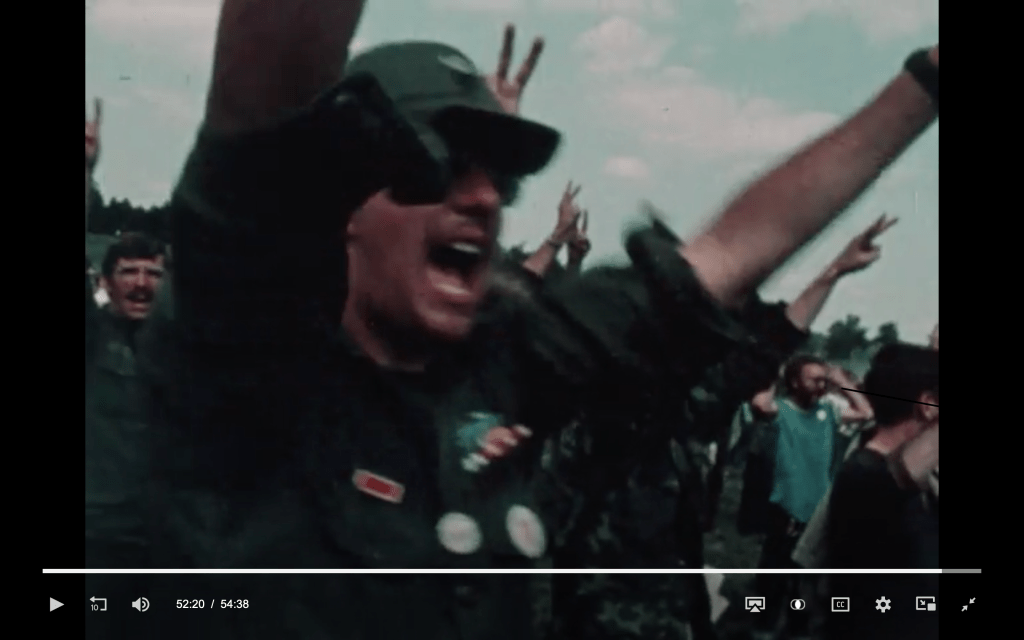
On April 30 the people of Vietnam celebrated fifty years of independence from foreign domination. Reunification Day, they call it — also known as victory in the American War, as it is known in Vietnam, and defeat for the US in what we call the Vietnam War. These days in May the Pentagon is honoring Vietnam veterans, everyone who served between November 1, 1955, and May 15, 1975. Those commemorations edit out the soldiers who played a critical role in the antiwar movement. The soldiers who published underground antiwar papers on hundreds of bases, who manned GI coffeehouses, who engaged in direct action in the US and in Vietnam, who became mutineers, who founded Vietnam Veterans Against the War, and whose protests are powerfully documented in David Zeiger’s film Sir! No Sir! (which Kopkind screened publicly before its general release in 2005).
We remember those men and women here, whose valiant refusal is captured in one three-and-a-half-day action documented in Jack Ofield and Bowling Green Films’ 1971 short Different Sons. It is a moving document, available to the public from the Internet Archive and here by clicking the image above. Seventy-five combat veterans began a ninety-mile march from Morristown, New Jersey, on September 4, 1970. En route to Valley Forge, Pennsylvania, they took secondary roads, walking single file, wearing fatigues and carrying plastic M-16s, stopping for the night on Quaker-owned property, eating C rations or the equivalent. Along the way, they simulated their jobs in Vietnam, brutalizing or killing civilians. They didn’t expect to win converts, one of their leaders told the filmmakers; they hoped to provoke their fellow citizens to think differently, or begin to. The soldiers’ civilian-volunteers could never register the terror of the real thing, but outside post offices in tiny towns not known for antiwar sentiment, the re-enactments must have been shocking. Some bystanders mocked the vets for their long hair and moustaches; one stated they were working on orders from Satan. In the end, the vets, their number steadily enlarged and forming wide rows across the Valley Forge battlefield, chanted, “Peace Now!” ever louder, and broke their plastic rifles over their knees. This was a unique public demonstration, but opposition to the war was not a fringe opinion among troops. By 1971, one colonel remarked, it had “infested the entire armed services”.
The adamant memory of Vietnam goes a way to illuminating this country’s current crises. The story of the war and the Sixties culture of opposition that it stoked have been in the gunsights of the right from that time to today, as witness the machinations of the current regime’s braintrust and hangers on. Within a few years of the defeat in Vietnam, war fantasies were revived in Washington, and with them cold war liberalism as well as an emboldened right. Within a decade, an academic/political project to rewrite the history of the war in line with the views of those mocking bystanders — and, more important, the arms makers, war profiteers and their political satraps — had been established. The backlash that powered Ronald Reagan’s Make America Great had many helpers, including the corporate press and some precincts of the notionally left, reflected in a 1982 New York Times Magazine essay by Irving Howe titled “The Decade That Failed”. The right never forgot, and its project to extirpate every last gain of the Sixties era is the openly stated aim of ‘anti-woke’ crusader Christopher Rufo and his ilk today. Thus, among much else, the erasure of the soldiers’ revolt in marking the end of the Vietnam War.
Fifty years ago Andy Kopkind used the title above in an article for Ramparts about the great documentary Hearts and Minds, by our friend Peter Davis. We did a public screening of that film, too, early on in the so-called War on Terror, launched in 2001. A generation of Americans has grown up now with no memory of 9/11 and its aftermath, much less of Vietnam — no memory of the lies used to justify the invasion of Iraq, the first Shock and Awe, the roundup of US citizens said to be terror symps, the US torture regime and Guantanamo, now used to imprison kidnapped immigrants. No memory of Iraq Veterans Against the War, or the soldiers destroyed by their destruction of other people. Or Reagan’s proxy wars in between; or Obama’s Tuesday meetings to pick assassination targets after. No broad context in which to place the current US terror bombing upon the people of Yemen, or the long complicity with Israel to crush the Palestinians.
“Now, you don’t want to hear about it”, Andy quotes a Vietnam veteran, William Marshall, featured in Hearts and Minds. “I’ll tell you about it every day and make you sit and puke on your dinner, you dig, because you got me over there and now you done brought me back. And you want to forget it so somebody else can go do it somewhere else. Hell no.”
History is a weapon. Andy’s “The Adamant Memory of Vietnam” is reprinted in his collected writing, The Thirty Years’ Wars: Dispatches and Diversions of a Radical Journalist, 1965-1994. His first draft of history, the book provides an indispensable, analytical backstory to our time.
 Kopkind Colony