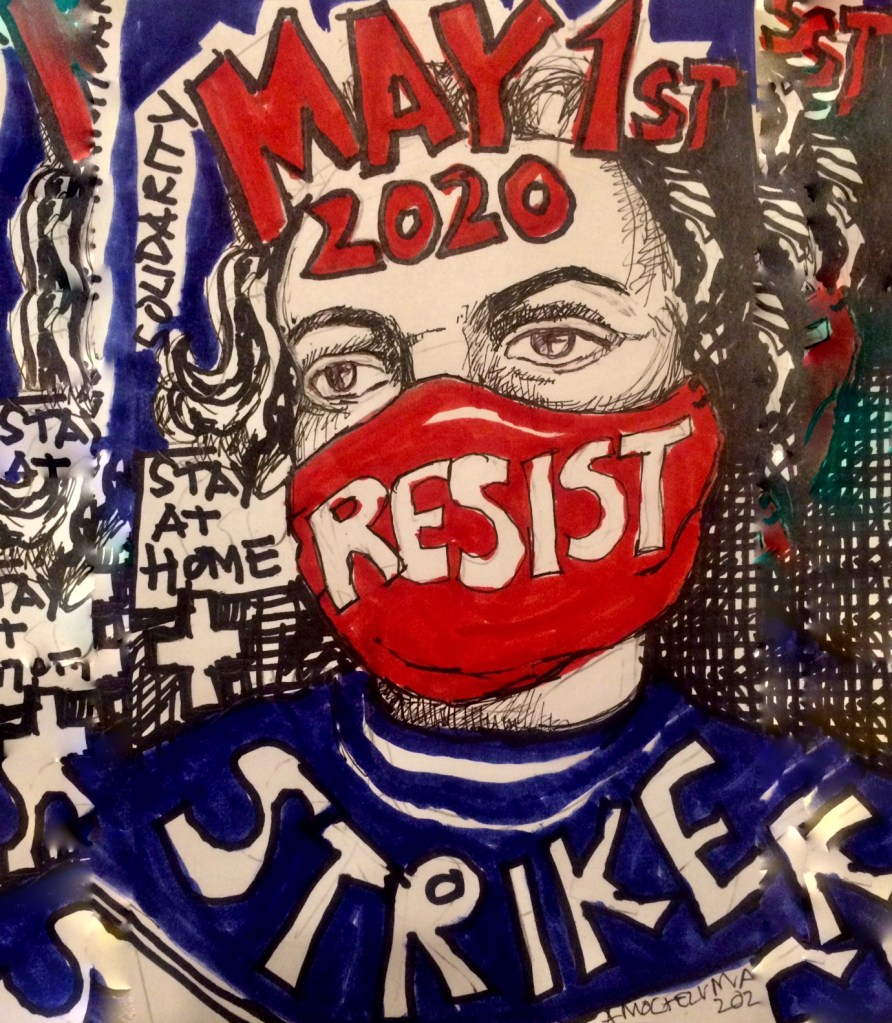
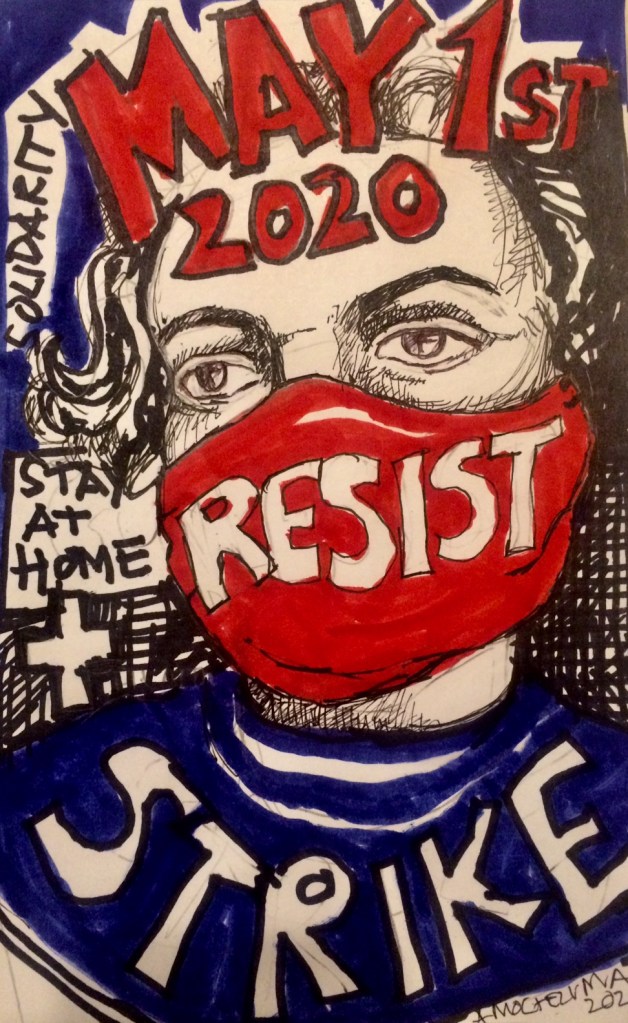
“Something is afoot,” our friends Peter Linebaugh (past Kopkind mentor) and David Roediger write today in CounterPunch. Let us “grasp the spirit of the time.” As workers continue to wildcat throughout the country and the world against systems of death and disposability, from meatpacking houses to hospitals, grocery stores to digital services, construction sites to warehouses, herewith: posters from our friend Alessandra Moctezuma in San Diego, and verse from the great Jamaican poet Claude McKay (1889-1948).
If We Must Die
If we must die—let it not be like hogs,
Hunted and penned in an inglorious spot,
While round us bark the mad and hungry dogs,
Making their mock at our accursed lot.
If we must die—oh, let us nobly die,
So that our precious blood may not be shed
In vain; then even the monsters we defy
Shall be constrained to honor us though dead!
Oh, Kinsmen! We must meet the common foe;
Though far outnumbered, let us show us brave,
And for their thousand blows deal one deathblow!
What though before us lies the open grave?
Like [wo]/men we’ll face the murderous, cowardly pack,
Pressed to the wall, dying, but fighting back!
                                                                         Claude McKay
This post continues a series of dispatches from Kopkind participants, advisers, guests and friendson life in coronavirus timeas they observe it. The series is a collaboration between Kopkind and The Nation.
Gabrielle Eitienne with mint (photo: Derrick Beasley)
‘We Were Asking Ourselves, How Can We Support Black Farmers?’
Hurdle Mills, North Carolina
Linda Leach wears a mask as much for the pollen that’s whipping through the air as coronavirus. Sticking her head out her pickup-truck window, she checks the progress in the shed on the farm she owns with husband Stanley Hughes.
Gloved and intent, Gabrielle Eitienne and Gerald Harris pull apart tangles of herbs. They sort them into piles, determining what’s what by smell and sight: cilantro, oregano, sage, mint. Soon, the scent in the Pine Knot Farms shed is an olfactory cocktail, as Hughes peels an orange and the wind picks up, blowing empty boxes off the truck bed a few steps away. Those boxes will soon each hold a dozen fresh eggs and Pine Knot’s trademark sweet potatoes, then gradually fill up with the vegetables of this in-between season: kale, mustard greens, bundles of collards, leaves as broad as fans—the bounty from five farms, ready for pick-up.
What’s happening here is a new community-supported agriculture (CSA) service, the Tall Grass Food Box, featuring the produce of black farmers around the state’s Triangle region. It was an idea among friends, who hustled to organize the CSA in about a week and a half as the coronavirus crisis hit: Eitienne, a cook and cultural preservationist; Harris, a university administrator interested in food sovereignty; and Derrick Beasley, an artist and co-founder of Black August, a showcase for black food producers, business, and creativity held annually in Durham. “We were asking ourselves, Who’s taking care of black farmers? How can we support them?” says Harris.
Leach and Hughes didn’t blink when asked to participate. Sitting in the couple’s gleaming kitchen, Hughes estimates that 50 percent of their sales comes from farmers markets, now disallowed under North Carolina’s stay-at-home order.
But Pine Knot specializes in survival. It’s a rare “century farm,” acreage bought in 1912 by Hughes’s grandfather. As Hughes puts it, “I’ve been farming as long as I’ve been black”—all of his 71 years. Pine Knot is among the best-known small farms in North Carolina, and the first black-owned one in the state to be certified organic, in 1996 — when few farmers of any race earned the designation. Hughes became one of the country’s pioneers of organic tobacco. Gourmet proclaimed his collards a national treasure in 2003, and his sweet potatoes draw competitors’ envy.
“Everybody wants to know how he cures his sweet potatoes,” says Leach with an emphatic nod, speaking of the process that makes the vegetables storable for months. “He won’t tell it to anybody—except for me.”
Pine Knot’s longevity is also unusual in a state where black land dispossession is a century-long and ongoing tale. Hurdle Mills was once dotted with African-American homesteads. Driving the verdant route there, about 30 minutes from Durham, I saw more than a few rural-gentrifying McMansions. “You can hardly find a black full-time farmer here for the next 10 miles,” says Hughes.
As we speak on a sunny day, rain has delayed spring planting by two weeks. That’s not an insurmountable problem, and workers are now “cutting the land,” prepping the fields.
Hughes epitomizes the farmer as working-class scientist. He reels off the soil sugar levels tobacco needs to thrive, the names of sweet potato varieties beyond the orange Beauregards in a supermarket near you, and the price a40-pound box of his favorite tubers is fetching (about $30). Leach handles paying the bills and other business matters. Together, they’re always looking for new revenue streams.
Eitienne is thrilled that the Tall Grass Food Box will contain Pine Knot’s Murasaki white sweet potatoes. If people talked about sweet potatoes like they talk about wine, the Murasakis would be described as having “notes of brown sugar.”
Food can comfort and connect in hard times. Eitienne shares her favorite sweet potato soup recipe: “I’ll soften up some leeks with butter, maybe some carrots. Then I put in the boiled sweet potatoes, or I’ll roast them depending on how much time I have. I’ll puree and thin it out with beef stock. And then I’ll finish it with a little good olive oil or chive oil. Maybe I’ll use wild yard chives or some fresh thyme.”
Leach shares her tip for sweet potato pie: Use the Murasakis and a packet of instant vanilla pudding to hold it together. Imparting that knowledge, she smiles at Beasley, Etienne, and Harris, lined up in front of her. “I appreciate what you’re doing,” Leach says. “I’m looking at millionaires now, and you’re going to do it with black farmers.”
The CSA sold 30-odd boxes in its inaugural week, and there’s room to expand. Beasley defines success in material and community terms, and the current crisis as an opportunity beyond accumulation: making sure black farmers are visible, paying them fair retail prices upfront, getting fresh produce to people, helping consumers think outside grocery stores, creating new markets that are friendly and beneficial to both producers and customers of color. “There’s enough for all of us,” he says.
“Oh, there’s enough for all,” agrees Leach. And shouldn’t black farmers and small businesses have a bigger share? The Lord wants us to speak success, she says. “Everybody can get a slice of the pie. The sweet potato pie.”
Cynthia Greenlee is an independent historian, writer, and editor based in Durham.She was a participant in Kopkind’s 2007 camp for political journalists and activists.This piece appeared on thenation.com on April 22, 2020. We thank Katrina vanden Heuvel, D.D. Guttenplan and all our collaborators in The Nation crew.
Bonus: A Photo From the Bay Area
San Francisco, April 24. I took a bike ride last Saturday up to Hill 88, a former Nike missile site in the Marin Headlands, just over the Golden Gate Bridge from here. It’s one of the highest and westernmost peaks in the Headlands, at the edge of the Pacific Ocean. The military installation up top, a series of stripped-out bunkers and truck-sized concrete brackets and platforms, once part of the US nuclear-capable Cold War air-defense network, is surreally abandoned. It’s been heavily tagged and painted by graffiti writers. The art is often gorgeous, and totally present tense. — Josh Wilson
(photo: Josh Wilson)
Josh Wilson is a journalist and a founding member of the Northern California Media Co-op, a collective of local, regional and advocacy news organizations from San Francisco to Mendocino, including a number of Bay Area neighborhood newspapers, as well as leading publications representing the lgbtq and black communities.Josh was a participant in Kopkind’s 2019 camp.
This post continues a series of dispatches from Kopkind participants, advisers, guests and friendson life in coronavirus timeas they observe it. The series is a collaboration between Kopkind and The Nation.
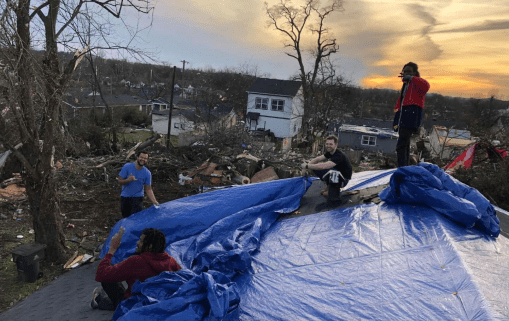
First a tornado, then Covid-19 (photo: Tristan Call)
‘Gentrification Is NOT an Essential Industry’
Nashville
It rained all day yesterday. My neighbor down the street called to ask if I’d help him move some boxes once the rain stopped; his roof caved in during the tornado that hit weeks ago, and now the tarps had failed, dumping deep piles of loose, wet insulation throughout the house. All along the half-mile-wide scar that the tornado had left through North Nashville (and then for 60 continuous miles across three counties), yesterday’s rain trickled through puddling and straining tarps, echoing on the floors of abandoned homes and soaking into the mattresses and drywall of those still occupied. The mayor has issued a “safer at home” order requiring us to stay in to prevent the catastrophic spread of coronavirus. “What home?” my neighbor grunted, as we lifted the boxes into my truck. The tornado scattered us, and the virus bottles us back in.
The night after the March 3 tornado, we mobilized, thousands of us, cutting apart the hundreds of mammoth hackberry trees whose roots had given way to the wind, crushing roofs and cars and knocking out every electric line in nine ZIP codes. We rented or borrowed every chainsaw in the county, as the tireless young people from the Sunrise Movement set up a mutual aid hub across from the corner market. Neighbors pulled out ladders and hammers to tarp one another’s roofs; the racial justice crew Gideon’s Army mobilized volunteers to provide humanitarian supplies and clear roads. The same day that the governor announced the first confirmed Covid-19 case in Middle Tennessee, city officials opened up the downtown farmers’ market and neighborhood community centers as emergency shelters for hundreds of homeless families. Over the following days we didn’t talk much about the virus except as an explanation for why we couldn’t find gloves or masks for work crews starting to gut houses.
“A friend from Brooklyn calls, concerned, knowing that I’ve been in the street for weeks. ‘The virus isn’t a tornado,’ she says; ‘your neighbors don’t carry the tornado in their lungs.’ But the tornado is still here, and the gentrifiers and the landlords aren’t taking a break.”
The tornado hit on Super Tuesday and I took a half hour out to vote for Bernie, but there was no line at the gymnasium that day. We didn’t get power back for eight days. Some homes are still without it. As temperatures dipped toward freezing, rumors spread that house flippers were prowling the block offering black homeowners cash for a fraction of their property’s worth. We made agreements with strangers on the street that if we caught house flippers, we’d slash their tires and run them out of the neighborhood. We gathered generators to keep peoples’ space heaters going; even now, you can hear generators running at night.
After the first grim days, the streets started filling with people, great floods of volunteers, now with pale skin and sunglasses and joking about “taking lumberjack selfies.” The crowd disappeared as coronavirus moved into the headlines: dozens were dead in Seattle; Italy’s medical system was overwhelmed; African nations were denying entrance to their northern neighbors. Now I walk through North Nashville and the streets are empty. The bartenders and housekeepers and restaurant workers who had brought the volunteers work gloves and hot meals in early March are home now, researching unemployment programs, trying to figure out how they’re going to make the rent. The city is bipolar: the Honky-Tonks on Second Avenue are closed by decree, but construction sites are still bustling. The house flippers managed to get some properties in North Nashville after all, and a friend who is organizing with construction day laborers agitates on Facebook: “Gentrification is NOT an essential industry.”
But none of us knows how to pivot between crises, and online agitation doesn’t feel like enough. When I do run into a neighbor, we talk about a citywide rent strike. He thinks it might just work; he stays on the sidewalk with his dog while I talk from the porch, 20 feet away. A friend from Brooklyn calls, concerned, knowing that I’ve been in the street for weeks. “The virus isn’t a tornado,” she says; “your neighbors don’t carry the tornado in their lungs.” But the tornado is still here, and the gentrifiers and the landlords aren’t taking a break. Church pews and family photos still litter the street on 21st and Formosa, fading in the rain as city workers set up the new Covid-19 treatment tents outside General Hospital a few blocks away. As I drive home at dusk after dropping off the last load of my neighbor’s boxes at a storage unit, the flashing blue-and-red marquee in front of the neighborhood church is the only visible activity. The words march past in three-foot-tall letters, announcing to no one at all that GOD IS STILL IN CONTROL. God or the virus or the tornado or the landlords, or all four, because it damn sure isn’t us yet.
Tristan Call, based out of the Nashville Greenlands urban farming community, is an organizer with working-class groups in Tennessee and Mississippi. Tristan participated in Kopkind in 2013. This piece appeared on thenation.com on April 15, 2020. We thank Katrina vanden Heuvel, D.D. Guttenplanand all our collaborators in The Nation crew.
Bonus: A Garden Tour From Palestine
In 2003, Mazin Qumsiyeh and his wife, Jessie, were dinner guests during Kopkind’s collaborative session with the Eqbal Ahmad Initiative at Hampshire College. Mazin, who describes himself as “a bedouin in cyberspace, a villager at home,” is the co-founder (with Jessie) and (volunteer) director of the Palestine Museum of Natural History at the Palestine Institute of Biodiversity and Sustainability, Bethlehem University, Occupied Palestine. The other day he sent this:
In these days of staying at home we offer you a tour of our gardens, museum exhibits and much more. This first part is the garden, which is in its peak now. Enjoy. https://youtu.be/7cBil5ahC6o
April 17, Mazin noted, was Prisoners Day: When complaining about being stuck at home for six weeks, we should think of them. Over 5,000 Palestinians are in Apartheid Israeli prisons in crowded and unsanitary conditions. Hundreds are in administrative detention not even allowed to see a lawyer or go to court and most are denied proper medical care in time of coronavirus. As both a Palestinian and US citizen and fellow human being, I also think about the 2.3 million people crowded in US prisons. Here is something I wrote on the occasion nine years ago (still valid).
The olive and citrus trees were blooming all over Palestine on Prisoners’ day. Pink irises, red puppies, and yellow flowers weave interesting patterns among the endless green carpet underneath the fruiting almonds, fig, and loquet trees. Green almonds are eaten with a pinch of salt and are addictive. There are already some ripening loquots. We harvest new green grape leaves (waraq dawali) to make a most amazing dish. Amid this beauty and abundance of nature, there is also beauty and abundance among those of us humans who are still connected to nature and partially free. But we remember the nearly 7,000 political prisoners.
This post continues a series of dispatches from Kopkind participants, advisers, guests and friendson life in coronavirus timeas they observe it. The series is a collaboration between Kopkind and The Nation, where each dispatch initially appears online.
(photos: Kate Savage)
Life, Disease & the Geography of Catastrophe
Salt Lake City
When the earth starts shaking, you’re not supposed to run to a doorframe. The doorframe is no safer than anywhere else, and rushing there is dangerous.
It doesn’t matter. When the largest earthquake in Salt Lake City’s recorded history hits—as it happens, early on Wednesday morning, March 18—and at every heavy aftershock, we still run to the doorframe. Education doesn’t help; the allure of the wood of the doorframe is inescapable. Gripping it is a plan. A goal. Something to doamid the uncontrollable.
From the doorframe I learn that the first stage of an earthquake is chaos-shaking; the second stage is rocking, forward and back, as if the earth finally finds its rhythm. I learn the noise of it, a low raspy hum right at the lowest frequency my ear can detect.
Our city sprawls at the foot of the Wasatch Range. These are absurdly beautiful mountains, ready-made for brochures. Only now do we remember the Wasatch Range was built by catastrophe, bit by bit.
“It confuses me, all the small kindnesses of this place, and all the big cruelties. All the catastrophes past, present, and future.“
The day of the quake, our city is at the foot of another slope, the exponential rise of Covid-19 cases. We refresh websites all day. One tab shows the latest aftershocks, so we can determine whether the earth moved underneath us or we just imagined the tremor. Another tab shows the latest case count for the virus in Utah.
The numbers don’t help us. They are doorframes, a useless handhold amid the uncontrollable.
* * *
I live in a small community house. There are just four of us, all climate justice and immigration rights organizers. All introverts. Here we call this the Crone Virus, and embrace the life we hope to have when we are old. We tend to our hens and our sprouting garlic. We make big batches of soup and herbal tea. We feel a secret relief that we are ethically obligated to stay home.
But we’re still stumbling over this new moral calculus, trying to sustain a network of families facing deportation and detention, using phone calls and texts and awkward porch drop-offs. I cherish my time with two kids during a food delivery as they describe their favorite TikTok videos and tease each other about their crushes. They are so lively and normal. But we all grow silent when their mom asks what will happen to her husband in immigration detention.
Throughout the day I remember; I forget; I remember. The cold chill of it. The people we know in detention, the people we don’t know. Even in non-pandemic times, diseases hit detention centers hard. Last year mumps and chickenpox roared through Colorado’s Aurora Detention Center. In expensive phone calls to their families living here, detainees described the nightmare: whole wings locked down in quarantine, the aches and fevers and fainting. They said it felt like they had been left to die.
* * *
When my ancestors first settled this place, they brought all their dreams and all their diseases. Both their dreams and diseases eradicated whole peoples. The part of Utah Mormon culture that feels so safe and stable to me was, like the mountains, built by catastrophes.
Today, a woman from the suburbs left boxes of fancy food-storage meals on our porch for us to redistribute to immigrant families. The food comes from her Mormon neighbor, part of his two-year End Times supply that he wants to share with those who need it more.
It confuses me, all the small kindnesses of this place, and all the big cruelties. All the catastrophes past, present, and future.
Salt Lake City is built around a Mormon temple, with all the street numbers counted out from this ground zero. At the top spire stands a 12-foot-tall Angel Moroni, hammered out of copper and covered in 22-karat gold leaf. He faces east and holds a trumpet to his mouth. When I was a kid, my mom told me the statue would blow the trumpet to announce the End Times.
In the earthquake, Moroni’s trumpet clattered out of his grip and fell to the ground, and now we have to wait here within time, unsure what’s beginning and what’s ending.
Kate Savage lives in a collective house in Salt Lake City. For money she writes about legal technology. For no money she works at local immigration rights organizing. Kate participated in Kopkind’s Occupy camp in 2012. This piece appeared on thenation.com on April 8, 2020. We thank Katrina vanden Heuvel, D.D. Guttenplanand all our collaborators in The Nation crew.
Bonus: A Note From Tariq Ali
London, April 11. For your Kopkind short reads? Cao Zhi, son of Cao Cao and one of the best-known poets of the late Han/Three Kingdoms period, wrote this piece, below, about a plague.Here in the UK, 1,000 deaths a day, and this is not counting care homes, where a holocaust of the elderly is in process all over Europe. The nuns near Valencia fled from a home, leaving people to agonising deaths… T.
The Plague Airs Cao Zhi (192-232 CE)
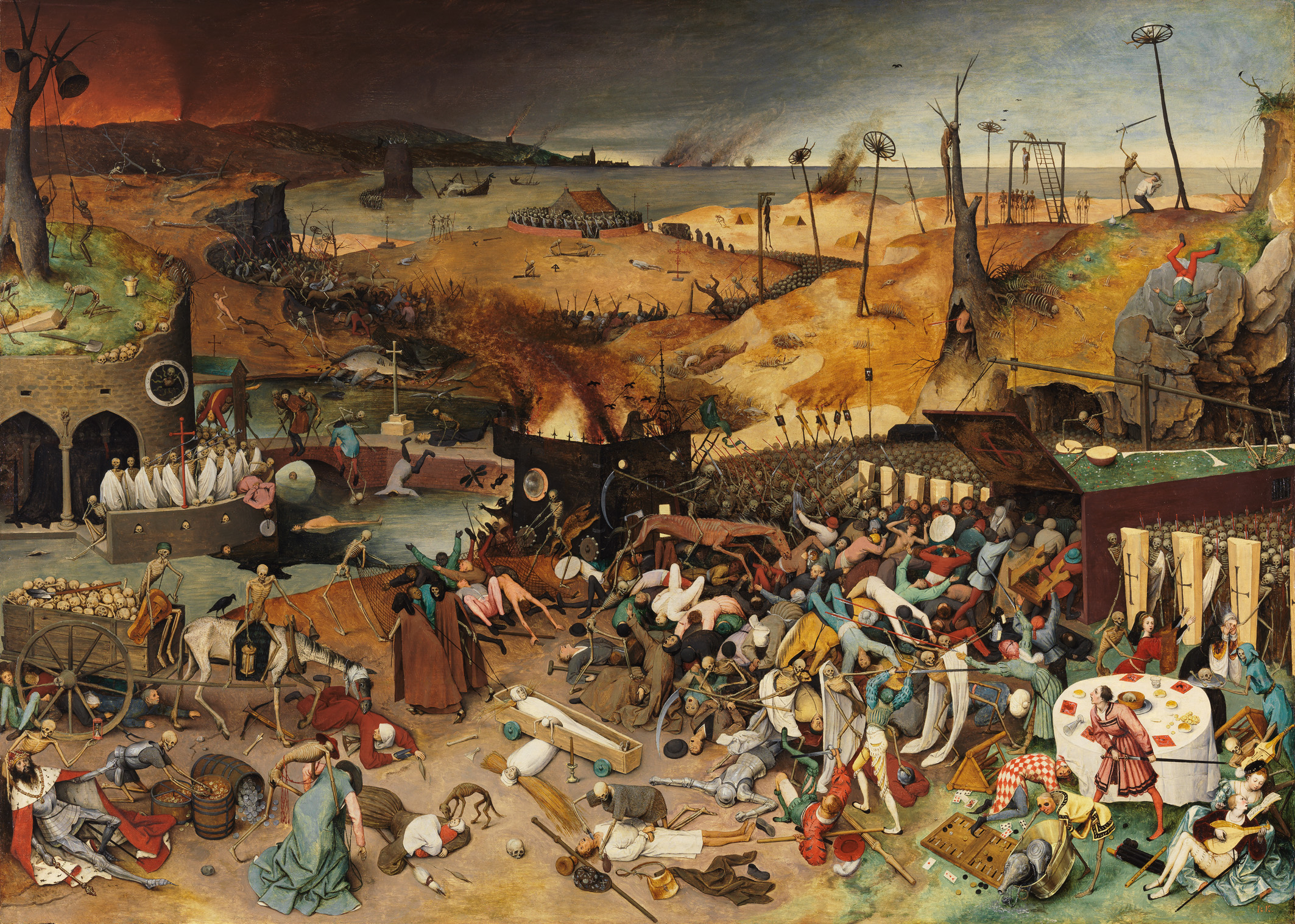
In 216, the 22nd year of Establishing Peace, the contagion spread, bringing sorrows over corpses in every family, tears of lament in each abode. They died behind shuttered doors or perished by the clan. Some said this was the work of ghosts or spirits. Yet the fallen were the rag-wearers and bark-eaters, in hovels of bramble and sedge. Among those who dwelt in great halls and supped from bronze cauldrons, cloaked in marten fur, on plush cushions… it was rare. The cosmic forces were out of balance; winter and summer had turned around: this was its cause. Some tried to drive it away with far-fetched spells. That was laughable too.
Pieter Brueghel the Elder, Triumph of Death. Circa 1562. Oil on panel. Prado Museum.
This post begins a series of dispatches from Kopkind participants, advisers, guests and friendson life in coronavirus timeas they observe it. The series is a collaboration between Kopkind and The Nation, where each dispatch initially appears online.
Display window of a photo shop in El Paso (photo: Debbie Nathan)
Something’s Happening Here
El Paso, Texas
Last Thursday morning an ICE plane flew from Phoenix to El Paso, then El Paso to Guatemala City. The flight held at least 40 people—far more than the maximum 10 that our new “social distancing” rule allows to be together. The passengers were undoubtedly shackled; that’s how deportees travel on ICE planes. On Sunday, March 29, three days after the trip, the Guatemalan government announced that a passenger had just tested positive for Covid-19. This was the first documented case on an ICE flight. The director of our airport told City Council it was no big deal for us locals. The infected person must have got on in Phoenix, she said.
Here in El Paso and our Mexican sister city, Juarez, the numbers are still low—57 cases as of March 30, in a binational community of 2 million people—but coronavirus has created a special foreboding, caused by the area’s longtime and lately intensified use as a law-and-order punching bag. In the guard and punishment economy, social distancing is farcical where it’s not terrifying.
Both sides of the border are nests of infection risk created by US laws and their enforcers. One bug house is the federal court downtown, where immigration cases are heard. Judges are still working. Most defendants are charged with petty smuggling (of drugs or people), trying to cross the border with false documents, or simply traversing the Rio Grande and getting caught.
3/26/20: an ICE plane flew from Phoenix to El Paso, then El Paso to Guatemala City. It marked the first recorded instance of an ICE flight deporting a person with the virus.
In one courtroom last week, three shackled inmates, wearing orange and blue uniforms of the county jail, waited on benches. Two sat a foot apart. They were guarded by two U.S. Marshals. One wore a mask and gloves. The other didn’t.
At the prosecution table, an assistant US Attorney coughed explosively, then exited, a hand pushing open the half doors that separate the administrative side from the rest of the courtroom. Another prosecutor, with a Van Dyke-ish beard, approached the doors and put his hand on the place his coughing colleague had just touched. Van Dyke then leaned on one besuited hip and schmoozed for a few minutes with a public defender—all the while caressing the half door. With the same hand, Van Dyke then stroked his beard. The hand soon migrated from beard to mouth.
Across the room, a court-appointed defense lawyer huddled with a middle-aged woman in jail clothes. The huddle left a few inches distance between the two. The woman would plead guilty for driving two undocumented immigrants to a Border Patrol checkpoint. The lawyer collated the papers, repeatedly licking his index finger. He picked up a pen with his licked hand and signed the papers. He gave the pen and papers to the client. She signed, and the lawyer walked over to Van Dyke’s table. Van Dyke took the papers, then patted his beard and mouth. The woman was sent back to jail to await sentencing.
A very young Honduran woman, charged with illegal entry, also pleaded guilty. The judge told her she could have got months in prison, but the public defender had made a deal with Van Dyke to lower the charges from felony to misdemeanor. The woman, who had been locked in jail for almost eight weeks already, got time served plus one day. “Be very grateful,” the judge said. “We hardly ever see this happen.”
El Paso’s county jail holds hundreds of border crossers, there because of a lucrative contract with the feds. Four additional detention centers hold immigrants for ICE. Every few days there are ICE flights. For years those have earned airport-use commissions for the city.
Meanwhile, in Juarez, immigrants seeking asylum in the United States languish under the Orwellian-named Migrant Protection Protocols. Denied due process, they wait, stuffed by the thousands into crumbling apartments and crowded shelters. In one shelter I know, a family of six lives on a jungle of bunk beds in an 8’ by 10’ room. In another, people sleep on dirty mats, on and under church pews.
A person who’d been working in the court told me the feds are trying to empty the jail. That’s helter-skelter, but business goes on as usual in detention centers. At one, according to a declaration filed by a local immigration attorney, “A member of my team asked a guard…on 3/17/2020 about Covid protocols and he [said] that they had not received any special training on how to keep themselves or detained individuals safe during the pandemic, and then said ‘if it happens, it happens.’”
The Honduran woman was sent from the bug house courtroom back to jail for a day. From there, she would be remanded to a crowded ICE detention center, where she would wait for deportation on a crowded ICE plane, or for Covid-19, whichever comes first.
Debbie Nathan lives in El Paso. She is the author of Women and Other Aliens: Essays from the US-Mexico Border.Debbie was a mentor at Kopkind in 2013 and 2016. This piece appeared on thenation.com on April 1, 2020. We thank Katrina vanden Heuvel, D.D. Guttenplanand others from The Nation crew who make this collaboration possible.
May “the principles of freedom, of humanity, and of justice … finally triumph over falsehood, tyranny and delusion, and every principle inimical to the interests of the human race”*
Kopkind 2019
Wishing you love, peace and power in the new year.
—John Scagliotti, JoAnn Wypijewski and everyone involved in Kopkind
*from the final speech of Ned Despard, quoted in Peter Linebaugh’s Red Round Globe Hot Burning
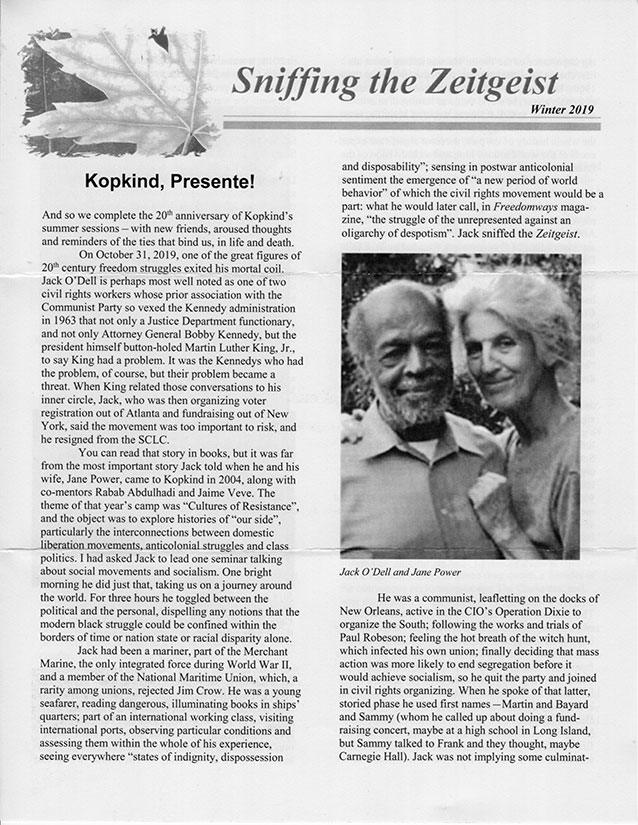
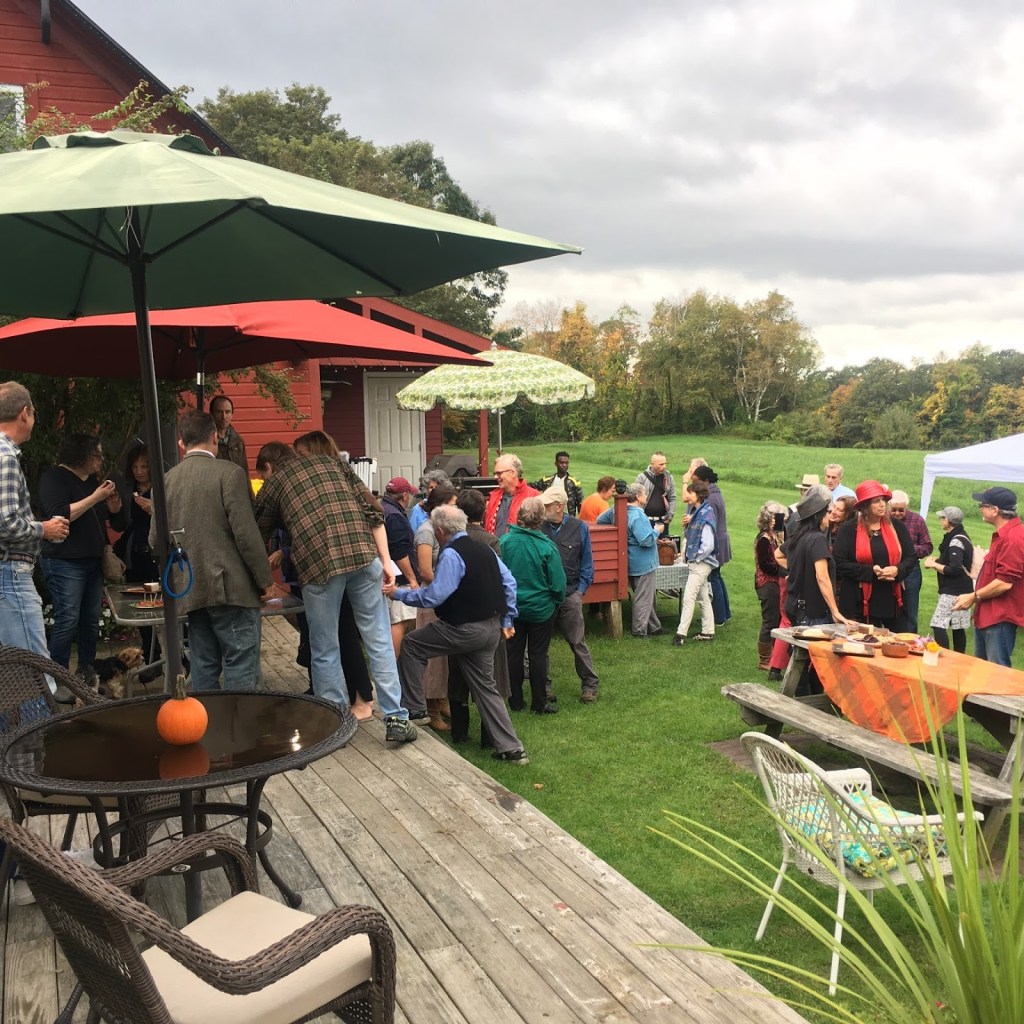
Please Join Us on Sunday, October 13, 2019 at 2 pm for Kopkind’s Annual Harvest Late Brunch Benefit, featuring Verandah Porche and John Scagliotti in conversation on Being Brave & Remembering Pleasure: Thoughts from 50 years, for the next 100
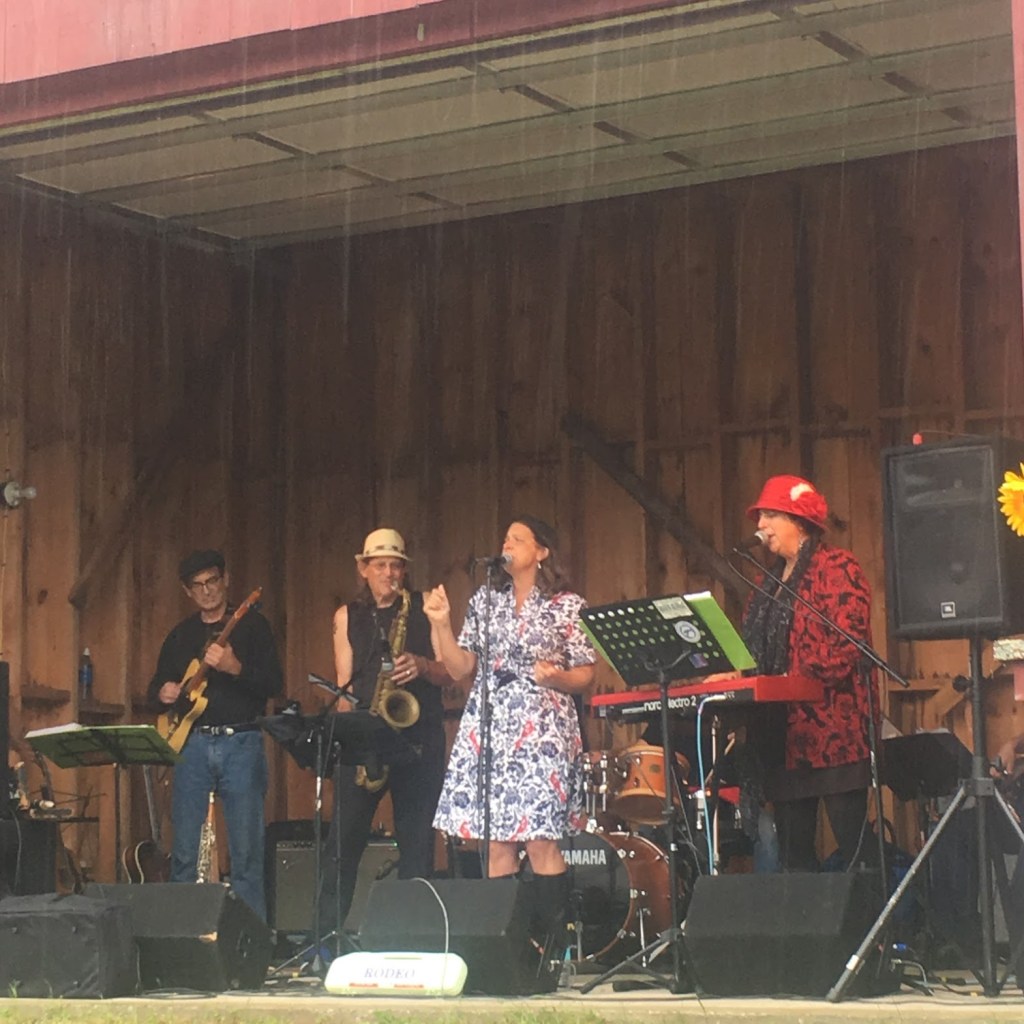
With earthy fare, and the music of Patty Carpenter
John Scagliotti successfully challenged one form of police entrapment in Massachusetts in the 1970s and became a pioneer in gay radio, television and documentary film.
Verandah Porche was a pioneer in the commune movement in 1968 and invented “told poetry,” a collaborative form of literature she has been practicing for the past 30 years in nursing homes and mental hospitals, on street corners, and with those recently settled into permanent housing.
In this season dominated by presidential crimes and ambitions, Kopkind is celebrating individual bravery, collective action and the radical power of art. As always, the great questions involve accommodation or rebellion, silence or finding voice, humanity or barbarism. As always, they are personal and political, historical and contemporary. The past lives in the present, and challenges us all to fight for the future — and enlarge the space for joy. Are we up for it?
The Organ Barn at Guilford, 158 Kopkind Rd., Guilford, Vt. 05301
Kopkind and the Center for Independent Documentary present a film on the meaning of community
East
LA Interchange
“Not just a
story about one neighborhood, a funny, insightful and poignant documentary that
will transform how you think about living in the United States today.”
(Huffington Post)
With filmmaker Betsy Kalin, Kopkind/CID Film Camp Alumna
Saturday,
August 3, 7:30 pm — The Organ Barn, Guilford, Vt.
Why do
we build community? Can we make a difference together? And can we protect our
communities and cultural tapestry in the face of tremendous obstacles? These
are questions at the heart of Betsy Kalin’s fascinating documentary East
LA Interchange. Telling the story of Boyle Heights—a multicultural,
immigrant and working-class neighborhood of Los Angeles that has fought to
survive despite highway construction, dispossession and other social and
economic changes—the film explores the values of home (housing,
health, human solidarity) that transcend geography. A provocative, hopeful
film, originally workshopped at Kopkind/CID Film Camp, it has sparked
discussion wherever it has been shown, in communities large and small. This is
its first Vermont showing. The screening is free, open to the public and
will be followed by discussion.
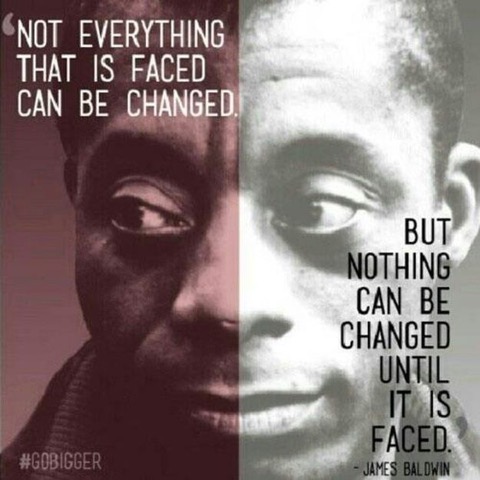
Please join us for Kopkind’s Potluck & Movie Night, a free public event, featuring James Baldwin: The Price of the Ticketwith special guest Kenyon Farrow, followed by discussion.
Janes Baldwin
In
this our 20th anniversary summer we salute two other birthdays, Stonewall 50
and the 95th anniversary of James Baldwin’s birth, with the screening of this
wonderful documentary. It is told mostly in the words of one of America’s
greatest writers, whose exquisite voice, whether in fiction, essays, speeches
or video and audio recordings, continues to call us to conscience on the price
of history and the promise in the effort for love and human liberation.
Joining us will
be Kenyon Farrow, writer and activist, currently senior editor at TheBody.com, former executive director of Queers
for Economic Justice, named by Black Entertainment TV as a Modern Black History
Hero.
When: Sunday, July 14; potluck cook-out
begins 5:30 pm (bring a dish), with screening to follow
Where: The Organ Barn, 158 Kopkind Road,
Guilford, Vt.
With Everyone’s Books, Kopkind is thrilled to bring Peter Linebaugh, “the best, most creative, most original historian living today,” to Downtown Brattleboro on Friday, July 19 at 6 pm for a celebration of, and free public talk on, his new book
In 1803 an Irish renegade, Ned Despard, stood on the gallows in London to be hanged for revolutionary conspiracy. His final speech, written with his Caribbean-born wife, Kate, expressed the hope that “the principles of freedom, of humanity, and of justice will triumph over falsehood, tyranny, and delusion.” The radical love between Kate and Ned serves as a cornerstone for this monumental history of the origins of capitalism (and simultaneously the UK and USA) as well as resistance to it, told through the lives and deeds of people whose No to war, privatization, capitalism and inequality resonates into the present. It is a story of dispossession and defeat, but also of common dreams and of the lessons that interlaced struggles for freedom hold for today. Kopkind was pleased to have Peter Linebaugh—a wondrous speaker and writer, praised in the quote above by Robin D.G. Kelley—as a mentor in residence five years ago. We are so happy Everyone’s Books will host this event this year for Red Round Globe Hot Burning, which, as Noam Chomsky says, “provides fascinating insights into the origins of our society” and is a work of beauty and genius.
Please join us!








 Kopkind Colony