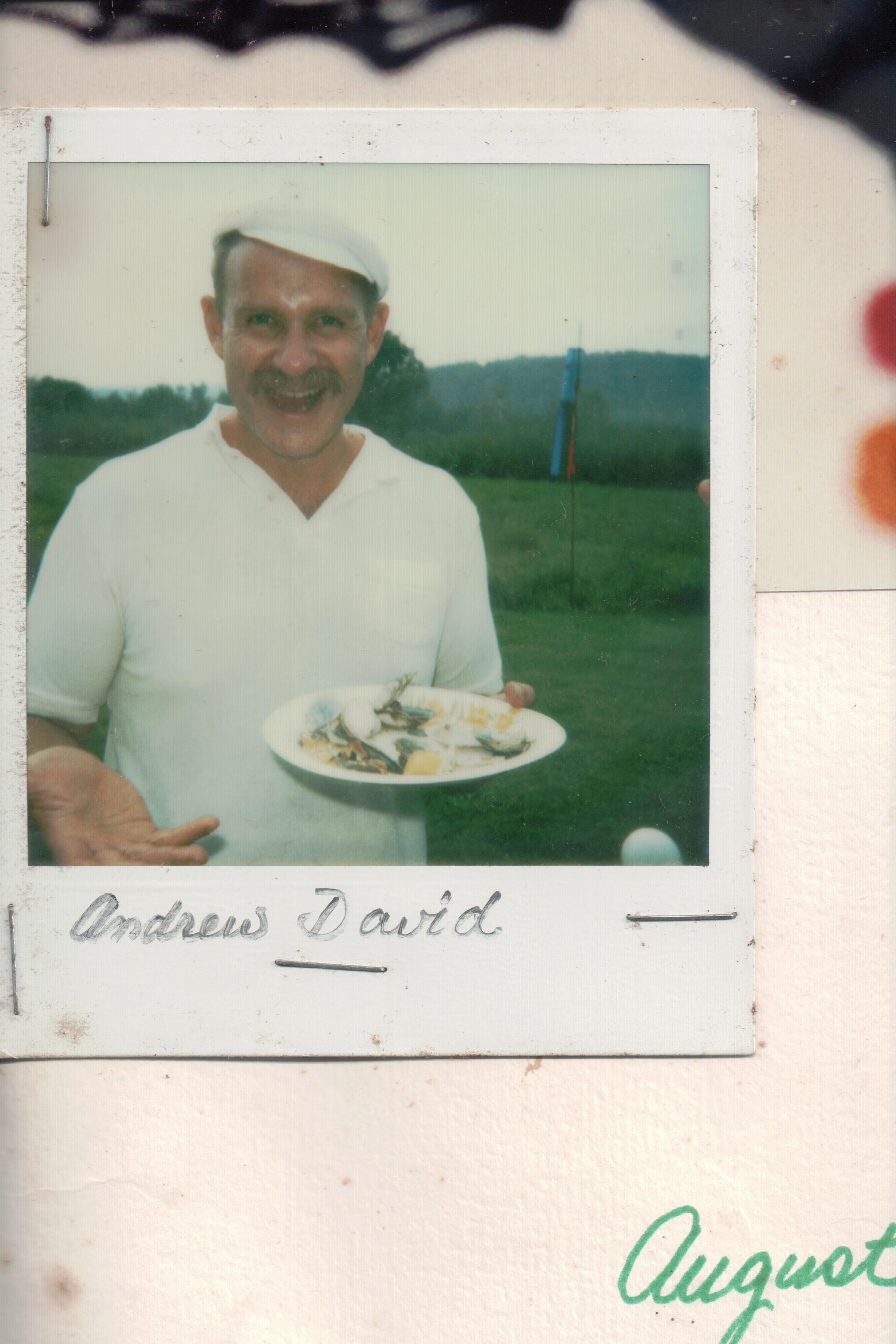
Andy in August, from his and John’s summer scrapbooks (photo: John Scagliotti)
The good people at the Brattleboro Words Project, chiefly Lissa Weinmann, write to tell us that their podcast this month features a sound documentary about Andy Kopkind. It was made by our dear friend, comrade, collaborator and Kopkind honorary board member Maria Margaronis. Maria was Andy’s first intern at The Nation. She is a beautiful writer, a sensitive radio documentarian (mostly for BBC Radio), a deep soul. Her episode for the Brattleboro Words Trail Podcast is a love letter, a memento, an evocation of Andy and John and the world they created at Tree Frog Farm in Guilford, Vermont, which inspires everything we’ve been doing at Kopkind for 25 years now. We are grateful to Lissa, Maria and everyone who was involved in producing this beautiful piece, which we send out with love.
The picture here was taken during one of Andy’s famous birthday celebrations. This year we will be hold a celebration of Kopkind’s 25 birthday on Andy’s birthday, August 24, at Tree Frog Farm. More details to come, but Save The Date: 8/24/24!
January 1, 2024, will mark 30 years since the Zapatistas burst onto the world stage, rebelling — as Andy Kopkind wrote in The Nation at the time — against ‘a new world order … that intrudes in the most pernicious manner on the way of life of people always overlooked’. It was an armed revolt that regained some land plundered from indigenous people and was met with state terror, but inspired the desiring world anew. ‘They have infused left politics’, our companera Margaret Cerullo writes, ‘with an imaginative, literary, or poetic dimension—organizing horizontally, outside and against the state, and with a profound respect for difference as a source of political insight, not division.’ And they persist. This new year they will be celebrating their decades’ long phase in 500 years of indigenous resistance in the Americas.
The desiring world is the one we inhabit, perched between cynicism and hope, painfully aware of the bleak old world but rejecting its shackles on the imagination. The future will not be foreclosed, we say, never sure except in the belief that the opposite is unacceptable.
*
Augusta Palmer, who at film camp in 2022 workshopped Blues Society, which promises to be a marvelous documentary on the Memphis Country Blues Festivals, held in the tumultuous years from 1966 to 1969, wrote John Scagliotti this year on his 75th birthday: ‘Film camp was a game changer for me. One of my characters says, “We were filled with eroici furori, poetic furor … I always thought that was the best thing that could happen to you, to be thrown together with this group of people who had a heroic enthusiasm.” He was talking about the blues, but Kopkind was like that for documentary. Thank you for that gift.’
Continuity and change have been central to Kopkind from the start. A living memorial that honors the past and feeds the future could not but be mindful of that duality. Now anticipating our 25th anniversary, we are mindful of it, also, in the people who remember, like Augusta, and those who, having been to Kopkind, then return, like our mentors this year, Jennifer Berkshire and Scot Nakagawa; like Jeff Sharlet, who was our guest speakerat a free public event this summer; like Bob Pollin, who since 1999 has come to talk to Kopkind’s journalists and activists on economics. This year he and his wife, Sigrid, brought Nancy Folbre, our new friend, talking about the astonishing, unmeasurable human capabilities in the unpaid work required simply to live, and the implications of this ‘care economy’ for women and girls especially, for families and the unfamilied, for any left political project that cares if people and communities can thrive.
We are mindful of it in the people who have paid the experience forward, and those who will, and all of you reading this who support Kopkind. And those, too, in our orbit who died this year: people who were important to the broad political culture and to early discussions about this project, namely Amber Hollibaugh; and people who, in addition, were closely involved with us for 20 years, namely Kevin Alexander Gray. In an earlier note on Kevin we wrote that, in short, he held to ‘a politics of humanity for humanity’. The phrase, which could be the subtitle to every theme of every Kopkind political camp across the years, is from the Zapatistas. So simple that almost no one can achieve it, though we must try.
*
And so to freedom dreams … Recalling that these have been essential to every great movement for a politics of humanity, as Robin D.G. Kelley discussed years ago in a magical talk (with a bat and a broom) in the barn at Kopkind while he was working on his terrific book by that name.
In this time of remembrance and resistance, in this dark, terrible time for the world, we with Kopkind wish you light, courage, hope. On the cusp of our 25th anniversary, we look back on spirits aflame, but ever forward. We will be celebrating Kopkind’s birthday on Andy’s birthday, August 24, at Tree Frog Farm. Stay tuned.
With poetic furor and warm wishes for 2024!
If you are able, please help with a year-end gift. And if you can spare $100, we have a treat: Zapatista Stories for Dreaming An-Other World, translated and with commentaries by the Lightning Collective. Allegorical tales with bite and humor and tips on taking the lion down. You can make checks payable to Kopkind and send to 158 Kopkind Road, Guilford, Vt. 05301. Or press the Donate button above. If you would like the book for your $100+ donation, please write jwyp2000@gmail.com with your name and mailing address. Thank you!
Seventy-five years ago, on December 10, 1948, world representatives gathered at the United Nations adopted the Universal Declaration of Human Rights, the brainchild of Eleanor Roosevelt and other internationalists who defied the idea that war, misery and oppression should be natural conditions of life. The declaration was always more aspiration than reality, but now, as the US enables a war of ‘unprecedented killing’ in Gaza, its provisions, for all people, must be our mandate. The recent death of Henry Kissinger was a reminder of the brutal continuities of US foreign policy. It should be an occasion as well to honor their opposite, and to remember those who in every age have resisted the tyranny of violence, at home and abroad, on city streets and in prisons, and the structures and ideologies that undergird it. The essay below, which originally appeared in ‘Sidecar’, gestures to continuities of defiance.
What About …
JoAnn Wypijewski
It is 1988, Santiago. Chile is on the cusp of a popular repudiation of the world that Henry Kissinger helped to make scream. Throngs of international observers have come to witness the plebiscite on Gen. Augusto Pinochet’s dictatorship. I am part of the US delegation organized by the National Lawyers Guild. At the first meeting in our precinct, local people introduce themselves by name and political identification, too many socialist tendencies to remember. They are good-humoured, optimistic, organized for getting out the vote. As has been said for years now, ever since mass protests began in the capital, ‘the people have lost their fear’. A cinema in the city centre is showing Charlie Chaplin’s The Great Dictator, the marquee illuminating the title in large letters.
Pinochet’s collaborators have been defecting by the day. None of this was supposed to happen. The 1973 coup against Salvador Allende – backed by the United States, fortified by international lenders and elaborated by the Chicago Boys’ economic violence programme – had been engineered for permanence. State terror was supposed to take care of internal opposition. The plebiscite itself – Yes or No, do you approve of our handiwork? – was intended as a bit of legitimating latticework. But after years of murder, disappearance, imprisonment and torture, the right’s plans have fallen to history’s penchant for surprises. ‘Joy is coming!’ announces the slogan of the No campaign.
I am staying with a working-class family involved with one of the socialist parties. Every night the power goes out. Every morning a little girl named Alejandra comes to my room, disciplined, intent on teaching me Spanish. She climbs onto my bed and points to the pictures in her primer, instructing me to sound out the words for animals, cooking utensils, common things. In the afternoon her grandmother takes me downtown on public transit. These tracks, she says, lie over mass graves.
In the aftermath of the coup, armed men came to this woman’s home one night and dragged her son away. Right there, in the kitchen, through the same door we use to enter and leave the house, in the same blackout conditions that now seem a reminder or a threat whenever the lights go out. For a long time, he was a desaparecido. For a long time, his mother haunted the entrances of police stations, prisons, hospitals, morgues. Eventually a prison sentry – sick of seeing her? moved by pity? – handed her a list of inmates. She found her son, alive but scarred by torture. Somehow, she got him out; somehow, he fled the country.
In 1975, Pinochet’s foreign minister visited Kissinger to discuss a problem. The junta had released a couple of hundred prisoners, trouble-makers, but couldn’t find countries willing to take them off Chile’s hands. ‘You will know what to do’, Kissinger said, as memorialized in official documents declassified years later. My host doesn’t need to know the numbers – which by 1990 will total 3,216 people killed, 38,254 imprisoned or tortured by official count, thousands more exiled. Somehow, she saved her son. Somehow, other women and men like her mustered the courage for defiance. Alejandra’s grandmother has her outfit planned for October 5, the day of the plebiscite, the red and black of her party.
In his memoir, White House Years (1979), Kissinger describes early 1970 – the year Allende’s election accelerated Washington’s counterattack on the Latin American left, Nixon invaded Cambodia, and the National Guard shot student protesters dead at Kent State – as ‘those faraway days of innocence’. Oh, there was a bit of ‘propaganda’ and ‘spoiling activities’ in advance of Allende’s election. Not enough: ‘I should have been more vigilant.’ Naturally, the US did some sniffing around among the Chilean military to test the feasibility of a coup before Allende’s inauguration, but it was slapdash. In any case, ‘we played no role whatever’ in the ‘conception, planning and execution’ of the coup three years later. Really, the US is a victim of its own benign incompetence:
Of course, covert operations have their philosophical and practical difficulties and especially for America. Our national temperament and tradition are unsuited to them. Our system of government does not lend itself spontaneously to either the secrecy or subtlety that is required. Those eager to dismantle our intelligence apparatus will have little difficulty finding examples of actions that were amateurish or transparent.
In Santiago, no one we meet has illusions about US innocence. An American warship is cruising off the coast. ‘Jakarta’, some say, has begun to appear scrawled on city walls, as it had in 1973, though I haven’t seen this prophecy of extermination myself. At a press conference at the US Embassy, TheNew York Times’ Shirley Christian, prototype media quisling of US policy in Latin America, asks a question about possible Cuban-backed plans to sabotage the referendum. On cue, other scribblers demand, Just what do we know about Cuban saboteurs? This happens to be the scenario that the former mistress of a general close to Pinochet related breathlessly the night before to a room of anti-Pinochet organizers in a middle-class high rise: if the outcome is looking bad for him, Pinochet will create some type of explosion, blame Cuba and Chilean leftists, and cement his position as supreme leader. Former exiles, recently returned, are popping tranquilizers at a luncheon with Bianca Jagger. Some are staying in safehouses guarded by men in sunglasses who lead us through confounding passageways to meet them.
There’s just one problem with Pinochet’s scheme, to which the working-class people who’ve lost their children are savvier: conditions have changed. In virtually every sector of the population there is opposition to the junta, including within the junta itself. The military is fractured. Reagan is a lame duck, his administration still reeling from the Iran/contra scandal. The likely inheritors of the Chilean government are not radical. The global neoliberal order has constricted the room for economic manoeuvre, for now anyway. Early that morning, the White House summoned the Chilean ambassador; Pinochet appears to be done for. If not, militants in La Victoria and other precincts of the poor have been preparing Molotov cocktails.
*
Years of Upheaval, volume two of Kissinger’s memoirs, was published in 1982. It was five years since he left government, and Kissinger busily made the rounds, proffering his views on world affairs. Alexander Cockburn wrote in The Wall Street Journal at the time: ‘I had thought Mr Kissinger’s chosen mode, that of international superstar, café society’s preferred oracle would not for long endure; that the decline would be rapid, from special adviser to NBC, to guest on the Johnny Carson show, to final apotheosis on the Hollywood Squares. Not so.’ Volume three, Years of Renewal, arrived in 1999. Its publication may well have been the occasion of my only encounter with Kissinger.
It is night-time in front of the Barnes and Noble on Union Square in downtown Manhattan. Kissinger is to be interviewed, on camera, by Charlie Rose. A call has gone out for the indignant to distribute flyers. We are a small but peppy band. The flyers are brightly coloured and provide a counterpoint to Kissinger’s deceptions about US foreign policy. As the show begins, we figure it is foolish to stand in the dark talking among ourselves and head in to watch.
Inside, the store’s second floor has become Rose’s stage set: a round table with chairs on a riser; the two men under bright lights; some rows of chairs below for the audience; and, surprisingly, a substantial crowd of people seated on the floor and standing among the long bookshelves. I take up a position among the books, stepping up onto the lowest tier of a shelf so that my chin just clears the top.
The cameras roll and Rose leans in, unctuous as ever. Kissinger is absurd. He has been out of the game too long – there’s no inside baseball, none of the winking, I’m loathe to discuss covert ops but just this once, for you… (though that hasn’t stopped the obsequious entreaties from candidates, presidents and their advisers, ‘humanitarian interventionists’, even supposed policy rivals, seeking his counsel). Every answer is a platitude or the mumbo-jumbo of phony statecraft. Every question is inane. I feel a rumbling coming from my toes, an electric, involuntary quiver rising.
And then Kissinger says something akin to America is the most honourable country in human history, and as if in a slow-motion movie I have raised my hands to form a megaphone around my lips, and now I am raging: What about Chile… Vietnam… Cambodia… Laos… What about… What about… Bangladesh… East Timor… Argentina … Angola… What about…? I’m citing dates and statistics and bloody incidents in an unbroken chain of What abouts.
I’m hard to spot, with my head barely visible, and among so many other heads along so many rows of shelves. Another voice, coming from somewhere else in the room, begins chanting low and steady, like a death drum, ‘War Criminal… War Criminal…’ Only as the security guards have escorted me, still ranting, to the escalator do I realize that the bass line to my treble of indictment came from my friend Deborah Thomas of FAIR, who is also being removed and didn’t know the other voice was mine.
*
Protest politics, whether heroic or, in the scheme of things, paltry, merited two phrases in the two front-page obituaries that The New York Times devoted to Kissinger on successive days: ‘Hey, Hey, Henry K, how many kids did you kill today?’; and ‘While protesters at his talks dwindled…’ Daniel Ellsberg gets no mention. The newspaper’s own publication of the Pentagon Papers serves but to illustrate Kissinger’s fury and obsession with leaks. Third World peoples count only in bulk: 300,000 killed in what would become Bangladesh; 10 million refugees driven into India; 100,000 East Timorese killed or starved to death; 50,000 Cambodian civilians killed by carpet-bombing (silence on the genocide it sparked); 3 to 4 million dead Vietnamese, whose armies and determination, at least, the paper cannot ignore. ‘I can’t believe that a fourth-rate power like North Vietnam doesn’t have a breaking point’, Kissinger is quoted as telling his staff.
‘Critics’ abound in these tributes, to comment on the man’s ‘defects’ as well as his ‘brilliance’, on his strategies for supposedly managing the Cold War, and on ‘everything else’ – that is, the world beyond superpowers. ‘It was the everything else that got him into trouble’. This isn’t surprising (though an editor might have anticipated readers cringing over who was in trouble), but it’s nevertheless important to acknowledge that, loathsome as he was, the man was never the principal target of his opponents on the left, just as the Cold War wasn’t ever primarily about superpowers but about that ‘everything else’. Kissinger was a symbol, a servant, a latter-day ‘racketeer for capitalism’, in the words of Marine general Smedley Butler. He was also a failure. The objective of his foreign policy approach, he boasted, was order not justice. The world he’s credited with shaping has neither.
Tony Eskridge looking out from the top of Belden Hill, Guilford, VT, August 2023.
“Before we can build a new world, we must untether the system from our own heads,” Tony Eskridge wrote before coming to Kopkind this summer. At 24, he was deeply involved working on the Poor People’s Campaign as an organizer with the Kairos Center for Religions, Rights and Social Justice in Memphis, Tennessee. What is the conventional frame around the realities of this world and the range of possibilities on offer? What does that frame confine? What does it omit? How to broaden it, break the frame, see differently? A fresh sense of possibility. A new horizon. Untethering the system from our own heads. That is a big part of Kopkind’s work.
This Giving Tuesday, please remember Kopkind if you can. We feed the future — for solidarity, for liberation.
Tony joined nine other activists or journalists from around the country for a week of seminar discussions, informal talks, special guests, rejuvenating vistas and activities. Our theme was The War on Youth. But along with sharing experience and analysis, we stoke freedom dreams. Before he left, Tony wrote us a note:
“It’s hard to capture in words what a wonderful week this has been. My fellow campers, in such a short span of time, feel like comrades and real connections that we can always draw from. They are such brilliant, loving and committed people; they’ve brought out the best in me. It almost feels like a snapshot of the beloved community we are trying to build. Endless appreciation to everyone who worked so hard so I could spend time being present … We are in a Kairos moment, a time of grand crises but also a time of grand opportunity. I look forward to continuing to build this movement with you all. Forward Together, Not One Step Back!”
Endless appreciation to all friends, supporters, alumni, guests, collaborators, fellow workers and other interlocutors as Kopkind enters its 25th year.
The Donate button is above. You can also send a check to Kopkind, 158 Kopkind Road, Guilford VT 05301. Thank you!
Fierce, funny, brilliant, argumentative, perceptive, pioneering, sharpening, gentle, greathearted, gay, radically original … Today we honor John Scagliotti, our founder and administrator, 75 years on the planet this November 14.
His trail-blazing work in lgbtq media is well-known, beginning with The Lavender Hour (radio), on to Before Stonewall (documentary film) and In The Life (television), with many more films, from the earliest, Stuff of Dreams, to the most recent, Before Homosexuals. His analyses of (and anecdotes from) the 1960s antiwar and early gay liberation movements, of cultural politics, of the possibilities for a left that is ‘multi’ in all the ways that real life is experienced and a generous freedom imagined, have enlivened kitchen tables and group meetings; the pages of magazines, the lecture halls of colleges and the work of so many who for so long have had the pleasure of his conversation. His understanding of visuals and sound and the relationship between emotion and meaning — and his crystallization of those in constructive advice — has encouraged younger filmmakers for decades. “I will forever be John’s mentee!”, Desireena Almorade, a wonderful documentarian who got her start at In The Life, wrote in our book after participating in this past summer’s Kopkind/CID Film Camp.
On this day, we also honor the beauty of love, which, as manifest in John’s union with Andy Kopkind, moved so many of us. And the power of an idea which, whether conveyed in media or blossomed in the magic of Kopkind’s summer project, has inspired countless people to say, “You have changed my life.”
Here’s to the example of a lavish love, a memorable phrase, a joke when you need it most, an imagination to the stars, a life-so-far that contains multitudes. Happy Birthday and thank you, John!
To everyone reading this: you are most welcome to remember John’s 75th birthday with a gift to Kopkind (the Donate button is on the top bar here). And because we all need a moment of joy, however hard the times, here is a song to lift every internationalist, rococo, fabulous beating heart.
Marlon Becerra and moonlight. (photo: Jeff Sharlet)
In a year of celestial wonders, August brought two supermoons. Stargazers would have most recently awaited the Blue Moon, which rose on August 30, and is in its last quarter this Labor Day weekend. That’s the waning Sturgeon Moon in the photograph above, taken on August 5, the last night of Kopkind’s ‘camp’ with political journalists and activists. The full moon had risen on August 1, and every night, it seemed, campers were out on the grass behind the house, heads to the sky.
The Sturgeon Moon is named for the giant fresh-water fish that populated the Great Lakes and Lake Champlain for ages and was especially profuse in late summer, when it was a major part of the regional Native American diet. It is rarer now, a casualty of industrial overfishing in the 19th century and habitat degradation. Endangered, it persists, plying the waters, stirring the lake bottoms with its whiskers for food. The name sturgeon derives from several old European languages, meaning ‘the stirrer.’
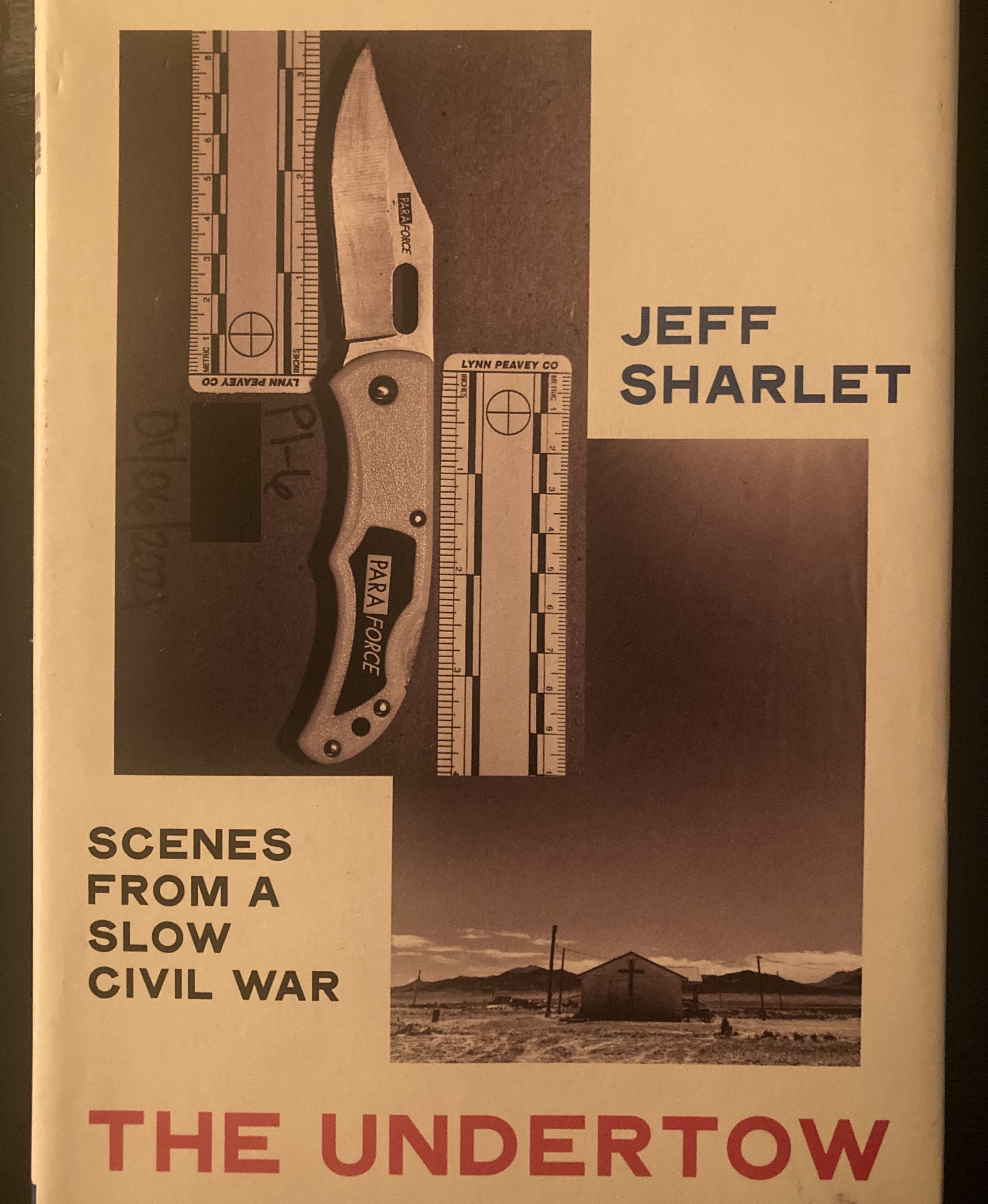
An apt name for a moon during a gathering of people who stir it up. Marlon Becerra was one of them. Jeff Sharlet took this picture as some of us sat around a fire after Jeff had given a public talk about his latest book, The Undertow. Based mostly on reporting on the grassroots militarized right, the book is an act of witness and a warning. The talk was as well, but it also honored persistence on the left: the certainty of conflict, the tradition of struggle, the good fight. We will have more to say down the road about this year’s cohort, which collectively was remarkable for both its gamesome spirit and adamant determination to shape a humane future. And also about our wonderful film camp, with the Center for Independent Documentary, which ran July 16 – 23.
On August 6, people headed home. Marlon, a recent graduate of Harvard Law, drove back to Queens to be in time to meet with his class of Heroes Academy, a school he started in a public park during the pandemic, which teaches local kids math, SAT skills, life skills, chess, first aid… The subject of Freedom Schools had come up frequently during the week of discussions, their history of enhancing practical skills and political consciousness, the contemporary possibilities. Marlon got to ponder these things on the highway home.
Much gratitude to everyone who made the summerpossible! And greetings of solidarity on Labor Day!
Jeff Sharlet, a terrific reporter and writer, will be at Kopkind on Saturday, August 5, to talk about his new best-selling book, The Undertow: Scenes From a Slow Civil War, a free public event to close out our seminar/retreat session for left journalists and activists.
When: 6 pm, community potluck to start off the evening. (Bring a side dish!)
7:30 pm, book talk, followed by discussion.
Where: The Organ Barn, 158 Kopkind Road, Guilford, Vt. 05301
In 2021, Jeff took a cross-country trip following the ghost of Ashli Babbitt, the 35-year-old blonde Air Force veteran who was shot by an officer while climbing through a broken window inside the Capitol on January 6. Along his trip, he’d talked with white people who venerate Ashli as a martyr; with people who’ve revised her age downward, to where she’s just a girl, maybe only 16, curious— just wanting to see: hey, what’s going on?—innocent; with Christians who see her killing as the start of, or battle in, a civil war; with others who insist storming the Capitol was a “false flag,” even though they were were doing the storming; with preachers who have removed the cross from churches because suffering Jesus is a sissy; with one who has fashioned an altar out of swords.
Jeff has reported on the Christian right for decades; this was the first time, he said, that he had been afraid. During a church service, one preacher had already denounced him as an enemy of the people. It was something Donald Trump had started calling the media at his rallies in 2016, while reporters were caged and the candidate’s worshipers were encouraged to take ecstatic pleasure in the abuse he heaped upon them. After the service, having been denied an interview with the preacher, Jeff was in the parking lot talking with two women when an usher and a heavily armed guard threatened him and ordered him to leave. “I have a notebook and a pencil, and you come with guns?” he said, recalling the moment to us toward the end of the trip, miming the pathetic way he’d held up his weapons.
His encounters across the country form the center of the book. They are bracketed by extraordinarily beautiful essays on history, culture and radical hope. “Weaving religion, hate, hope and fear into stories that catch us unaware, Jeff Sharlet confronts us with the realities of the shifting American psyche,” Anthea Butler, author of White Evangelical Racism, wrote about the book. “A must-read in order to understand the conflicting voices and tensions in America today.”
Jeff is a must-hear witness to the shape of authoritarian desire—guns, power, war, a strongman.
Action! Pioneering filmmaker and Kopkind administrator John Scagliotti.
Be there tonight, Saturday, July 22, as Kopkind features the fascinating, moving, funny, profound and all-around wonderful work of Belden Hill Movie Makers, people who live and work in the immediate vicinity of the Kopkind Colony. We will screen little- or never-before-seen short work from five terrific filmmakers: Chuck Light, Mac Christopher, Olivia Wiggins, David (“Cubby”) Hall and John Scagliotti. A Home Movie Night of vast dimension!
Time: 7:30 pm
Place: The Organ Barn at Guilford, 158 Kopkind Road, Guilford, Vt. 05301
This is a free public event, which concludes the Kopkind/Center for Independent Documentary Film Camp.
Back in March we announced here the death of our friend and tender comrade Kevin Alexander Gray. We said we might write more but never could summon the words. Kevin died suddenly on March 7, a shock. July 1 is his birthday. He would have been 66 today. He loved his birthday, and would sometimes send his friends presents of songs to mark the occasion. “The politics begins in the music,” he once said. That sums up the experience of a lot of people growing up his age in the Sixties. So here are some songs for him, in memory; and for everyone out there, with pleasure, because, to borrow a word he used to characterize one great, formative political experience, they are “glorious.”
Kevin was talking by Zoom to journalists and activists at Kopkind last year about what it was like to be part of a class-conscious, black-led, multi-racial, anti-imperialist, social-movement-based, barnstorming national electoral campaign. He’d been a founding member of the Rainbow Coalition, had worked for Jesse Jackson’s 1984 campaign, and was South Carolina coordinator for the ’88 campaign. “It was glorious,” he said. It was. Andy Kopkind covered it for The Nation. Some of the magazine’s staff volunteered. Steve Cobble, Frank Watkins, Jack O’Dell, Anne Braden, Gwen Patton, Ron Walters, Kevin — people who had worked in the background — became important interlocutors for anyone, journalists especially, who was thinking about the relationship between left movements and electoral politics. An all-star band, all gone now.
He died raking leaves. Working. Outdoors, free. His heart, we think. It had been a good day, an ordinary day. He’d opened a barbecue restaurant in 2020, which he wrote about here, in “Scenes From a Pandemic,” but March 7 was a Tuesday, and the restaurant is closed on Tuesdays. He drove to a garden nursery that morning. There was a joyful ease in his voice then. He was thinking about plants. He was only a little irritated with other people. A couple of hours before he died he talked about preparing for his next phase, the next book to write, a stretch in DC. He always thought he had time.
Sade may not have been on Kevin’s twitter page singing this particular song, but like music videos of Aretha and Prince and all the artists here, hers would pop up in his tweets, amid news of the black and left world. Anyone who died after contributing to the sweet or just side of life, especially if obscure or unsung, Kevin would recognize. Who died today? you could ask yourself. What happened on this day in (often black Southern) history? Likely, Kevin would have a tweet about that. NASA names a mountain on the moon for Melba Mouton, the mathematician at the center of Hidden Figures: Mons Mouton. Nikki Haley is being credited (or reviled) for removing the Confederate flag from the South Carolina statehouse grounds; let’s remember the decades of people’s agitation and action against the flag. Jeff Beck dies; here’s his great live version of “People Get Ready,” with Rod Stewart. It’s Christmas and the anniversary of James Brown’s death; here again is Kevin’s terrific essay, “The Soul Will Find a Way,” vividly capturing the texture of life in the segregated South in which Kevin and James both grew up, the roots of the music. The scroll of his old tweets is like raw footage for a documentary of his personality and his work. “I write about what I see and experience,” Kevin states in the preface to his collection, Waiting for Lightning to Strike: The Fundamentals of Black Politics. It’s what made his best writing and public talks so rich — the threads of history, personal stories, political analysis/reporting, cultural references, the mood of the streets, all interconnected. And of course, South Carolina: “You know James Jamerson came from Edisto Island, right?” (The great bass guitarist appears in the video below at 1:24 and throughout.)
Any road trip with Kevin was a musical extravaganza. He had binders of CDs, with music of all genres, which he’d curate while driving, knowing the exact location of every disk and smoothly popping it into the player. He’d been a radio deejay in his youth, and never lost the touch. He knew the words to the most obscure songs. And he was a marvelous storyteller. He seemed to know the backstory of every inch of South Carolina. His own account of burning the Confederate flag in front of the statehouse was many times told, and always landed with effect. He’d had the flag stitched to a Nazi flag, which went up dramatically. Meanwhile, the battle flag resisted the lighter fluid and the flames from mechanical clickers, as counterprotestors joyfully sang, “Our flag won’t burn, our flag won’t burn…” to the tune of “Dixie.” Finally, the hated polyester rag melted. Kevin always ended this story with a piece of advice: “If you’re going to burn a flag, make sure it’s cotton.” He moved through life as a wildly original combination of anger and optimism. A beautiful soul. Rest in power, brother.