The Adamant Memory of Vietnam

10 05 2025
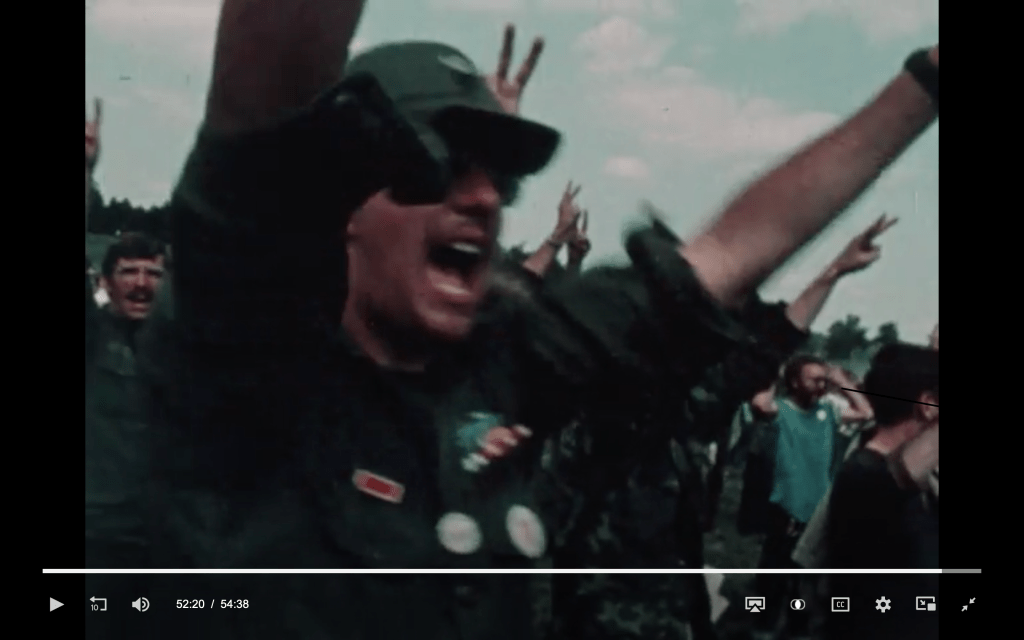
Screenshot from Different Sons: Vietnam veterans chant “Peace Now!” en masse in Valley Forge, 1970.

On April 30 the people of Vietnam celebrated fifty years of independence from foreign domination. Reunification Day, they call it — also known as victory in the American War, as it is known in Vietnam, and defeat for the US in what we call the Vietnam War. These days in May the Pentagon is honoring Vietnam veterans, everyone who served between November 1, 1955, and May 15, 1975. Those commemorations edit out the soldiers who played a critical role in the antiwar movement. The soldiers who published underground antiwar papers on hundreds of bases, who manned GI coffeehouses, who engaged in direct action in the US and in Vietnam, who became mutineers, who founded Vietnam Veterans Against the War, and whose protests are powerfully documented in David Zeiger’s film Sir! No Sir! (which Kopkind screened publicly before its general release in 2005).

We remember those men and women here, whose valiant refusal is captured in one three-and-a-half-day action documented in Jack Ofield and Bowling Green Films’ 1971 short Different Sons. It is a moving document, available to the public from the Internet Archive and here by clicking the image above. Seventy-five combat veterans began a ninety-mile march from Morristown, New Jersey, on September 4, 1970. En route to Valley Forge, Pennsylvania, they took secondary roads, walking single file, wearing fatigues and carrying plastic M-16s, stopping for the night on Quaker-owned property, eating C rations or the equivalent. Along the way, they simulated their jobs in Vietnam, brutalizing or killing civilians. They didn’t expect to win converts, one of their leaders told the filmmakers; they hoped to provoke their fellow citizens to think differently, or begin to. The soldiers’ civilian-volunteers could never register the terror of the real thing, but outside post offices in tiny towns not known for antiwar sentiment, the re-enactments must have been shocking. Some bystanders mocked the vets for their long hair and moustaches; one stated they were working on orders from Satan. In the end, the vets, their number steadily enlarged and forming wide rows across the Valley Forge battlefield, chanted, “Peace Now!” ever louder, and broke their plastic rifles over their knees. This was a unique public demonstration, but opposition to the war was not a fringe opinion among troops. By 1971, one colonel remarked, it had “infested the entire armed services”.

The adamant memory of Vietnam goes a way to illuminating this country’s current crises. The story of the war and the Sixties culture of opposition that it stoked have been in the gunsights of the right from that time to today, as witness the machinations of the current regime’s braintrust and hangers on. Within a few years of the defeat in Vietnam, war fantasies were revived in Washington, and with them cold war liberalism as well as an emboldened right. Within a decade, an academic/political project to rewrite the history of the war in line with the views of those mocking bystanders — and, more important, the arms makers, war profiteers and their political satraps — had been established. The backlash that powered Ronald Reagan’s Make America Great had many helpers, including the corporate press and some precincts of the notionally left, reflected in a 1982 New York Times Magazine essay by Irving Howe titled “The Decade That Failed”. The right never forgot, and its project to extirpate every last gain of the Sixties era is the openly stated aim of ‘anti-woke’ crusader Christopher Rufo and his ilk today. Thus, among much else, the erasure of the soldiers’ revolt in marking the end of the Vietnam War.

Fifty years ago Andy Kopkind used the title above in an article for Ramparts about the great documentary Hearts and Minds, by our friend Peter Davis. We did a public screening of that film, too, early on in the so-called War on Terror, launched in 2001. A generation of Americans has grown up now with no memory of 9/11 and its aftermath, much less of Vietnam — no memory of the lies used to justify the invasion of Iraq, the first Shock and Awe, the roundup of US citizens said to be terror symps, the US torture regime and Guantanamo, now used to imprison kidnapped immigrants. No memory of Iraq Veterans Against the War, or the soldiers destroyed by their destruction of other people. Or Reagan’s proxy wars in between; or Obama’s Tuesday meetings to pick assassination targets after. No broad context in which to place the current US terror bombing upon the people of Yemen, or the long complicity with Israel to crush the Palestinians.

“Now, you don’t want to hear about it”, Andy quotes a Vietnam veteran, William Marshall, featured in Hearts and Minds. “I’ll tell you about it every day and make you sit and puke on your dinner, you dig, because you got me over there and now you done brought me back. And you want to forget it so somebody else can go do it somewhere else. Hell no.”

History is a weapon. Andy’s “The Adamant Memory of Vietnam” is reprinted in his collected writing, The Thirty Years’ Wars: Dispatches and Diversions of a Radical Journalist, 1965-1994. His first draft of history, the book provides an indispensable, analytical backstory to our time.




Heart as a Political Principle

1 05 2025
(image: StockCake)

May Day recovers memories, every year, of the origins of International Workers’ Day, sparked by the general strike of 1886 in Chicago — ‘Haymarket’, in short, and the arc of fellow feeling, courage, state violence and global solidarity the name implies. May Day returns us, every year, to our friend Peter Linebaugh’s marvelous book The Incomplete, True, Authentic, and Wonderful History of May Day (PM Press). ‘Marvelous’ is literal here, because the story of human striving for freedom and equality, of the conflict inherent in class consciousness and class struggle, contains marvels, indeed, and Peter, a past Kopkind mentor and speaker, seems to know all of them. “We cannot avoid the ache of history,” he writes; “its grief we feel in the gut.” But also: “We must study the record. It must pass through our heart again.”

For this record, Peter raids the storehouse of cultural artifact and history, including the great book by James Green, Death in the Haymarket: A Story of Chicago, the First Labor Movement, and the Bombing That Divided Gilded Age America (which featured in a public talk at Kopkind many years ago). “The book is trying to put some freedom back into history, telling us that it could have been otherwise”, Peter writes. “We call this human agency. The theory is something like this. It’s human history, we’re humans, history is something we make with our deeds and our words. This is where free will rubs up against determinism.” The history has special resonance these days, in which the ruling class not only plays its standard role, aiming to make everyday people feel small, confused, helplessly divided, but the president elevates the Haymarket period as the time of America’s greatest happiness and general bounty.

So today, a bit of the record from Peter’s telling:

The freight handlers struck, the upholsterers struck, the lumber shovers went on strike. Four hundred seamstresses left work in joyous mood. A storm of strikes swept Chicago, on the first of May 1886. The great refusal, Jim Green calls it. It was a new kind of labor movement that “pulled in immigrants and common laborers.” Irish, Bohemian, German, French, Czech, Scot, English, to name a few. In Socialist Sunday Schools, brass bands, choirs, little theatres, saloons, there was a working-class culture in Chicago. The Chicago Tribune hated it and compared the immigrants to zoological nightmares. It demanded deportation of “ungrateful hyenas” or “slavic wolves” and “wild beasts” and the Bohemian women who “acted like tigresses.” In the spring of 1886 strikes appeared everywhere in industrial centers; called the Great Upheaval, it agitated for shorter hours. Of course they were against the mechanization of labor, against the exploitation of child labor, opposed to the convict lease system of labor, and opposed to contract labor. The anthem of the Knights of Labor was the “Eight-Hour Song”:

We want to feel the sunshine; / We want to smell the flowers; / We’re sure God has willed it. / And we mean to have eight hours. / We’re summoning our forces from / Shipyard, shop and mill; / Eight hours for work, eight hours for rest, / Eight hours for what we will.

Anyone carrying a sign to a protest these days saying ‘Make America Good Again’ (as some have) need to study the record. Any children of long-ago European immigrants, denied the knowledge of their forebears’ battles and bravery, need to study the record. And it is the job of the left to make that record a common knowledge again, “a people’s story,” recovered from the same power-made tombs from which have been unearthed so many peoples’ stories, newly told, as Peter writes “in the people’s language with the people’s future: the opposite of the official story”.

Green tells the story of the strike, of the time, with detail and verve. He tells of the bomb in Haymarket Square, believed to be thrown by police; and the aftermath, a period of police terrorism, of torture, handcuffed justice and hangings. “The day will come when our silence will be more powerful than the voices you are throttling today”, August Spies, a German immigrant and radical newspaper editor, famously declared before his execution. Of the Haymarket Martyrs, Peter writes: “None died from a broken neck, all strangled to death, slowly as it appeared to the witnesses, convulsing and twisting on the rope. That was November 11, 1887. James Green tells us that it was a turning point in American history.” Green also describes the astonishing sweep of workers’ refusals and solidarity. Globally, May Day was born. In the US, the ruling class declared May 1 to be Law Day. Repression was ferocious in this now-named best of all times. History was not finished, though. Nor are its curiosities without relevance today.

The 151-foot Statue of Liberty was dedicated only two weeks before the hangings in Chicago. Inscribed on its pedestal were the words of Emma Lazarus: “Give me your tired, your poor, / Your huddled masses, yearning to breathe free, / The wretched refuse of your teeming shore. / Send these, the homeless, the tempest-tossed, to me: I lift my lamp beside the golden door.”

John Pemberton, a pharmacist, invented a medicine to relieve headaches and alleviate nausea. It combines coca leaves from the Andes with cola nuts from Africa, mixed with water, caramel and sugar: Coca-Cola, the Atlantic remedy for the ills of the barbarism of capitalism. Both William Morris in England and José Martí exiled from Cuba in Manhattan likened the Chicago working class to a cornered animal.

At the same time, Martí, reviewing the rivalries of nationalities, ethnicities and colors among the working classes, wrote that “the common denominator of pain has accelerated the concerted action of all who suffer”. Here, Peter writes, “is heart as a political principle”.

Pablo Neruda, José Martí, even Walt Whitman had a big, hemispheric conception of America: two continents, half the planet, yet united by the German geographer Humboldt’s Afro-America, a big S: New Orleans, Cuba, Venezuela and Brazil. What happens in one part affects the other: sugar, aluminum, gold, bananas, silver, copper, coffee, rum, pot, and coke, yes, they are the products, the commodities, ripped from the bowels of the earth. They’re easier to recognize than the undergrounds of people, whose migrations, sailings, tunneling have preserved the memory of los mártires. José Martí predicted that “the world’s working class will revive them [the martyrs’ memories] every First of May.”

A century later Eduardo Galeano wrote, “That is still not known, but Martí always writes as if hearing, where it is least expected, the cry of a newborn child.”

In Havana in 1887 the anarcho-syndicalists started a newspaper, El Productor, which covered the Haymarket tragedy … May Day was celebrated in Mexico in 1913. From then on Primero de Mayo became a national holiday known as the Day of the Martyrs of Chicago in Italy, France, Spain, Argentina, Cuba, Mexico. In 1903 Teddy Roosevelt signed an immigration law denying entry into the United States of anarchists, paupers, prostitutes, and the insane. Galeano celebrated the marriage of heart and mind. “From the moment we enter school or church, education chops us into pieces: it teaches us to divorce soul from body and mind from heart. The fishermen of the Colombian coast must be learned doctors of ethics and morality, for they invented the word sentipensante, feeling-thinking, to define language that speaks the truth.” … Halfway between the gut and the head lies the heart. The heart and soul of our movement may be found on May Day, and it’s going to take our arms and legs to find them, as well as our brains.

It took fifty-two years just to win the eight-hour day by law. It took a fight against child labor to win free public schools, as Jennifer Berkshire explained in a Kopkind seminar a couple summers ago. It took a civil war, a hundred years of struggle and Bloody Sunday in Selma to win voting rights legislation in 1965 — the same year, as Laura Flanders, another friend and longtime Kopkinder, reminds us, that LBJ also put immigration reform and Medicare on Washington’s agenda pushed by the spirit of the time. As we see, no victory is permanent. The mind and heart for solidarity could be. In this briefest sketch of the incomplete, true, authentic and wonderful history of May Day run threads to be gathered for that kind of sentipensante, that solidarity expressed in a people’s language and acted upon in common. People everywhere want to feel the sunshine and smell the flowers. So, “Take heart! All out for May Day!”


July 27 Movie Night : Israelism, Palestine & the Responsibility of Americans

26 07 2024

One of the rich pleasures of going to the movies is the chance to talk about it after. Kopkind’s Movie Night on Saturday, July 27 – 7 pm at 118 Elliot in downtown Brattleboro – will feature the documentary Israelism, followed by comments from special guests from the Palestine solidarity movement of Western Massachusetts, who will then engage the audience in discussion. In the project’s tradition, this is an inter-generational group, with two people who have been doing organizing and activism together for more than twenty years, and two who have worked together on a number of actions over the past year, including the UMass Amherst encampment. The event is free and open to the public.

A bit more about our guests, in their own words:

Hind Mari was born and raised in Palestine. She was nearly 6 years old when the Six-Day War took place in June 1967, placing her city of Nablus under Israeli military rule. She has vivid memories of the bombings and the earliest days of Israeli military occupation. In early September of that year, her dad, who was a school superintendent, was jailed for six weeks for going on strike and refusing to start the new school year as a protest to a ban by Israel on 84 textbooks.

Hind likes to call herself (and her brother) the original BDS organizers for their refusal to buy Israeli candy in 1967, and for convincing the neighborhood kids to follow suit. She went to college in Nablus, Occupied Palestine, where her education was interrupted by school closures, roadblocks and jailings. She earned a Fulbright for her master’s in 1986 and came to UMass Amherst, where she earned her doctorate and continues to work.

Alisa Klein grew up an ardent Zionist in a Jewish American family, and lived as a teenager and young adult on a kibbutz in the north of Israel. She completed high school there, served two mandatory years in the Israeli army, and attended university in Tel Aviv. What she experienced in the army, and then studied at university, ultimately brought her to an understanding of the inherent inhumanity and genocidal nature of the settler colonial project that is Zionism and the State of Israel. After writing her master’s thesis in Amman, Jordan, and serving as the editor of a Bethlehem-based online journal of alternative analysis of Israel and Palestine, she returned to the US as an ardent Palestine liberation activist and annual visitor/activist to the West Bank. Since 2000, she has lived and conducted activism in Northampton in Western Mass. 

Molly Aronson grew up in an observant Jewish and politically minded household, and became skeptical of Israel and the Zionist project at an early age. In college at the University of Michigan, they were one of a few vocal Jews advocating for divestment, and later got involved in more radical Palestinian solidarity movements. While Zionism had made Jewish spaces unattractive for most of their life, learning about the history of anti-Zionist Jews and organizations such as Jewish Voice for Peace opened up a new road into organizing for Palestine and connecting with their own faith, history and lineage. Since October, Molly has been organizing for Palestine in Western Mass with Jewish Voice for Peace, Jewish Voice for Peace Action and the Western Mass Coalition for Palestine. They were a lead organizer of the 25 Mile March for Palestine – a march the length of Gaza that mobilized more than 600 people from Northampton to Springfield, MA. 

Louai Abu-Osba is a Palestinian American, born to parents from Salama, Palestine. Salama was the first village to be ethnically cleansed by Zionist militias from Europe during the Nakba. He grew up primarily in Saudi Arabia and Jordan, with a sprinkling of Connecticut, Maryland and Qatar. He graduated from Hampshire College in 2003, where he was elected student commencement speaker. During his commencement speech, Louai characterized Israel’s founding as genocide, its policies in occupied Palestine as apartheid, and strongly advocated for Hampshire College to divest its endowment from Israeli companies. Louai has worked as a content creator and software engineer in media and entertainment ever since, and recently founded The ArtStead, a permaculture and experiential media lab focused on social justice, climate change and community activism.

Israelism tells the story of two young Jewish Americans who were raised to love Israel unconditionally but whose perspectives take a sharp left turn when they witness the brute realities of the Israeli occupation of Palestine. They join a movement of young American Jews battling the old guard to redefine Judaism’s relationship with Israel, revealing a deepening generational divide over US policy in the Middle East and modern Jewish identity.

We decided to show this film now because despite the multicultural, multiracial, multigenerational masses demanding a ceasefire and opposing US complicity in genocide in Gaza – in other words, the evidence of one’s own eyes and reality – so much media and political bloviation has sought to downplay or even erase not only the participation of young Jewish Americans in the protests and campus encampments but the decades’ long movement for Palestinian liberation in this country.

Simultaneously, the vast majority of reportage on Israel and Palestine in most anyone’s memory – as well as on the genocide in Gaza – has invisibilized the Palestinian experience or rendered it narrowly, prejudicially, often stupidly or in a deliberately deceptive fashion. Our guests on the 27th are all involved in the current movement. Hind and Louai’s life experiences as Palestinian, what they want audiences of the film to know and be thinking about beyond the confines of its story, are especially critical to any informed consideration of the solidarity movement and of this crisis for the people of Gaza, the Occupied Territories, the diaspora and the world. A genocidal war is everyone’s business. Given longstanding and current US foreign policy, every American has a responsibility to try to stop it.

The question of Palestine and a people’s right to self-determination have been part of Kopkind’s concerns from the start of this project. They were critical issues that Andrew Kopkind wrote about and analyzed in his journalism. Alisa Klein, who has been the central organizer of the panel for the upcoming post-screening discussion, was a ‘camper’ at the Kopkind/Eqbal Ahmad Initiative seminar/retreat on the Middle East in 2003. This free Movie Night culminates Kopkind’s first session this summer, with political journalists and organizers, who have been meeting and thinking for the past week on the theme ‘The Politics of Life vs. Death’.


For Life Against Death — Join Us at Two Public Events This Week!

22 07 2024

Kopkind began its first seminar/retreat session in this 25th anniversary year on July 20 with left journalists and organizers who hail from as far away as Lafayette, Louisiana, as near as Brattleboro, and towns and cities in between – who focus on issues as diverse as tenants’ rights and the criminalization of dissent; workers’ power and land use; body autonomy and tech sector organizing; prison abolition and, for all, both ending the genocide in Gaza and stopping fascism at home. Their mentors for a week built around the theme “The Politics of Life vs Death” are Margaret Cerullo, who was one of Kopkind’s first mentors, in 1999; and Dania Rajendra, who was a young Kopkind ‘camper’ in 2001. As do often the case, we’re bringing it all home.

We’re putting on two free public events at 118 Elliot in downtown Brattleboro this week. Everyone in the area: please come!

Wednesday, July 24, 6:30 pm:  Speaker’s Night. Margaret Cerullo will speak on the Zapatista movement and prospects in Mexican politics under its new president, the first woman to hold the post. Margaret, a professor emerita of sociology and feminist studies at Hampshire College, has focused on social movements, global migration and Latin America, having been involved with the Zapatista movement since its emergence on the world stage on January 1, 1994. Her latest book, co-edited with her fellow members of the Lightning Collective, is a translation with commentaries: Zapatista Stories for Dreaming An-Other World. The book’s foreword is written by Kopkind president and program director JoAnn Wypijewski. The collective’s introduction quotes Andy Kopkind, whose Nation editorial almost immediately upon the 1994 uprising remains a model of historical analysis, political acuity and style. Margaret’s talk will be followed by discussion. This event is being hosted by the Windham World Affairs Council.

Saturday, July 27, 7 pm: Movie Night. Featuring Israelism, a documentary by Erin Axelman and Sam Eilertsen, about two Jewish Americans whose consciousness takes a sharp left turn as they see the brute realities of occupation firsthand and later pronounce, “We came to Israel and left from Palestine”. The screening will be followed by comments from a panel that represents the long-building grassroots movement for justice in Palestine: Hind Mari and Kopkind alum Alisa Klein, a Palestinian-American and Jewish Israeli-American, respectively, have been doing Palestine liberation organizing and activism together in Western Mass for more than 20 years; Louai Abu-Osba, a Palestinian-American who organizes with the Western MA Coalition for Palestine, and Molly Aronson, a Jewish American who is a central organizer of the Western Mass chapter of Jewish Voice for Peace, have worked together on a number of actions over the past year, including the UMass Amherst encampment. This panel will then engage the audience in discussion.

Kopkind recognizes the essential connection between language, history, analysis and action in the realization of Freedom Dreams, as Robin D. G. Kelley discussed at a Kopkind public event years ago. The Zapatistas, as Andy explained way back in 1994, surprised the world with their rebellion, but its roots went deep, and they persist. “They have infused left politics”, Cerullo writes, “with an imaginative, literary, or poetic dimension—organizing horizontally, outside and against the state, and with a profound respect for difference as a source of political insight, not division.” The movement against genocide in Gaza and US complicity is the profound insurgent development in the US this year, but it too did not come out of nowhere. Kopkind mentor Dania Rajendra, a journalist and activist who has been working at the crossroads of capitalism and authoritarianism, has long been involved with Palestine solidarity, and her work on the political instrumentalization of antisemitism to promote anti-Muslim bias, racism, patriarchy and exploitation is used by community organizers in the US and Europe.

Please join us!

Kopkind has done remarkable things across the past quarter century. Our mentors have included eminent radical historians like Peter Linebaugh, brilliant longtime strategists and organizers like Makani Themba (who, along with Margaret, was our first mentor), astute independent journalists like Alexander Cockburn, who was a great friend of Andy’s. Our young participants have gone on to play critical roles across the country in the founding of Black Lives Matter, in youth organizing, in Palestine solidarity, in documenting the rise and political agenda of Christian nationalism, in advancing ideas about economic democracy and collective ownership, in fighting homophobia and the culture war, in arguing for abortion and bodily autonomy, in telling stories out of a queer/feminist/black radical tradition, in fighting the state’s power to kill and imprison, and in presenting alternatives. Our filmmakers have told luminous stories about culture and politics through the lives of Lorraine Hansberry, Howard Zinn, Susan Sontag, William Kunstler, Bayard Rustin, Gilda Radner, and the experiences of communities, movements and individuals around the world. Our events have, like the seminars, raised provocative ideas but on a public stage – from Robin Kelley, Edward Said (via film), Laura Flanders, Eddie Glaude, Patricia Williams, Kenyon Farrow, Jeff Sharlett, Tariq Ali, Najla Said, Elena Letona, Vijay Prashad, Grace Paley and more.

Andy Kopkind wrote out of a left analysis, a gay sensibility, a profound curiosity and sense of history, a resistance to inhumanity and a radical hope. This living memorial has strived to honor and advance all of that across the 25 years. In troubled times, we continue to keeping the left alive.

Kopkind has always relied on the kindness of friends and strangers. Please hit the Donate button above to contribute to this project that is unlike anything else.


Our Lives, Our History – Celebrating 40 Years since the Stonewall Riots

4 06 2009

Kick off Pride in Vermont with the grand opening on Gallery Walk Night, Friday, June 5th (5pm to 7pm) of a special art installation:

“Our Lives, Our History – Celebratin

g 40 years Since the Stonewall Riots.”

Includes a special historical visual remembrance by David M. Hall of some of the famous LGBT pioneers like Audre Lorde, Barbara Gittings and Amistead Maupin. Also the opening of the GrassRoots Wall “We Were Here!” with memorabilia from LGBT people, their families and friends in the local area.

It takes place at the Hooker Dunham Theater and Gallery, 139 Main Street. Brattleboro, VT (refreshments will be served).

Sponsored by The Kopkind Colony’s CineSlam

“I don’t think such a thing has been presented before in the area. My hope is that this presentation will get some folks in the archive preserving local history field in our local towns to begin to see GLBT lives and stories in rural America and all the great things they have done as something worthy of preserving in a serious manner.

It is my belief that we are still considered somewhat marginal when it comes to what is important to be saved and honored in rural America. I would say that GLBT marginalization is not only a symptom in the straight community but also part of the GLBT community itself. It is hard even in these times to break that feeling that our history and lives are not quite that important when it comes to saving our legacy. After so many hundreds of years of being invisible and dishonored by the major institutions of our societies, it is a very difficult task to rebound. But many are doing it.

In big cities we do have major archives like the Hormel Center in SF, the New York Public Library, Lesbian Herstory Archives, One Institute at UCLA, and Homodok in Amsterdam’s Public Library. But those took a determined effort by the many employees and activists and historians in those areas. As Audre Lorde said, “Everything we do must contribute to the struggle, because everything they do is grinding us into dust, and we will not be ground.”

So we start somewhere here in Brattleboro with this presentation and I appreciate all the folks who contributed and helped make the exhibition so wonderful. As well as the hard work that David M. Hall put into designing the historical posters.

I hope everyone reminds their friends to come and see it on Opening Night.”
-John Scagliotti

John Scagliotti, creator of In the Life.

John Scagliotti, creator of In the Life.