Semiquincentennial: Not all Ridiculous
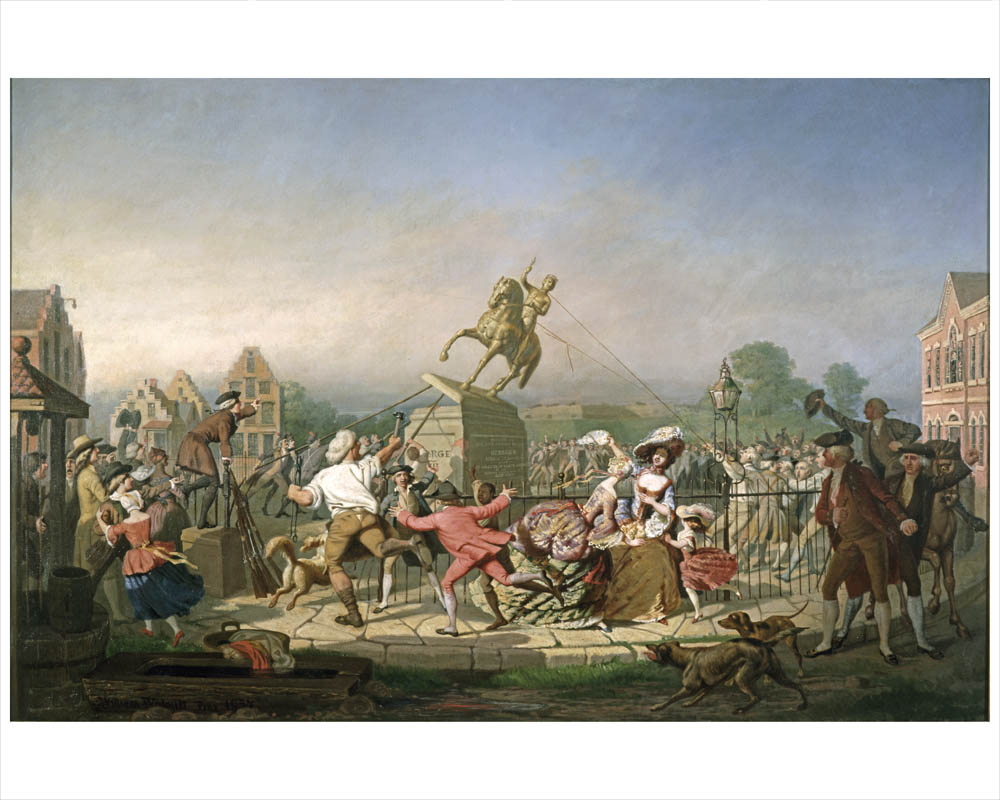
In New York City, the Declaration of Independence was publicly pronounced for the first time on July 9, 1776. Thereupon, the people did not stroke their chins and adjust their bonnets; rather, that evening they proceeded to attach ropes to a fifteen-foot, 4,000-pound gilt statue of King George III erected at Bowling Green, and haul it down. The gold was but veneer, with something far more useful, lead, beneath. Melted down, this monument to monarchy was transformed into many thousands of musket balls to fire at the King’s troops. It’s said that an 11-year-old girl involved in the production process, Mary Ann Wolcott, was alone responsible for making 10,000 musket balls.
This holiday weekend, an immersive documentary which was workshopped at Kopkind/CID ‘film camp’ last summer is playing every hour on a loop from 11 am to 5 pm at Dupont Underground, 19 Dupont Circle NW, Washington, DC. By George: It All Comes Down, by director Paul Moon, tells the story of the statue’s toppling while also exploring the many instances of social mobilizations to tear down monuments, from ancient Rome to the Arab Spring to the height of the Black Lives Matter movement, which saw the removal of statues from Richmond’s Monument Avenue among other places. The film will have a public outdoor screening at 8 pm at The Battery in New York, on the 250th anniversary of the toppling, July 9. (Earlier in the day the New York Historical museum will host a re-enactment of the revolutionary July events.)
We are so used, in the United States, to being taught of the Revolution as a meeting of propertied white men in Philadelphia arguing over language, signing their names and going down in history as Founding Fathers that it’s always something of a surprise to be reminded that, no, the Revolution was a raucous, bloody, grinding and occasionally joyous event in people’s history. The revel of July 9 in New York was swiftly followed by the royal armies’ victory in the battles of New York and military occupation of the city, beginning of August 1776 and lasting seven years. New York was the only city under British occupation for the war’s entirety. Those who fled became refugees; those who stayed lived under martial law, many as real or de facto internees, their homes confiscated, their shelter tents, their diets meager; more than 11,500 of those who fought and didn’t die instantly or escape died of abuse, starvation and disease on at least sixteen prison ships, rotting hulks that the British used to hold POWs, then known as traitors, in Wallabout Bay in Brooklyn. Along with local revolutionaries and those from other states, hundreds of internationalists — Spanish, French, Dutch and Polish troops or volunteers — languished or died on the ‘hell ships’. The bodies of the dead were thrown overboard or buried in shallow graves by the shore. Ultimately bones were gathered up in barrels and interred, augmented with new finds, dug up, interred again — a tangled story that lay behind the Prison Ship Martyrs’ Monument, which one is unlikely to learn about in school but might stumble upon in Fort Greene Park.
No revolution is without its contradictions, and America’s was full of them. But its stories of oppression, resistance, war, flight and far-from-finished freedom dreams also link people in this country with others everywhere who have ever dreamed and suffered and strived to make the world anew — if only we recognize it.


Leave a comment