Movie Night, 8/3, with Potluck at 5:30 pm

30 07 2025
still image: Raised by Wolves

‘A generation is telling us their world is dystopian’, Dana Coester says at one point in her new documentary, Raised by Wolves. They do it through their memes and online pre-occupations, their jokes about mass shootings and sometimes their political choices. Her film explores the ways in which the world of so many rural youth – particularly boys and young men – make them susceptible to digital mis/disinformation and domestic violent extremism. ‘We have to recognize this as the battle for a generation that it is’, she says.

Kopkind’s second public Movie Night of the season, on Sunday, August 3, will commence with a potluck cookout at 5:30 pm on the lawn at Tree Frog Farm, 158 Kopkind Road in Guilford. Bring a covered dish! After the meal, we will have the screening in the Organ Barn. Dana will be on hand for discussion.

Set in Appalachia, where Dana grew up and now works as a journalist, a community mediamaker and professor of media arts, Raised by Wolves is part personal narrative, part investigation into far-right extremism in social media and online gaming spaces, part meditation on rural shame – all against the backdrop of an opioid-traumatized, postindustrial landscape of longstanding exploitation and poverty.

Documenting the vulnerability of youth and the escalation of violence in America as it unfolds in real time, and close to home, Coester has observed, “Shame is an essential ingredient for manipulation. In our region, young people know where they sit in relation to power structures in the rest of the world, but shame is not something they bring to that. Shame is a shadow that the media and the rest of the world casts on them.” Power, or the illusion of it, is what the right and its glorification of violence dangle. Abandonment provides a fertile environment.

We chose to show this film not only because we have the good fortune to have Dana with us for the week as a mentor, along with Phoenix-based playwright and political/cultural journalist James Garcia, but also because the violence system, which is increasingly the chief function of the state, is a many-headed hydra. How systemic violence works as both an exploiter of and enticement for poor rural youth is something the left doesn’t talk about enough. So let’s talk about it, because, however else it might be defined, fascism is a politics of death and desire both.

This event kicks off Kopkind’s seminar/retreat session bringing together young jour-nalists and activists from around the country with veterans in the field. The theme this year is One Struggle, One Fight, toward a popular front for our time.

Hope to see you!


Movie Night, 7/26, 7 pm, Organ Barn

14 07 2025
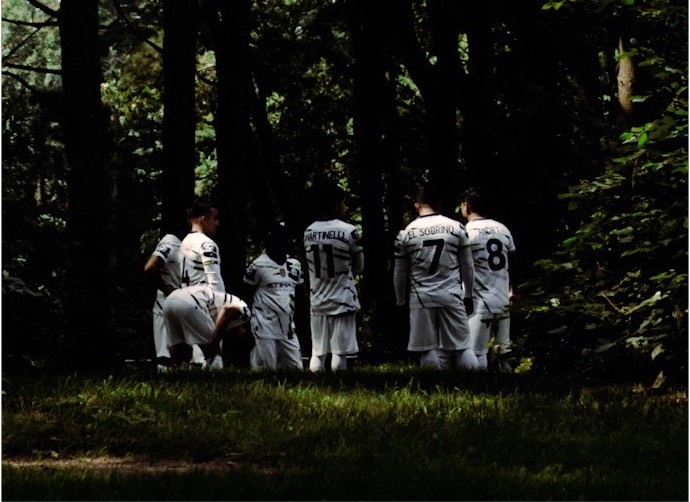
photo: still from La Liga

The word has been purloined – think, ‘law enforcement community’ – but community, accurately considered, is not just any collection of interests, however inhumane; it is what plain people create to survive and thrive, what they’ve always created, what is crucial today, especially among those who are under threat.

On Saturday, July 26, beginning at 7 pm, Kopkind will hold a free public event, screening two short films documenting different, wondrous community efforts 50 years apart in historical time but similarly resonant of the human instinct toward both mutual aid and making something beautiful in concert.

The image above, from Mac Christopher’s new film, La Liga, contains worlds of hurt, effort and creative life behind its pastoral setting. A story of immigrant dairy workers in rural Vermont, the short film explores the often-overlooked experience of undocumented workers in New England as it reveals people forging bonds of mutuality through soccer, ‘the beautiful game’. La Liga follows the workers who keep the dairy industry alive in Vermont while simultaneously being the population that is most heavily persecuted and harassed. It is a story of community and hope where even the act of playing a sport becomes a high-risk necessity.

photo: still from The Stuff of Dreams

The night’s screening will start off with a brief remastered section of The Stuff of Dreams, a 1977 film by John Carroll, Alan and Susan Dater and John Scagliotti on the relationship between hippie communards and the larger Brattleboro-area community, told through The Monteverdi Players’ magical staging of The Tempest on Sweet Pond in Guilford, pictured above. Shot on 16mm film, The Stuff of Dreams has been digitized and is in the process of being remastered, in which the original print is scanned at a higher resolution, with blemishes removed and frame-by-frame color correction. It is a long process, just begun, and what we will show Saturday night is only a bit — a kind of sneak peak — of what the entire, beloved film will look like when fully remastered.

Remastering The Stuff of Dreams is part of the larger community effort to preserve Guilford history. La Liga is similarly a document of a time in Vermont history — our time, now, as the call to the appreciation of humanity and solidarity is as great as it has ever been.

Saturday’s event will begin with a welcome of wine and cheese outdoors at Tree Frog Farm, 158 Kopkind Road in Guilford. The screening will then proceed in the Organ Barn. John Scagliotti and Mac Christopher will be on hand for Q&A and Kopkind’s traditional spirited discussion. Dessert to follow.

This event will conclude the Kopkind/Center for Independent Documentary film seminar/retreat, which brings together filmmakers for a week to workshop their projects in progress. Since 1999 Kopkind has put on public events and brought together journalists, activists and documentary filmmakers for seminar/retreats in Guilford, where Andy Kopkind spent 25 summers with his life partner, John Scagliotti, a pioneer in gay media and the project’s administrator. Kopkind follows in Andy’s spirit of thinking deeply, analyzing astutely, living expressively, and extending the field for freedom, pleasure and imagination. 


Iranian Films & More at CineSlam, June 28

24 06 2025
Still image from Sonata of Good Women, a film from Iran

As the US regime ponders whether Iranians deserve to live — along with Palestinians, trans people, prisoners and immigrants from all over the world (but mainly brown and black people) who’ve made a home in this country — the art of film puts humanity center stage. This year, CineSlam’s selection of shorts includes a trio of films from Iran. Beautifully made, often haunting, open-ended, these films are meetings with another human figure, taking us into the life of Iran and its people, their intimacies and conflicts, their courage, their every-dayness and vulnerability.

We did not plan on war when making this year’s selections, but here we are, at a time when seeing common humanity across borders and barriers has taken on the greatest urgency. CineSlam’s lgbtq shorts film festival, this coming Saturday, June 28, at 4 pm, is all about visibility. Whether the subject is a courtroom drama in Tehran or a romance on the road in the American southwest, drag balls in 1920s Harlem or the heartsick-angry-ecstatic poetry of Allen Ginsberg on California’s Lost Coast, lesbian love against the odds or documentary photography as a record of life quiet and out loud, this year’s line-up is provocative, moving, charming, not to be missed.

Also not to be missed: Celebrating James Baldwin 💯: ‘Go the Way Your Blood Beats’, a talk by Richard Goldstein, eminent journalist and Baldwin interviewer. Sunday, June 29, 4 pm, at 118 Elliot, which is co-sponsoring this free public event. Donations welcomed.


Celebrating James Baldwin 💯: June 29

21 06 2025

“Go the Way Your Blood Beats,” Baldwin famously told Goldstein, an admonition to live one’s life authentically. As a black man, a gay man, a person who grew up in Harlem before WWII and left the country for Europe—spending the rest of his life in transit—Baldwin resisted what he called “all of the American categories” and, in his novels, essays and speeches, uniquely challenged America to look at itself, to liberate itself from the violence that still consumes it and defines its power in the world. Baldwin’s homosexuality, evident in his works’ frankness about sex, desire, fear and the many, intertwined obstacles to love and human freedom, is often un- or under-discussed. Our event honors the man, his dazzling originality and rebellious vision in full.

Richard Goldstein was executive editor of The Village Voice, for which he wrote on popular culture and sexual politics for 32 years. Among the umpteen interviews Baldwin gave in his life, Goldstein’s is perhaps the only one that dealt directly with homosexuality, the queer liberation movement and their relationship to Baldwin’s life and work. An award-winning commentator on lgbtq issues, a founder of rock criticism and early champion of graffiti culture, Goldstein is the author of, among other works, The Poetry of Rock; Homocons: Liberal Society and the Gay Right; and Another Little Piece of My Heart: My Life of Rock and Revolution in the `60s. He lives in New York City and Vermont.

This celebration of James Baldwin will be Kopkind’s second Pride Month event. It is part of the prolonged centenary commemoration of the revolutionary author and public figure, who was born in August 1924. On the preceding day, Saturday, July 28, Kopkind presents its annual lgbtq short film fest, Cineslam, at the Latchis Theatre at 4 pm. A reception and Pride Cake to follow. For tickets to Cineslam: https://www.cineslam.com/


Pride Begins With Rebellion

19 06 2025

If you are in the vicinity of Brattleboro, Vermont, join us for two marvelous, must-see events, capping Pride Month, honoring the spirit of liberation and rebellion, and launching Kopkind’s summer season!

CineSlam’s line-up this year includes foreign and domestic films, comedy and drama, feature, animation and experimental documentary – including a rare art film made by Allen Ginsberg and Bruce Conner, recovered in Allen Ginsberg’s Lost Work. Shot on California’s ‘Lost Coast’, the 1970 film sets Ginsberg’s poetic recitation to a montage of Conner’s visual artistry: an extraordinary expression of love, lust, heartbreak and dissent; of “memories and flickering images and nasty truths”.

CineSlam’s entire program is always a filmic cornucopia. For tickets, see https://www.cineslam.com/. There will be Pride Cake to follow!

This second Pride Month event salutes the life and legacy of America’s greatest writer, James Baldwin, with a talk by Richard Goldstein, who in a long and passionate career interviewed Baldwin over the course of a few days in New York in 1984. This event is part of the prolonged centenary commemoration of the revolutionary author and public figure. It is a free public event. (Donations welcomed.)

“Go the Way Your Blood Beats,” Baldwin famously told Goldstein, an admonition to live one’s life authentically. As a black man, a gay man, a person who grew up in Harlem before WWII and left the country for Europe—spending the rest of his life in transit—Baldwin resisted what he called “all of the American categories” and, in his novels, essays and speeches, uniquely challenged America to look at itself, to liberate itself from the violence that still consumes it and defines its power in the world. Baldwin’s homosexuality, evident in his works’ frankness about sex, desire, fear and the many, intertwined obstacles to love and human freedom, is often un- or under-discussed. Our event honors the man, his dazzling originality and rebellious vision in full.

Richard Goldstein was executive editor of The Village Voice, for which he wrote on popular culture and sexual politics for 32 years. Among the umpteen interviews Baldwin gave in his life, Goldstein’s is perhaps the only one that dealt directly with homosexuality, the gay liberation movement and their relationship to Baldwin’s life and work. An award-winning commentator on lgbtq issues, a founder of rock criticism and early champion of graffiti culture, Goldstein is the author of, among other works, The Poetry of Rock; Homocons: Liberal Society and the Gay Right; and Another Little Piece of My Heart: My Life of Rock and Revolution in the `60s. He lives in New York City and Vermont.

We do so hope to see you!


The Adamant Memory of Vietnam

10 05 2025
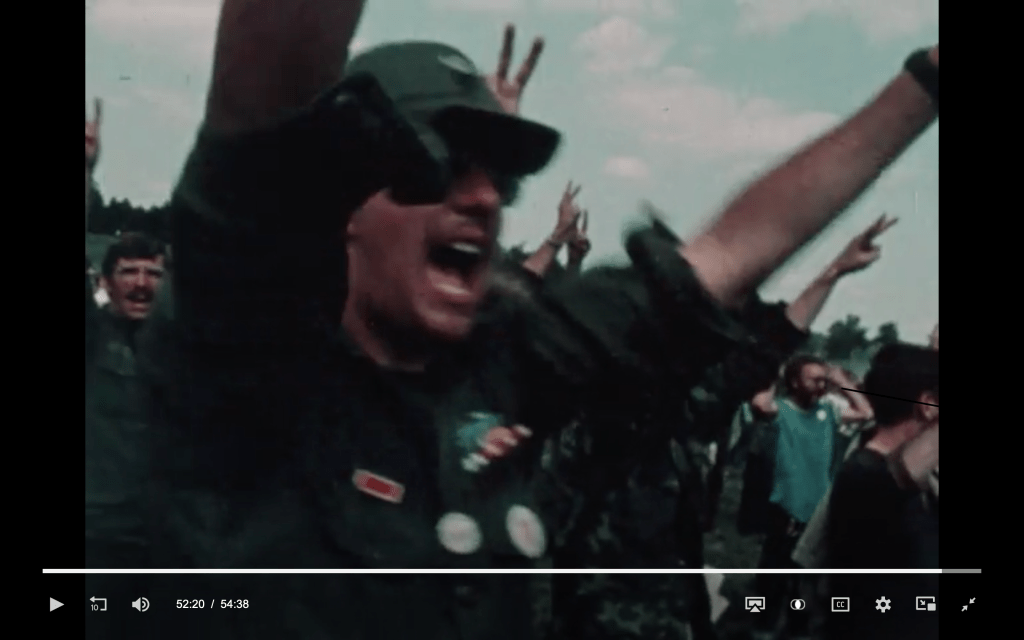
Screenshot from Different Sons: Vietnam veterans chant “Peace Now!” en masse in Valley Forge, 1970.

On April 30 the people of Vietnam celebrated fifty years of independence from foreign domination. Reunification Day, they call it — also known as victory in the American War, as it is known in Vietnam, and defeat for the US in what we call the Vietnam War. These days in May the Pentagon is honoring Vietnam veterans, everyone who served between November 1, 1955, and May 15, 1975. Those commemorations edit out the soldiers who played a critical role in the antiwar movement. The soldiers who published underground antiwar papers on hundreds of bases, who manned GI coffeehouses, who engaged in direct action in the US and in Vietnam, who became mutineers, who founded Vietnam Veterans Against the War, and whose protests are powerfully documented in David Zeiger’s film Sir! No Sir! (which Kopkind screened publicly before its general release in 2005).

We remember those men and women here, whose valiant refusal is captured in one three-and-a-half-day action documented in Jack Ofield and Bowling Green Films’ 1971 short Different Sons. It is a moving document, available to the public from the Internet Archive and here by clicking the image above. Seventy-five combat veterans began a ninety-mile march from Morristown, New Jersey, on September 4, 1970. En route to Valley Forge, Pennsylvania, they took secondary roads, walking single file, wearing fatigues and carrying plastic M-16s, stopping for the night on Quaker-owned property, eating C rations or the equivalent. Along the way, they simulated their jobs in Vietnam, brutalizing or killing civilians. They didn’t expect to win converts, one of their leaders told the filmmakers; they hoped to provoke their fellow citizens to think differently, or begin to. The soldiers’ civilian-volunteers could never register the terror of the real thing, but outside post offices in tiny towns not known for antiwar sentiment, the re-enactments must have been shocking. Some bystanders mocked the vets for their long hair and moustaches; one stated they were working on orders from Satan. In the end, the vets, their number steadily enlarged and forming wide rows across the Valley Forge battlefield, chanted, “Peace Now!” ever louder, and broke their plastic rifles over their knees. This was a unique public demonstration, but opposition to the war was not a fringe opinion among troops. By 1971, one colonel remarked, it had “infested the entire armed services”.

The adamant memory of Vietnam goes a way to illuminating this country’s current crises. The story of the war and the Sixties culture of opposition that it stoked have been in the gunsights of the right from that time to today, as witness the machinations of the current regime’s braintrust and hangers on. Within a few years of the defeat in Vietnam, war fantasies were revived in Washington, and with them cold war liberalism as well as an emboldened right. Within a decade, an academic/political project to rewrite the history of the war in line with the views of those mocking bystanders — and, more important, the arms makers, war profiteers and their political satraps — had been established. The backlash that powered Ronald Reagan’s Make America Great had many helpers, including the corporate press and some precincts of the notionally left, reflected in a 1982 New York Times Magazine essay by Irving Howe titled “The Decade That Failed”. The right never forgot, and its project to extirpate every last gain of the Sixties era is the openly stated aim of ‘anti-woke’ crusader Christopher Rufo and his ilk today. Thus, among much else, the erasure of the soldiers’ revolt in marking the end of the Vietnam War.

Fifty years ago Andy Kopkind used the title above in an article for Ramparts about the great documentary Hearts and Minds, by our friend Peter Davis. We did a public screening of that film, too, early on in the so-called War on Terror, launched in 2001. A generation of Americans has grown up now with no memory of 9/11 and its aftermath, much less of Vietnam — no memory of the lies used to justify the invasion of Iraq, the first Shock and Awe, the roundup of US citizens said to be terror symps, the US torture regime and Guantanamo, now used to imprison kidnapped immigrants. No memory of Iraq Veterans Against the War, or the soldiers destroyed by their destruction of other people. Or Reagan’s proxy wars in between; or Obama’s Tuesday meetings to pick assassination targets after. No broad context in which to place the current US terror bombing upon the people of Yemen, or the long complicity with Israel to crush the Palestinians.

“Now, you don’t want to hear about it”, Andy quotes a Vietnam veteran, William Marshall, featured in Hearts and Minds. “I’ll tell you about it every day and make you sit and puke on your dinner, you dig, because you got me over there and now you done brought me back. And you want to forget it so somebody else can go do it somewhere else. Hell no.”

History is a weapon. Andy’s “The Adamant Memory of Vietnam” is reprinted in his collected writing, The Thirty Years’ Wars: Dispatches and Diversions of a Radical Journalist, 1965-1994. His first draft of history, the book provides an indispensable, analytical backstory to our time.


Heart as a Political Principle

1 05 2025
(image: StockCake)

May Day recovers memories, every year, of the origins of International Workers’ Day, sparked by the general strike of 1886 in Chicago — ‘Haymarket’, in short, and the arc of fellow feeling, courage, state violence and global solidarity the name implies. May Day returns us, every year, to our friend Peter Linebaugh’s marvelous book The Incomplete, True, Authentic, and Wonderful History of May Day (PM Press). ‘Marvelous’ is literal here, because the story of human striving for freedom and equality, of the conflict inherent in class consciousness and class struggle, contains marvels, indeed, and Peter, a past Kopkind mentor and speaker, seems to know all of them. “We cannot avoid the ache of history,” he writes; “its grief we feel in the gut.” But also: “We must study the record. It must pass through our heart again.”

For this record, Peter raids the storehouse of cultural artifact and history, including the great book by James Green, Death in the Haymarket: A Story of Chicago, the First Labor Movement, and the Bombing That Divided Gilded Age America (which featured in a public talk at Kopkind many years ago). “The book is trying to put some freedom back into history, telling us that it could have been otherwise”, Peter writes. “We call this human agency. The theory is something like this. It’s human history, we’re humans, history is something we make with our deeds and our words. This is where free will rubs up against determinism.” The history has special resonance these days, in which the ruling class not only plays its standard role, aiming to make everyday people feel small, confused, helplessly divided, but the president elevates the Haymarket period as the time of America’s greatest happiness and general bounty.

So today, a bit of the record from Peter’s telling:

The freight handlers struck, the upholsterers struck, the lumber shovers went on strike. Four hundred seamstresses left work in joyous mood. A storm of strikes swept Chicago, on the first of May 1886. The great refusal, Jim Green calls it. It was a new kind of labor movement that “pulled in immigrants and common laborers.” Irish, Bohemian, German, French, Czech, Scot, English, to name a few. In Socialist Sunday Schools, brass bands, choirs, little theatres, saloons, there was a working-class culture in Chicago. The Chicago Tribune hated it and compared the immigrants to zoological nightmares. It demanded deportation of “ungrateful hyenas” or “slavic wolves” and “wild beasts” and the Bohemian women who “acted like tigresses.” In the spring of 1886 strikes appeared everywhere in industrial centers; called the Great Upheaval, it agitated for shorter hours. Of course they were against the mechanization of labor, against the exploitation of child labor, opposed to the convict lease system of labor, and opposed to contract labor. The anthem of the Knights of Labor was the “Eight-Hour Song”:

We want to feel the sunshine; / We want to smell the flowers; / We’re sure God has willed it. / And we mean to have eight hours. / We’re summoning our forces from / Shipyard, shop and mill; / Eight hours for work, eight hours for rest, / Eight hours for what we will.

Anyone carrying a sign to a protest these days saying ‘Make America Good Again’ (as some have) need to study the record. Any children of long-ago European immigrants, denied the knowledge of their forebears’ battles and bravery, need to study the record. And it is the job of the left to make that record a common knowledge again, “a people’s story,” recovered from the same power-made tombs from which have been unearthed so many peoples’ stories, newly told, as Peter writes “in the people’s language with the people’s future: the opposite of the official story”.

Green tells the story of the strike, of the time, with detail and verve. He tells of the bomb in Haymarket Square, believed to be thrown by police; and the aftermath, a period of police terrorism, of torture, handcuffed justice and hangings. “The day will come when our silence will be more powerful than the voices you are throttling today”, August Spies, a German immigrant and radical newspaper editor, famously declared before his execution. Of the Haymarket Martyrs, Peter writes: “None died from a broken neck, all strangled to death, slowly as it appeared to the witnesses, convulsing and twisting on the rope. That was November 11, 1887. James Green tells us that it was a turning point in American history.” Green also describes the astonishing sweep of workers’ refusals and solidarity. Globally, May Day was born. In the US, the ruling class declared May 1 to be Law Day. Repression was ferocious in this now-named best of all times. History was not finished, though. Nor are its curiosities without relevance today.

The 151-foot Statue of Liberty was dedicated only two weeks before the hangings in Chicago. Inscribed on its pedestal were the words of Emma Lazarus: “Give me your tired, your poor, / Your huddled masses, yearning to breathe free, / The wretched refuse of your teeming shore. / Send these, the homeless, the tempest-tossed, to me: I lift my lamp beside the golden door.”

John Pemberton, a pharmacist, invented a medicine to relieve headaches and alleviate nausea. It combines coca leaves from the Andes with cola nuts from Africa, mixed with water, caramel and sugar: Coca-Cola, the Atlantic remedy for the ills of the barbarism of capitalism. Both William Morris in England and José Martí exiled from Cuba in Manhattan likened the Chicago working class to a cornered animal.

At the same time, Martí, reviewing the rivalries of nationalities, ethnicities and colors among the working classes, wrote that “the common denominator of pain has accelerated the concerted action of all who suffer”. Here, Peter writes, “is heart as a political principle”.

Pablo Neruda, José Martí, even Walt Whitman had a big, hemispheric conception of America: two continents, half the planet, yet united by the German geographer Humboldt’s Afro-America, a big S: New Orleans, Cuba, Venezuela and Brazil. What happens in one part affects the other: sugar, aluminum, gold, bananas, silver, copper, coffee, rum, pot, and coke, yes, they are the products, the commodities, ripped from the bowels of the earth. They’re easier to recognize than the undergrounds of people, whose migrations, sailings, tunneling have preserved the memory of los mártires. José Martí predicted that “the world’s working class will revive them [the martyrs’ memories] every First of May.”

A century later Eduardo Galeano wrote, “That is still not known, but Martí always writes as if hearing, where it is least expected, the cry of a newborn child.”

In Havana in 1887 the anarcho-syndicalists started a newspaper, El Productor, which covered the Haymarket tragedy … May Day was celebrated in Mexico in 1913. From then on Primero de Mayo became a national holiday known as the Day of the Martyrs of Chicago in Italy, France, Spain, Argentina, Cuba, Mexico. In 1903 Teddy Roosevelt signed an immigration law denying entry into the United States of anarchists, paupers, prostitutes, and the insane. Galeano celebrated the marriage of heart and mind. “From the moment we enter school or church, education chops us into pieces: it teaches us to divorce soul from body and mind from heart. The fishermen of the Colombian coast must be learned doctors of ethics and morality, for they invented the word sentipensante, feeling-thinking, to define language that speaks the truth.” … Halfway between the gut and the head lies the heart. The heart and soul of our movement may be found on May Day, and it’s going to take our arms and legs to find them, as well as our brains.

It took fifty-two years just to win the eight-hour day by law. It took a fight against child labor to win free public schools, as Jennifer Berkshire explained in a Kopkind seminar a couple summers ago. It took a civil war, a hundred years of struggle and Bloody Sunday in Selma to win voting rights legislation in 1965 — the same year, as Laura Flanders, another friend and longtime Kopkinder, reminds us, that LBJ also put immigration reform and Medicare on Washington’s agenda pushed by the spirit of the time. As we see, no victory is permanent. The mind and heart for solidarity could be. In this briefest sketch of the incomplete, true, authentic and wonderful history of May Day run threads to be gathered for that kind of sentipensante, that solidarity expressed in a people’s language and acted upon in common. People everywhere want to feel the sunshine and smell the flowers. So, “Take heart! All out for May Day!”


‘You Will Not Erase Us’

20 04 2025
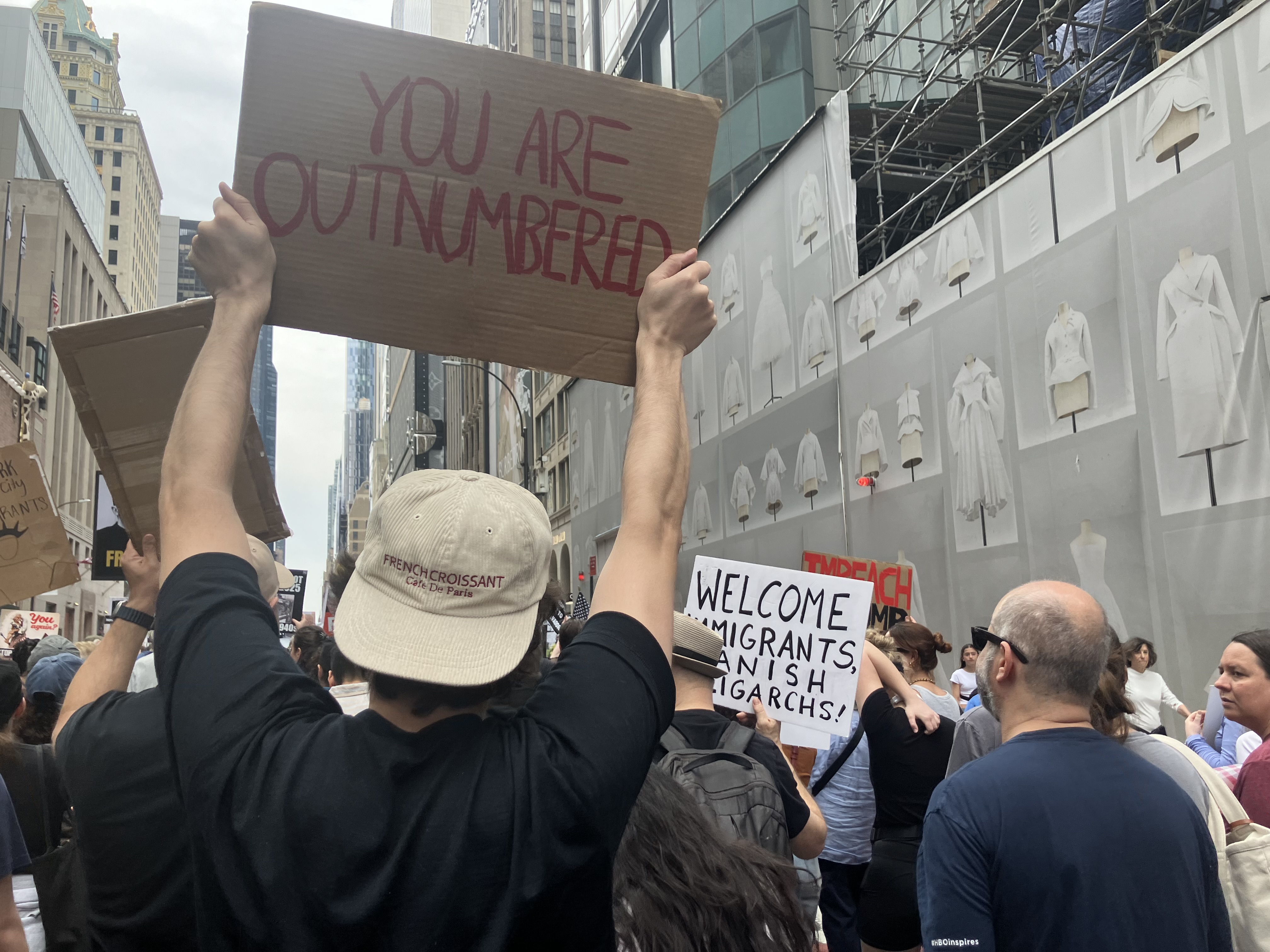
New York, April 19, where protest against disappearances and deportation predominated. (photos: JoAnn Wypijewski)

If there’s a through line to the first months of Trump 2.0 it’s the president’s penchant for trying to disappear his critics, enemies and the fast-multiplying targets of his disdain.

It’s classic authoritarian behavior.

Donald Trump is a dictator at heart, and like all “good” dictators, he relishes the idea that he can banish anyone he thinks could get in his way.

Don’t like brown immigrants? Snatch them off the streets, deport them and do all you can to keep them from coming here in the first place.

Don’t like a free press? Claim, without evidence, that it’s fake, do all you can to muzzle it, and prop up pliant members of the news media — like Fox, Newsmax and One America.

Don’t like the fact that women and minorities have had greater access to job opportunities in recent decades? Attack labor and civil rights laws under the guise that you’re dismantling DEI programs.

Don’t like that historically disenfranchised communities are allowed to vote? Suppress, or block outright, their access to the polls — and if they win elections anyway, falsely claim they cheated and the system can’t be trusted.

Don’t like people with disabilities, Muslims, veterans, the poor, environmentalists, public schools and universities, foreign aid, people of color, park rangers, student loans, scientists, academics, asylum seekers, Social Security and Medicaid, unions, the LGBTQ+ community (especially trans people), public broadcasting, artists, people with AIDS, people with COVID, fluoride, accurate historical accounts, kids who get the measles, or the president and people of Ukraine? (And, no, this is not an exhaustive list.) Do all you can to cripple or shut down federal agencies and illegally slash  congressionally mandated funding that supports these groups and programs.

Why? Because that’s what dictators do. That’s what oligarchs do. That’s what fascists do.

Trump’s goal is as simple as it is dangerous: to erase anyone and anything he considers a threat to his quickly expanding stranglehold on power. But if the reaction to his agenda by a growing and diverse contingent of Americans in the past few weeks is any indication, including by people who voted for him in November, Trump will not erase us.

On April 5, millions of people across 50 states and around the world took to the streets to roundly and courageously condemn the chaos, cruelty and corruption of Trumpism in action. As the Arizona Mirror reported, it was all part of a national day of protest called Hands Off “that saw more than 1,300 events across the country — many in heavily GOP areas that backed Trump by a large margin in the last election.”

“In many locations,” reporter Jerod MacDonald-Evoy wrote, “crowds dwarfed expectations: A march in Washington, DC, saw five times more than the 10,000 that were anticipated, while the New York City protest stretched for nearly 20 blocks and overwhelmed city streets.”

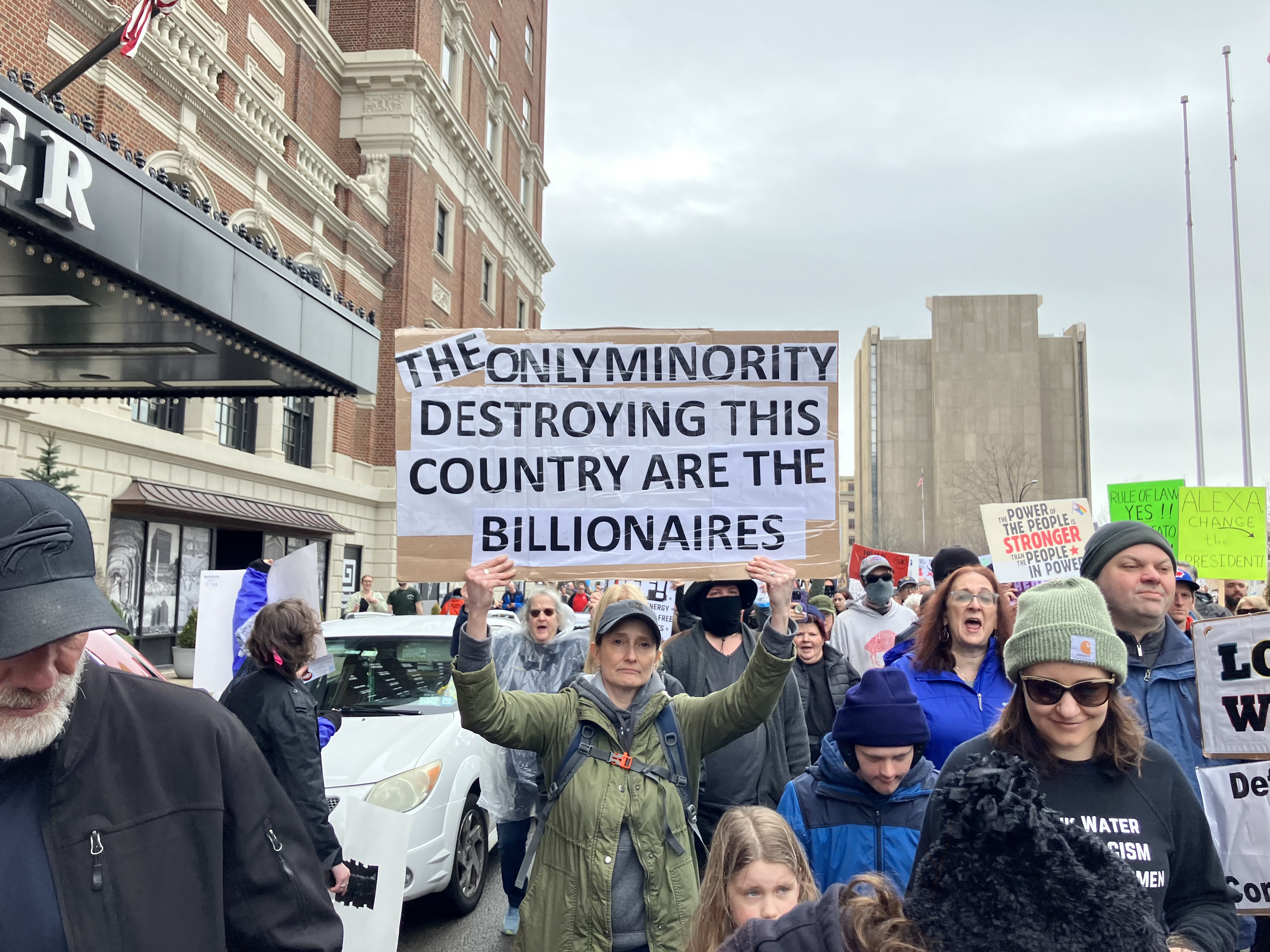
Buffalo, April 5; some of about 4,500 who turned out.

At the protest in Sedona, one of roughly 30 in the Grand Canyon State, Arizona Attorney General Kris Mayes told a crowd of nearly 1,000: “We are fighting back with what I call the three Cs: courage, crowds, and the courts.” Mayes has been partnering with other Democratic attorneys general across the country to file a slew of lawsuits challenging Trump’s most egregious executive measures.

Arizona Secretary of State Adrian Fontes told the more than 2,000 people gathered at the Capitol in Phoenix that they embodied the true meaning of the First Amendment: the right to petition the government for a redress of grievances. “Those grievances are growing larger and larger,” Fontes declared.

Alicia Van Driel, part of a “Hands Off” march in Salem, Oregon, said, “I knew Trump was dishonest before he got voted in. I didn’t vote for him, and everybody that has voted for him needs to take a look at what’s really going on.”

Demonstrators in Connecticut, like Jim Chapdelaine, a volunteer with the grassroots group Indivisible, gathered in a cold rain outside the Capitol building in Hartford. “A little rain is not going to stop us from saving democracy,” Chapdelaine told the crowd of between 2,500 and 3,000.

Facing a flood of what judges and legal scholars have labeled as unconstitutional executive orders issued by the president since taking office, millions of us are rising up to defy his naked power grab.

Oblivious to the depth and breadth of the growing resistance movement, Trump is still expecting us all to cower at his feet, fearful that the thugs he’s been ordering to disappear his critics in the immigrant community will come for us next. Or worse, that he’ll call out the troops to silence dissent.

The trouble with dictators, however, is that they always overreach. Blinded by narcissism and enabled by spineless sycophants, autocrats eventually start to believe the self-fabricated myth of their own omnipotence.

In Trump’s case, it’s one thing to be the most powerful man on earth, but quite another to expect that a critical mass of this country’s 330 million citizens are willing to abet their own demise.

No, Donald, you will not erase us.


Soundtrack to a Complicit Silence

28 02 2025

Do you hear that silence?

Soundtrack to a Coup d’État is a phenomenal film—brilliantly crafted.  

Johan Grimonprez unearths truths about the overthrow of Congo’s first prime minister, Patrice Lumumba, that history tried to sever, layering them like an intricate composition where every note matters.  

It is also a warning.  

A warning that is being met with applause instead of action.  

Audiences marvel at the editing, the nonlinear structure, the radical way jazz intertwines with the story of a crime.  

They are impressed, engaged, intellectually stimulated.  

And then—  

they move on.  

The film exists, but the silence remains.  

I do not expect you to fathom the pain of the Congolese people today.  

I do not expect you to stretch your imagination to grasp the inhumane exploitation of land, the abuse of innocent children, children who only wish to rest on their mothers’ bosoms but instead witness them raped, crying, or taking their last breath as gunfire interrupts their small, running feet.  

I do not expect you to feel it.  

But I do expect you to hear it.  

Even as you make me feel crazy for expecting you to hear it.  

(photograph: Julien Hameis)


The sound of UN guards laughing as they dismiss a small but mighty group of Congolese protesters.  

The sound of busy footsteps on First Avenue, people too preoccupied with their routines to pause.  

The sound of a Congolese mother calling a phone that will never ring is making my ears bleed.

The sound of a city cut off from the world, suffocated at the throat, is irregulating my breath.

As if my people’s deaths aren’t the reason you were able to connect with loved ones by Zoom during the pandemic.  

As if our mothers’ rape isn’t the reason you can hear your son, studying abroad, answer your call.  

As if you don’t owe it to us to consider that we, too, want to live and communicate.

But in peace, not at the price of our children.  

And yet, silence.

Not just in Congo, where bombs fall without warning and leave behind echoes of mourning.  

Not just in Bukavu, where rape crushes dignity and joy, this weapon that stings deeper than a fatal degree burn, that shatters entire families in ways no statistics can measure.  

Not just in the villages, where children dig for cobalt with hands too small to even hold their mothers’ thumbs.  

But here, in New York City.  

Where we marched for George Floyd’s breath.  

Where we spoke justice to power through Zoom organizing meetings.

Where we circulated evidence of injustice and said her name: Sandra Bland, Breonna Taylor.  

How is it that our comfort remains uninterrupted even as a genocide unfolds for the sake of the very phones we use to demand justice?  

Break this loud silence!

It is a silence louder than any siren.  

It is a silence that drowns and that kills.  

Filmmaker Grimonprez himself said: 

Le revers de la médaille c’est que pendant que les Belges regardent du jazz à la télévision, un génocide est en train de se produire au Congo oriental.

“The flip side of the coin is that while the Belgians were watching jazz on television, a genocide was taking place in Eastern Congo.”

What has changed?  

Today, you watch a film that maps the violence, that stitches together sound and silence, that tells you what has been done and what is still being done.  

Then you go home, and the war continues.  

People analyze the film’s historical layers, debate its themes, but they are not worrying about the Congolese people still dying.  

I do not need you simply to understand the film.  

I need you to engage with what it demands of you.  

Not just to be awed by its craft but to recognize that it is not just a film.

And who am I? Why should you care? I am a Congolese artist and filmmaker terrified by the idea that what we create is just for vibes. We, the Congolese people, need you to say our names, say that we too matter, if not because you believe it then because without us and the existence of our home, our minerals, our labor, you wouldn’t have most of what you think is more important than us.

Here is a document of a war that never ended.  

Here is a call to action, not a closing statement.  

You cannot treat it as an intellectual exercise while remaining silent in the face of the very horrors it exposes.  

To do so is to play into the very system it critiques.  

To do so is to watch history unfold and decide to let it repeat.  

(photograph: Soundtrack to a Coup d’Etat still)

Maybe 1885—King Leopold’s curse, backed by the Western world’s infamous Congo Club—feels too far removed for you. 

Maybe 1961—Patrice Lumumba’s last day, engineered by the same Club one year after we dared to claim independence—feels too far removed.

So let’s focus on last week.  

At least 3,000 dead.

One of them was my cousin.  

He was home when the bomb fell.  

My mother spoke to him on Sunday, January 26.  

Then silence.  

For two days, she called his phone, hoping, praying it was just the internet shutdown.  

That it was nothing more than a power outage.  

That the rebels had only cut the networks.  

That he was safe.  

But he wasn’t.  

A call came.  

And the silence was no longer just a silence.  

It was the end of his life on earth confirmed. 

A city cut off from the world.  

Goma thrown into digital darkness.  

No news could leave.  

No messages could arrive.  

While my cousin was dying, while hundreds of others were being slaughtered, the Congolese people were held hostage inside their own grief unable to call for help. 

Unable to say goodbye.  

Unable to tell their own stories.  

And the world moves on.  

Unworried.  

Uninterrupted.  

Not because the killings have stopped.  

Not because the war is over.  

But because the silence is effective.  

Because silence echoes, far and wide.  

What does silence do?  

It makes you believe nothing is happening.  

It makes you believe that history is history.  

That colonialism is past tense.  

That six million bodies, and just since 1998, are not stacked beneath the global economy.  

But history is not past.

(photograph: Pieter Boersma)

Imperialism has not ended.  

It has only evolved.  

Found new words, new weapons, new justifications.  

My people have died for rubber, for gold, for diamonds, for uranium.  

Now we are dying for cobalt, for lithium.

For the devices you cannot live without.  

I am not even asking you to get loud.  

I am asking you to turn up the volume.

Because right now—

right now, the radio is off.  

Right now, the world is enabling thousands of deaths for profit.  

And I do not need everyone to march.  

I do not need everyone to scream.  

But I do need something.  

I will take a whisper over nothing.  

Because right now, I hear the outcry of Congolese people, but from everyone else—  

not even whispering.  

Africa, United States of Africa, please whisper.  

Please say something. Spirit of Lumumba, please come awaken the zeal of unity in us.

Western allies, please say something to your leaders.  

I will take one hour of your time.

I do not need a world full of people shouting.  

But I do need a world where people are at least speaking.

Where people are doing.  

If you have breath in your lungs,  

if you have power in your voice,  

then use it.  

Not just in admiration of a film.  

Not just in academic debate.  

Not just in passive acknowledgment of history.  

Because silence is not passive.  

Silence is not neutral.  

Silence is a weapon.  

And if you continue to wield it—

then you are choosing the side of those who kill us.  

Maliyamungu Muhande is a Congolese artist and filmmaker based in New York. For ongoing reports and analysis on Congo, she recommends the work of Kambale Musavuli; for action updates and information, Friends of the Congo; for grassroots support, Focus Congo.


Wishes at Winter Solstice

21 12 2024
Charles Burchfield, Orion in Winter, courtesy Burchfield Penney Art Center. Provenance: Museo Nacional Thyssen-Bornemisza, Madrid

On the shortest day, and the longest night, in a period of transition as the cosmic clock turns, we wish you all some beauty, hope and reflection, even amidst what can seem, what often is, a forbidding landscape. The American artist Charles Burchfield, who spent most of his life working in Western New York, was a remarkable observer, an exuberant lover of the small changes, secrets and outright wonders of the natural world. He also wrote short verses, kept journals and otherwise recorded things seen and felt. In one entry from the start of 1915 which he titled ‘Winter Solstice’, he wrote, “I can nearly always, if I can a field, find some dandelions in December. Once I found them on New Years Day. I think of December as a leafless landscape, white sunlight, misty distances, & dandelions hugging the lichen-like turf.” In his paintings and watercolors of spring and early summer these once-sleepy dandelions arise in splendrous poofs, ready to float and spread fresh seeds, new life. (Oh so much more desirable in his pictures, and in imagination, than in one’s garden!)

This winter, this season, in 2025, may we all imagine possibilities worthy of nature, and find a way to be the face of love and hope in the world.

Kopkind’s annual newsletter, ‘Sniffing the Zeitgeist’, is on its way, soon to arrive in the physical mailboxes of many of you. It recounts some scenes from our summer sessions, quotes some thoughts for the future from a number of Kopkind alums — ‘campers’ and guests — as well as from some liberationist heroes in the never-finished work of making a better world.

At the close of this year and the beginning of another, here’s one fitting for the season and all time, from James Baldwin: ‘I can’t be a pessimist because I am alive. To be a pessimist means that you have agreed that human life is an academic matter. So, I am forced to be an optimist.’ May we choose this kind of optimism and act on it going forward.

From all at Kopkind, may you find joy in this holiday season! We thank you for your support and friendship, and welcome contributions. Kopkind is a 501(c)(3) educational and cultural project; all contributions are tax-exempt to the full extent allowable by law. The newsletter is accompanied by a return envelope for anyone who may wish to make a year-end donation by check. For online gifts, press the Donate button at the top of this site.